

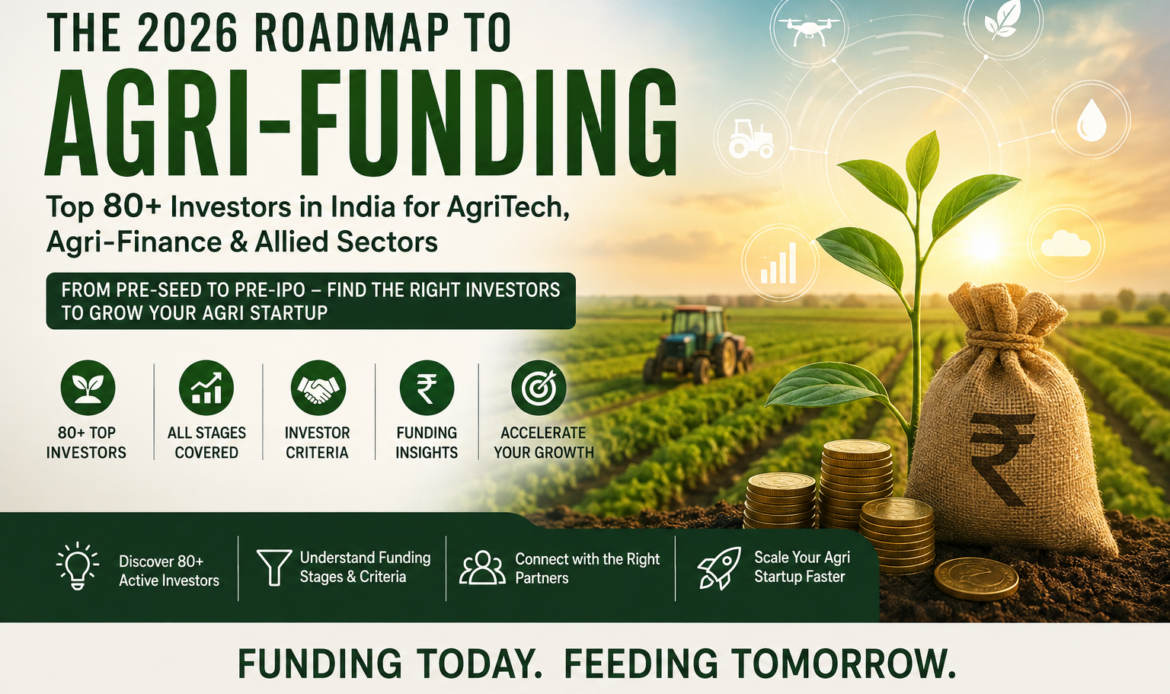
The 2026 Roadmap to Agri-Funding: Top 80+ Investors in India for AgriTech, Agri-Finance and Allied Sectors
Top 80+ AgriTech Investors in India 2026: Complete Funding Guide for Agriculture, Agri-Finance & Allied Startups
Looking for AgriTech funding in India? Explore 80+ investors for AgriTech, Agri-Finance, food, climate-tech and allied startups from Pre-Seed to Pre-IPO, with investment stages, focus areas and websites.
The 2026 Roadmap to Agri-Funding
India’s agriculture and allied economy is entering a technology-led transformation.
From precision agriculture, farm-management software, AI and satellite intelligence to agri-fintech, farm mechanisation, drones, food processing, cold chains, supply-chain technology, climate-smart agriculture, carbon farming, biotechnology, dairy-tech and rural financial services, the opportunity for entrepreneurs is expanding well beyond conventional farming.
For founders, however, one question remains critical:
Where should an AgriTech or agriculture-focused startup actually look for funding?
This Article provides a practical roadmap to 80+ investors, venture capital funds, angel networks, impact investors, strategic investors and alternative capital providers that may be relevant to Indian AgriTech, Agri-Finance, FoodTech, ClimateTech and allied businesses in 2026.
This is not a ranking of investors. Rather, it is a fundraising-oriented segmentation based on the investor’s known or reported sector interests, stage preferences, business models, and relevance to agriculture or adjacent sectors.
The Indian AgriTech ecosystem is considerably larger than a list of 80 investors. Current ecosystem databases track hundreds of investors and nearly 1,000 agriculture/AgTech deals, with Seed being one of the most common funding stages.
At the same time, founders should understand that an investor appearing on an agriculture-related database does not mean the fund is currently accepting every agriculture pitch. Investment mandates, cheque sizes, geographic preferences and fund deployment cycles change.
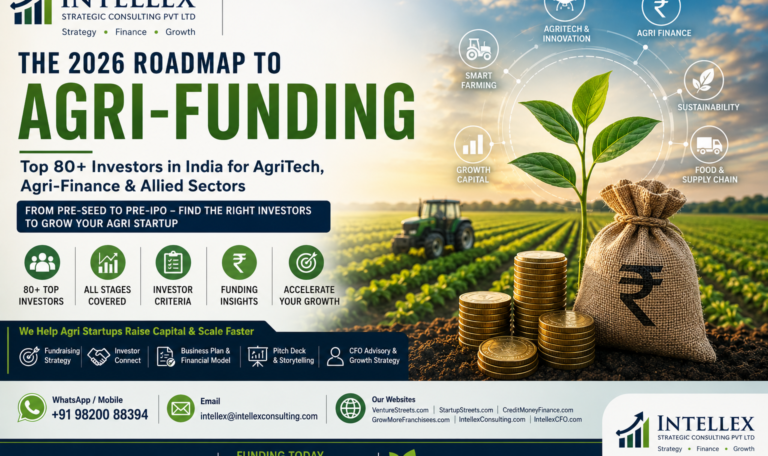
Why AgriTech Funding Is Becoming Increasingly Important
Agriculture is no longer simply a traditional sector. It is becoming a convergence point for:
- Artificial Intelligence
- Machine Learning
- Internet of Things
- Satellite imagery
- Drones and robotics
- Biotechnology
- Climate technology
- Financial technology
- Supply-chain technology
- Food processing
- Logistics
- Cold-chain infrastructure
- Digital marketplaces
- Embedded finance
- Rural commerce
- Carbon markets
- Renewable energy
- Precision agriculture
- Alternative proteins
- Aquaculture and dairy technology
For example, Indian agritech businesses are increasingly using satellite and data technologies to improve crop planning, resource utilisation and farmer economics.
The investment opportunity therefore extends far beyond a conventional “farm startup.”
A founder building a rural lending platform, for example, may need to approach fintech investors.
A startup developing soil sensors may be better suited to deep-tech investors.
A company developing carbon-credit projects through regenerative agriculture may need climate-tech or impact investors.
A food brand may need consumer-focused capital.
A cold-chain business may be relevant to logistics and infrastructure investors.
This is why choosing the right investor is often as important as raising the money itself.
Understanding the AgriTech Funding Lifecycle
Before approaching investors, founders should understand the different funding stages.
Stage 1 – Idea / Pre-Seed
Typical business condition:
- Idea or concept
- Prototype
- Research and development
- Founder validation
- Early pilots
- Limited or zero revenue
Potential capital sources:
- Founder capital
- Friends and family
- Grants
- Incubators
- Accelerators
- Angel investors
- Pre-seed funds
- Government programmes
Stage 2 – Seed
Typical business condition:
- MVP developed
- Initial customers
- Pilot projects
- Early revenues
- Farmer/FPO onboarding
- Product-market validation
- Initial repeat usage
Investors generally want evidence that the solution works outside the founder’s immediate network.
Stage 3 – Series A
At Series A, investors generally expect:
- Demonstrable product-market fit
- Revenue
- Strong customer acquisition
- Repeat customers
- Unit economics
- Technology differentiation
- Scalable distribution
- Strong founding team
- Large addressable market
Stage 4 – Series B / Growth
At this stage, the company may be looking for capital for:
- Geographic expansion
- Large-scale farmer acquisition
- Technology expansion
- Manufacturing
- Supply-chain infrastructure
- Acquisitions
- International expansion
- Working capital
- Institutional management
Stage 5 – Late Stage / Pre-IPO
Companies approaching this stage may seek:
- Private equity
- Growth capital
- Strategic investors
- Sovereign funds
- Global investors
- Structured finance
- Pre-IPO capital
- Public-market preparation
Top 80+ Investors for Indian AgriTech & Allied Startups – 2026
The following list is organised by the most logical stage and investment profile, rather than simply presenting an alphabetical directory.
A. SPECIALIST AGRITECH, AGRICULTURE & AGRIFOOD INVESTORS
These should generally be among the first investors researched by an agriculture-focused founder.
1. Omnivore
Stage: Seed, Series A, Series B
Focus: AgTech, agriculture, food systems, agrifood, climate, rural technology and agri-finance.
Omnivore is one of the most recognised specialist venture investors in India’s agriculture ecosystem and has been investing in Indian agritech since 2011. Its current investment thesis spans areas including agrifood technology, fintech, deeptech, food systems and value chains.
Website: Omnivore
Best suited for: Technology-led businesses addressing significant agricultural and food-system problems.
2. Ankur Capital
Stage: Pre-Seed / Seed / Series A
Focus: DeepTech, AgTech, precision agriculture, biotechnology, science-led innovation.
Ankur Capital is particularly relevant to founders building technically differentiated businesses. Its current thesis includes precision agriculture and deep science, with a strong emphasis on technology that can create globally significant businesses.
Website: Ankur Capital
3. NABVENTURES
Stage: Early to Mid Stage / Seed / Series A / Series B
Focus: Agriculture, food, rural businesses, rural financial services.
NABVENTURES is a wholly owned subsidiary of NABARD and specifically invests in agriculture, food, rural businesses and agri/rural financial services.
Website: NABVENTURES
4. AgriSURE
Stage: Early Stage
Focus: Agriculture and rural startups.
AgriSURE is particularly important for agriculture founders because its mandate is specifically designed to support innovative, technology-driven, high-risk and high-impact startups in agriculture and rural development.
Its structure includes a ₹300 crore direct scheme for early-stage startups and a ₹450 crore Fund-of-Funds scheme, giving the overall fund a reported corpus of ₹750 crore.
Website: AgriSURE / NABVENTURES
5. Indigram Labs
Stage: Pre-Seed / Seed / Angel
Focus: AgTech, agriculture, farming, food and rural innovation.
Indigram Labs is particularly relevant to early-stage agriculture entrepreneurs.
Website: Indigram Labs
6. Aavishkaar Capital
Stage: Growth / Impact / Institutional
Focus: Agriculture, rural businesses, financial inclusion, inclusive growth and impact.
Aavishkaar Capital has a long history of investing in businesses addressing large social and economic problems in emerging markets. Its portfolio and investment philosophy make it relevant to scalable agriculture and rural businesses.
Website: Aavishkaar Capital
7. Avaana Capital
Stage: Seed / Series A / Series B
Focus: Agriculture and food systems, climate technology, supply chains, advanced technology.
Avaana specifically identifies agriculture and food systems as one of its investment themes and backs technology-led businesses capable of producing significant economic and environmental impact.
Website: Avaana Capital
8. AgFunder
Stage: Seed to Growth
Focus: Agrifood, food technology, agriculture, biotechnology, climate and planetary health.
AgFunder is a global specialist investor and ecosystem player focused on food, agriculture and human/planetary health.
Website: AgFunder
9. Lightrock India
Stage: Growth / Impact
Focus: Climate, agriculture, sustainability, healthcare and inclusive businesses.
Website: Lightrock
10. Zephyr Peacock
Stage: Growth
Focus: Emerging-market businesses, financial services, agriculture and impact-oriented sectors.
Website: Zephyr Peacock
B. EARLY-STAGE VC FUNDS RELEVANT TO AGRITECH
These funds are not necessarily agriculture-only investors. However, they may be relevant where an AgriTech business has a strong technology, fintech, marketplace, SaaS, consumer, logistics or deep-tech component.
11. Blume Ventures
Stage: Pre-Seed / Seed / Series A / Growth
Focus: Technology, B2B, consumer, fintech, deeptech and emerging categories.
Blume generally invests early and has an established technology-startup portfolio. Its portfolio includes AgriTech and agri-finance businesses such as Jai Kisan and Niqo Robotics.
Website: Blume Ventures
12. Chiratae Ventures
Stage: Seed / Series A / Growth
Focus: Technology, consumer, deeptech and digital businesses.
Chiratae has an established Indian technology investment platform and operates a seed initiative as well as follow-on programmes.
Website: Chiratae Ventures
13. Accel
Stage: Seed / Series A / Growth
Focus: Technology, SaaS, marketplaces, fintech and consumer technology.
Website: Accel
14. Z47 — formerly Matrix Partners India
Stage: Seed to Series B
Focus: FinTech, B2B, manufacturing, consumer technology, frontier technology.
Z47 states that it generally enters early-stage partnerships, typically from Seed to Series B.
Website: Z47
15. Lightspeed
Stage: Seed to Growth
Focus: Technology, consumer, enterprise, fintech and climate-related opportunities.
Website: Lightspeed
16. Peak XV Partners
Stage: Seed / Series A / Series B / Growth
Focus: Technology, fintech, consumer, enterprise and emerging sectors.
Website: Peak XV Partners
17. Nexus Venture Partners
Stage: Seed / Series A / Growth
Focus: Technology, digital businesses and scalable platforms.
Nexus describes itself as an investor backing founders at Seed and Series A, particularly product-led and technology-driven businesses.
Website: Nexus Venture Partners
18. Prime Venture Partners
Stage: Early Stage
Focus: Technology, fintech, SaaS and scalable digital businesses.
Prime describes itself as an early-stage, sector-agnostic investor and often seeks to be the first institutional cheque.
Website: Prime Venture Partners
19. Kalaari Capital
Stage: Seed / Series A / Series B
Focus: Consumer, technology, digital platforms and emerging categories.
Website: Kalaari Capital
20. Elevation Capital
Stage: Seed to Growth
Focus: Consumer, technology, fintech, commerce and internet businesses.
Website: Elevation Capital
21. Kae Capital
Stage: Seed / Series A / Series B
Focus: Technology, consumer, commerce and disruptive businesses.
Website: Kae Capital
22. Siana Capital
Stage: Early Stage / DeepTech
Focus: Deep technology, industrial technology and science-led innovation.
Website: Siana Capital
23. Endiya Partners
Stage: Seed / Early Growth
Focus: DeepTech, healthcare, life sciences and IP-led technology.
Website: Endiya Partners
24. YourNest
Stage: Pre-Seed / Seed
Focus: DeepTech, AI, IoT, hardware and technology.
Website: YourNest
25. Speciale Invest
Stage: Pre-Seed / Seed / DeepTech
Focus: Deep science, robotics, space, climate and advanced technology.
Website: Speciale Invest
26. Axilor Ventures
Stage: Pre-Seed / Seed
Focus: Technology, deeptech, SaaS and early-stage startups.
Website: Axilor Ventures
27. Arkam Ventures
Stage: Seed / Series A
Focus: Bharat-focused businesses, financial services, consumer and technology.
Website: Arkam Ventures
28. 3one4 Capital
Stage: Seed / Series A / Series B
Focus: Technology, fintech, consumer and digital platforms.
Website: 3one4 Capital
29. Better Capital
Stage: Pre-Seed / Seed / Series A
Focus: Technology, fintech, SaaS and internet businesses.
Website: Better Capital
30. India Quotient
Stage: Seed / Series A / Growth
Focus: Bharat-focused consumer and technology businesses.
Website: India Quotient
C. CLIMATE-TECH, SUSTAINABILITY & ENVIRONMENTAL INVESTORS
AgriTech startups addressing climate resilience, regenerative agriculture, carbon removal, water, renewable energy, waste, resource efficiency and sustainable food systems should also consider climate-tech investors.
31. Green Frontier Capital
Stage: Early to Growth
Focus: AgTech, foodtech, renewable energy, waste, clean water and sustainable technology.
Green Frontier Capital specifically identifies AgTech and foodtech among its climate investment areas.
Website: Green Frontier Capital
32. Rainmatter
Stage: Early Stage
Focus: Climate, sustainability, financial inclusion and technology.
Website: Rainmatter
33. Just Climate
Stage: Growth / Climate
Focus: Climate solutions, decarbonisation and sustainable systems.
Just Climate led a $30 million investment in AgriTech company AgroStar in 2025, demonstrating relevance to climate-oriented agricultural businesses.
Website: Just Climate
34. WestBridge Capital
Stage: Growth / Large Growth
Focus: Scalable businesses and increasingly climate-related opportunities.
WestBridge led a $45 million investment in climate-tech company Varaha in 2026, demonstrating the growing intersection between agriculture and climate finance.
Website: WestBridge Capital
35. Acumen
Stage: Impact / Early and Growth
Focus: Resilient agriculture, renewable energy, livelihoods and poverty-focused businesses.
Acumen’s India programme specifically identifies sustainable agriculture among its investment areas.
Website: Acumen India
36. Caspian Impact
Stage: Growth / Impact / Debt and Equity
Focus: Agriculture, financial inclusion, rural businesses, social and environmental impact.
Caspian has invested equity and debt capital into impact businesses in India and has developed expertise in food and agriculture.
Website: Caspian Impact
37. Lightrock
Stage: Growth / Impact
Focus: Climate, sustainability, agriculture, healthcare and inclusive growth.
Website: Lightrock
38. BlueGreen Ventures
Stage: Early Stage
Focus: Climate and sustainability.
Website: BlueGreen Ventures
39. responsAbility
Stage: Growth / Impact
Focus: Financial inclusion, climate, agriculture and sustainable development.
Website: responsAbility
40. FMO Ventures / FMO
Stage: Growth / Impact
Focus: Emerging markets, financial inclusion, climate and sustainable businesses.
Website: FMO
D. IMPACT, SOCIAL INNOVATION & INCLUSIVE AGRICULTURE INVESTORS
41. Villgro
Stage: Pre-Seed / Seed / Incubation
Focus: Agriculture, climate action, inclusive livelihoods, social innovation.
Villgro has incubated hundreds of startups and specifically lists agriculture and climate action among its areas of expertise.
Website: Villgro
42. Social Alpha
Stage: Innovation / Early Stage / Scale
Focus: Science and technology-led solutions in food systems, resources, climate and other critical sectors.
Social Alpha supports science- and technology-led innovations from lab to market and reports working with smallholder-farmer-focused solutions.
Website: Social Alpha
43. CIIE.CO
Stage: Pre-Seed / Seed / Incubation
Focus: Technology, climate, agriculture, social innovation.
Website: CIIE.CO
44. Indian Angel Network
Stage: Angel / Pre-Seed / Seed
Focus: Sector agnostic, including agriculture, technology and consumer businesses.
Website: Indian Angel Network
45. Mumbai Angels
Stage: Angel / Seed / Early Growth
Focus: Technology, consumer, healthcare, food and emerging businesses.
Website: Mumbai Angels
46. Inflection Point Ventures
Stage: Angel / Seed / Early Growth
Focus: Sector agnostic; technology, consumer, fintech, agriculture and other emerging businesses.
Website: Inflection Point Ventures
47. Venture Catalysts
Stage: Pre-Seed / Seed
Focus: Technology, consumer, fintech, deeptech and emerging startups.
Website: Venture Catalysts
48. 100X.VC
Stage: Pre-Seed / Seed
Focus: Early-stage startups across technology and emerging categories.
Website: 100X.VC
49. We Founder Circle
Stage: Pre-Seed / Seed / Early Stage
Focus: Technology, consumer and emerging startups.
Website: We Founder Circle
50. FAAD Network
Stage: Pre-Seed / Seed / Angel
Focus: Early-stage startups and technology-enabled businesses.
Website: FAAD Network
51. First Cheque
Stage: Pre-Seed / Seed
Focus: Very early-stage technology startups.
Website: First Cheque
52. Whiteboard Capital
Stage: Pre-Seed / Seed
Focus: Technology-led early-stage startups.
Website: Whiteboard Capital
53. Antler India
Stage: Pre-Seed / Idea / Early Stage
Focus: Technology and high-growth startups.
Website: Antler India
54. Venture Highway
Stage: Seed / Series A
Focus: Technology and internet businesses.
Website: Venture Highway
55. PointOne Capital
Stage: Pre-Seed / Seed
Focus: Technology and SaaS.
Website: PointOne Capital
E. CONSUMER, FOOD, FMCG & AGRIFOOD INVESTORS
An AgriTech business that ultimately sells food, beverages, ingredients, consumer products or processed agricultural products may be better suited to consumer and food-focused investors.
56. Fireside Ventures
Stage: Seed / Series A / Growth
Focus: Consumer brands, FMCG, food and lifestyle.
Website: Fireside Ventures
57. Sauce.vc
Stage: Seed / Series A / Series B
Focus: Consumer, retail, food and digitally enabled brands.
Website: Sauce.vc
58. Sixth Sense Ventures
Stage: Series A / Series B / Growth
Focus: Consumer and food businesses.
Website: Sixth Sense Ventures
59. Rukam Capital
Stage: Seed / Series A / Series B
Focus: Consumer, food, manufacturing and emerging brands.
Website: Rukam Capital
60. Lightbox
Stage: Growth / Consumer
Focus: Consumer brands, food, commerce and technology-enabled businesses.
Website: Lightbox
61. Sauce.vc
Stage: Seed to Growth
Focus: Consumer, food, retail and brands.
Website: Sauce.vc
62. Agility Ventures
Stage: Pre-Seed / Seed / Series A
Focus: Food, consumer, retail and technology.
Website: Agility Ventures
63. GVFL
Stage: Seed / Series A / Growth
Focus: Manufacturing, food, technology and regional businesses.
Website: GVFL
F. AGRI-FINANCE, FINTECH & RURAL FINANCIAL SERVICES
This is a particularly important category because agriculture increasingly intersects with credit, insurance, embedded finance, equipment financing, warehouse receipts, payments and rural financial inclusion.
64. Prime Venture Partners
Relevant where the AgriTech company is fundamentally a technology/fintech platform.
Website: Prime Venture Partners
65. Arkam Ventures
Relevant for businesses serving India’s next billion consumers and businesses, including rural and financial-service models.
Website: Arkam Ventures
66. Nexus Venture Partners
Relevant for technology-driven financial and digital platforms.
Website: Nexus Venture Partners
67. Elevation Capital
Relevant for fintech, consumer internet and digital financial platforms.
Website: Elevation Capital
68. Blume Ventures
Especially relevant where agricultural finance is delivered through a technology platform.
Website: Blume Ventures
69. Caspian Impact
Particularly relevant to impact-oriented financial inclusion and rural businesses.
Website: Caspian Impact
70. Northern Arc Capital
Stage: Debt / Structured Finance / Impact Finance
Focus: Financial inclusion, emerging businesses and underserved markets.
Website: Northern Arc Capital
71. BlackSoil Capital
Stage: Venture Debt / Growth Debt
Focus: Startups, new-age businesses and growth companies.
Website: BlackSoil Capital
72. Alteria Capital
Stage: Venture Debt
Focus: Venture-backed startups and growth-stage companies.
Website: Alteria Capital
73. Stride Ventures
Stage: Venture Debt
Focus: Startup and growth companies.
Website: Stride Ventures
74. Innoven Capital
Stage: Venture Debt / Growth Capital
Focus: Venture-backed companies and high-growth businesses.
Website: InnoVen Capital
G. LARGE INSTITUTIONAL, STRATEGIC & GLOBAL INVESTORS
These investors are generally more appropriate when the company has substantial scale, strong revenues, significant technology/IP, proven market traction or a strategic reason for institutional investment.
75. Prosus Ventures
Stage: Growth / Venture
Focus: Technology, marketplaces, fintech, consumer and digital platforms.
Website: Prosus Ventures
76. Tiger Global Management
Stage: Growth / Late Venture
Focus: High-growth technology and internet businesses.
Website: Tiger Global Management
77. Temasek
Stage: Growth / Strategic / Institutional
Focus: Technology, sustainability, food and global businesses.
Website: Temasek
78. SoftBank
Stage: Growth / Late Stage
Focus: High-growth technology and platform businesses.
Website: SoftBank
79. IFC
Stage: Growth / Institutional / Development Finance
Focus: Agriculture, financial services, climate, infrastructure and emerging markets.
Website: IFC
80. U.S. International Development Finance Corporation
Stage: Growth / Development Finance
Focus: Development, climate, infrastructure and emerging-market businesses.
DFC has already participated in Indian AgriTech financing, including a reported investment in Pune-based Nutrifresh Farm Tech.
Website: U.S. International Development Finance Corporation
81. British International Investment
Stage: Growth / Development Finance
Focus: Emerging-market businesses, climate, infrastructure, financial inclusion and sustainable growth.
Website: British International Investment
82. FMO
Stage: Growth / Development Finance
Focus: Emerging markets, sustainable agriculture, climate and financial inclusion.
Website: FMO
83. Norfund
Stage: Growth / Impact
Focus: Renewable energy, agriculture, financial inclusion and emerging-market businesses.
Website: Norfund
84. Acumen
Stage: Impact / Early and Growth
Focus: Agriculture, livelihoods, climate resilience and low-income markets.
Website: Acumen
85. Bertelsmann India Investments
Stage: Growth
Focus: Technology, consumer and high-growth businesses.
Bertelsmann has participated in Indian AgriTech financing, including AgroStar’s 2025 funding round.
Website: Bertelsmann Investments
86. CPPIB
Stage: Growth / Large Institutional
Focus: Large-scale businesses, infrastructure, technology and consumer sectors.
Website: CPP Investments
87. Sofina
Stage: Growth / Venture
Focus: Technology, consumer and high-growth companies.
Sofina has participated in major Indian AgriTech businesses including DeHaat.
Website: Sofina
88. Hero Enterprises
Stage: Growth / Strategic / Venture
Focus: Technology, consumer and emerging businesses.
Hero Enterprises has participated in AgriTech financing, including AgroStar’s funding.
Website: Hero Enterprises
89. Google
Stage: Strategic / Technology / Ecosystem
Focus: AI, cloud, technology, digital platforms and innovation.
For AgriTech startups, Google’s relevance can extend beyond equity investment to technology partnerships, cloud infrastructure and accelerator ecosystems.
Website: Google for Startups
90. Walmart / Walmart Foundation / Strategic Ecosystem
Stage: Strategic / Growth / Ecosystem
Focus: Supply chains, retail, food, commerce and farmer-linked businesses.
Walmart has participated in the Indian AgriTech ecosystem, including investment in businesses such as Ninjacart.
Website: Walmart
How Should an AgriTech Startup Choose the Right Investor?
A major mistake made by founders is sending the same pitch deck to every investor.
Do not do this.
A company developing an agricultural drone should not necessarily approach a food-focused VC.
A dairy-tech SaaS company should not necessarily approach a consumer-brand fund.
An agri-fintech company should not necessarily approach a pure deep-tech investor.
Instead, classify the business.
Investor Matching Matrix
| Startup Type | Most Relevant Investor Category |
|---|---|
| AI for agriculture | AI / DeepTech / AgTech VC |
| Precision agriculture | AgTech / DeepTech VC |
| Soil technology | AgTech / DeepTech |
| Agricultural drones | DeepTech / Robotics / AgTech |
| Farm robotics | DeepTech / Hardware |
| Agri-fintech | Fintech / Rural Finance / AgTech |
| Farmer credit | Fintech / Impact / Rural Finance |
| Equipment financing | Fintech / Debt / Impact |
| Farm marketplace | AgTech / Marketplace VC |
| B2B agri-supply chain | AgTech / Logistics / B2B VC |
| Cold chain | Supply Chain / Climate / Infrastructure |
| Food processing | FoodTech / Consumer / Manufacturing |
| D2C agricultural products | Consumer / FMCG Investors |
| Regenerative agriculture | Climate / Impact / AgTech |
| Carbon farming | Climate / Impact / AgTech |
| DairyTech | AgTech / FoodTech |
| Aquaculture | AgTech / FoodTech / Blue Economy |
| Agri-biotech | DeepTech / Biotech / AgTech |
| Crop genetics | Biotech / DeepTech |
| Fertiliser technology | AgTech / DeepTech / Climate |
| Rural SaaS | SaaS / AgTech |
| Farmer advisory platform | AgTech / Impact |
| FPO technology | AgTech / Rural Finance |
| Agricultural exports | Supply Chain / B2B / FoodTech |
| Warehouse technology | Agri-supply chain / Fintech |
| Agri-insurance | InsurTech / FinTech / AgTech |
| Food waste reduction | Climate / FoodTech |
| Renewable energy for agriculture | ClimateTech / CleanTech |
| Water management | ClimateTech / AgTech |
| Farm solarisation | Climate / Energy / AgTech |
What Investors Typically Want to See
The fact that your company operates in agriculture does not automatically make it investable.
Investors typically want answers to six fundamental questions.
1. What Problem Are You Solving?
Explain the problem in measurable terms.
For example:
- How much does the farmer lose?
- How much is post-harvest loss?
- How expensive is credit?
- How much water is wasted?
- How much does logistics cost?
- How much time does the solution save?
- How much additional income does the farmer generate?
2. Who Is the Customer?
Do not simply say:
“Our customers are farmers.”
Define precisely:
- Small farmers
- Large farmers
- FPOs
- Cooperatives
- Agri-input dealers
- Food processors
- Exporters
- Banks
- NBFCs
- Insurance companies
- Government agencies
- Retailers
- Food brands
- Enterprise buyers
3. What Is Your Business Model?
Investors will want to understand whether you generate revenue through:
- Subscription
- SaaS
- Transaction fee
- Commission
- Lending spread
- Marketplace fee
- Equipment sales
- Equipment leasing
- Licensing
- Data
- API
- B2B contracts
- Consumer sales
- Franchise
- Asset-light aggregation
- Carbon credits
4. What Is Your Traction?
Your pitch should clearly communicate:
Revenue → Customers → Growth → Retention → Unit Economics
For example:
- ₹10 lakh monthly revenue
- 15,000 farmers onboarded
- 70% repeat usage
- 35% YoY growth
- 20% gross margin
- 80 FPOs
- 12 enterprise clients
Numbers make an agricultural story investable.
5. What Is Your Competitive Advantage?
Ask:
Why can’t another company copy this?
Your moat may be:
- Proprietary technology
- Patents
- Data
- Distribution
- Farmer network
- FPO network
- Brand
- Supply chain
- Exclusive partnerships
- Regulatory approvals
- Manufacturing capability
- Scientific expertise
- Proprietary algorithms
- Network effects
6. Why Will This Become a Large Business?
A venture investor generally needs a path to a very large outcome.
Therefore, explain:
India → Multiple states → National market → International market
rather than:
One district → One state → Small regional business
A profitable regional agricultural business can be excellent, but it may require debt, strategic capital, family-office capital or private equity rather than conventional venture capital.
How Much Funding Should You Raise?
Do not begin with:
“We want ₹10 crore.”
Begin with:
“What milestones will ₹10 crore enable us to achieve?”
A strong fundraising plan should specify:
Capital Requirement
For example:
₹5 crore
Use of Funds
- 25% Technology
- 25% Sales & Distribution
- 20% Working Capital
- 15% Team
- 10% Manufacturing / Infrastructure
- 5% Regulatory and Corporate Costs
The percentages should obviously be customised to the actual business.
What Should an AgriTech Pitch Deck Contain?
A professional investor deck should normally contain:
- Cover Page
- Executive Summary
- Problem
- Agricultural Market Opportunity
- Solution
- Product
- Technology
- Business Model
- Target Customer
- Traction
- Revenue
- Unit Economics
- Farmer/Customer Impact
- Competitive Landscape
- Competitive Advantage
- Go-To-Market Strategy
- Distribution Model
- Partnerships
- Management Team
- Financial Projections
- Funding Requirement
- Use of Funds
- Milestones
- Exit Potential
- Investor Proposition
The Importance of Investor Due Diligence
Founders should also perform due diligence on investors.
Before approaching a fund, investigate:
- Current investment thesis
- Current fund vintage
- Typical cheque size
- Recent investments
- Sector preferences
- Geography
- Investment stage
- Lead/follow behaviour
- Follow-on capacity
- Portfolio conflicts
- Board involvement
- Founder references
- Reputation
- Investment committee process
The best investor is not necessarily the investor with the biggest cheque.
The best investor may be the one who can provide:
Capital + Industry Knowledge + Distribution + Partnerships + Follow-on Capital + Strategic Guidance
Government & Non-Dilutive Funding Should Also Be Considered
Not every startup should immediately raise equity.
Agriculture entrepreneurs should investigate appropriate:
- Government grants
- Incubation programmes
- Innovation programmes
- R&D support
- Agricultural accelerators
- Technology grants
- BIRAC programmes where relevant
- RKVY-RAFTAAR programmes
- NABARD programmes
- Startup India programmes
- State startup policies
- University incubators
- ICAR-linked innovation ecosystems
- Corporate innovation programmes
This is especially important for pre-revenue and research-intensive startups, because raising equity too early can result in unnecessary dilution.
Equity vs Debt: Which Is Better?
An AgriTech company should not automatically assume that venture capital is the only source of money.
Equity may be suitable for:
- Technology development
- Product development
- Market expansion
- Hiring
- Brand building
- Farmer acquisition
- New geographies
- R&D
Debt may be suitable for:
- Working capital
- Inventory
- Equipment
- Receivables
- Purchase orders
- Warehouses
- Machinery
- Expansion of established operations
For certain companies, a combination of:
Equity + Venture Debt + Working Capital + Strategic Capital
can produce a much better capital structure than equity alone.
How Intellex Strategic Consulting Can Help AgriTech Startups
For an agriculture startup, finding investors is only one part of fundraising.
The bigger challenge is becoming funding-ready.
Intellex Strategic Consulting Pvt Ltd works with entrepreneurs and businesses on strategic growth, fundraising and corporate advisory requirements.
Our objective is to help founders approach the market with a structured, credible and investor-ready proposition rather than simply sending a generic pitch deck to hundreds of investors.
Startup Services That Can Be Useful for AgriTech & Agriculture Businesses
1. Fundraising Strategy
Developing a structured funding roadmap based on:
- Business stage
- Capital requirement
- Sector
- Investor profile
- Funding objective
- Growth plan
2. Investor Identification
Creating a targeted investor universe covering:
- Angel investors
- Venture capital
- Family offices
- Strategic investors
- Impact investors
- Private equity
- Venture debt
- Institutional capital
3. Investor Pitch Deck
Development and refinement of:
- Investor presentations
- Business presentations
- Fundraising decks
- Executive summaries
- Investment teasers
4. Business Plan & Financial Model
Professional preparation of:
- Business plans
- Revenue models
- Financial projections
- Cash-flow projections
- Valuation assumptions
- Scenario analysis
- Funding requirement models
5. Investor Readiness
Helping founders prepare for investor questions relating to:
- Market
- Competition
- Unit economics
- Scalability
- Technology
- Team
- Financials
- Valuation
- Exit strategy
6. Corporate Finance & CFO Advisory
Strategic financial support for growing companies, including:
- MIS
- Budgeting
- Cash-flow management
- Financial planning
- CFO advisory
- Fundraising preparation
- Investor reporting
7. Business Strategy
Support with:
- Market-entry strategy
- Growth strategy
- Revenue strategy
- Expansion strategy
- Partnership strategy
- Business restructuring
- Go-to-market strategy
8. Valuation & Fundraising Advisory
Assistance in preparing the company for:
- Equity fundraising
- Strategic investment
- Private equity
- Venture capital
- Debt
- Structured finance
- M&A discussions
9. Startup Mentoring & Advisory
Helping founders understand:
- How investors evaluate startups
- How to position the company
- How to communicate traction
- How to structure the fundraising story
- How to prepare for due diligence
10. Strategic Investor Outreach
Where appropriate, developing a targeted outreach strategy to potential investors and strategic partners based on the startup’s profile.
Why Investor Selection Matters More Than the Number of Investor Emails
A common misconception is:
“If we contact 500 investors, somebody will invest.”
Fundraising does not normally work this way.
A better approach is:
100 investors identified → 30 genuinely relevant → 15 high-priority → 8–10 serious conversations → 2–4 active discussions → potential term sheet
The exact conversion rate will vary significantly.
The objective should therefore be quality of investor targeting, not simply quantity of outreach.
A Practical 30-Day AgriTech Fundraising Preparation Plan
Week 1 – Business Readiness
- Finalise business model
- Define funding requirement
- Identify use of funds
- Prepare market sizing
- Analyse competitors
- Validate unit economics
Week 2 – Investor Materials
- Investor pitch deck
- Executive summary
- Financial model
- Business plan
- Investor teaser
- Founder profile
- Data room
Week 3 – Investor Mapping
Segment investors into:
A – Perfect Fit
B – Strong Fit
C – Strategic Fit
D – Opportunistic
Then prioritise outreach.
Week 4 – Fundraising
Begin structured engagement with:
- Investors
- Strategic partners
- Family offices
- Impact funds
- Venture funds
- Debt providers
- Government/innovation programmes
Final Checklist Before Approaching an Investor
Before sending your pitch, ask:
- Is the business legally incorporated?
- Is the cap table clean?
- Are founder agreements documented?
- Is the IP properly owned?
- Are financial statements available?
- Are GST/tax/compliance matters organised?
- Is the business model clearly explained?
- Is the market opportunity quantified?
- Is customer traction documented?
- Is revenue clearly demonstrated?
- Are unit economics available?
- Is the funding requirement realistic?
- Is the valuation defensible?
- Is the use of funds clear?
- Is the investor list properly targeted?
- Is the pitch deck professionally prepared?
- Is a due-diligence data room available?
The Bottom Line
India’s agriculture opportunity is no longer restricted to traditional farming.
The next generation of agricultural businesses will increasingly be built at the intersection of:
Agriculture + Technology + Finance + Climate + Data + Supply Chain + Food + Rural Commerce.
That creates a very large potential investment universe.
However, the right question for a founder is not:
“Which investor will give me money?”
The better question is:
“Which investor is most likely to understand my business, invest at my stage, support my growth and help me reach the next milestone?”
That distinction can dramatically improve fundraising efficiency.
The investors listed in this guide should therefore be treated as a starting universe for research and investor matching, not as a guarantee of funding.
Investment mandates, cheque sizes, fund availability and sector preferences change frequently. Founders should verify the current investment thesis and application/contact process directly with each investor before approaching them.
Looking to Raise Funding for Your AgriTech, Agri-Finance or Agriculture Business?
If you are building a:
- AgriTech startup
- Agri-FinTech platform
- Agricultural marketplace
- FoodTech company
- Farm-management platform
- Precision agriculture company
- Agri-biotech venture
- Climate-smart agriculture startup
- Rural fintech business
- Agricultural equipment company
- Agri-supply-chain company
- Cold-chain business
- Food-processing company
- DairyTech startup
- Aquaculture business
- Carbon-farming company
- Sustainable agriculture venture
- Farm-to-consumer business
- Agricultural SaaS company
Intellex Strategic Consulting Pvt Ltd can help you evaluate your funding strategy, prepare your investor proposition and develop a structured approach towards potential capital providers.
Get in Touch with Intellex Strategic Consulting Today
Intellex Strategic Consulting Pvt Ltd
Mobile / WhatsApp: +91 98200 88394
Email: intellex@intellexconsulting.com
Websites:
Intellex Consulting
VentureStreets.com
StartupStreets.com
CreditMoneyFinance.com
GrowMoreFranchisees.com
IntellexCFO.com
Discuss Your Funding Requirement With Us
WhatsApp: 98200-88394
Email: intellex@intellexconsulting.com
Team – Intellex Strategic Consulting Pvt Ltd
Strategic Advisory | Fundraising Support | Business Planning | Financial Modelling | Investor Readiness | CFO Advisory | Growth Strategy
More Similar Articles:
Strategic Growth Capital for Manufacturing Businesses in India.
Consulting Beyond Just Capital: Why Startups Need Strategic Advisors to Scale Successfully.
Top Angel Networks in India: A Comprehensive Guide for Startups Seeking Early-Stage Funding (2026).
Top Angel Networks in Singapore: The Ultimate Guide for Startups Seeking Angel Investment in 2026.
1 reply on “Top 80+ AgriTech Investors in India 2026: Complete Funding Guide for Agriculture, Agri-Finance & Allied Startups”
[…] Top 80+ AgriTech Investors in India 2026: Complete Funding Guide for Agriculture, Agri-Finance &… […]