


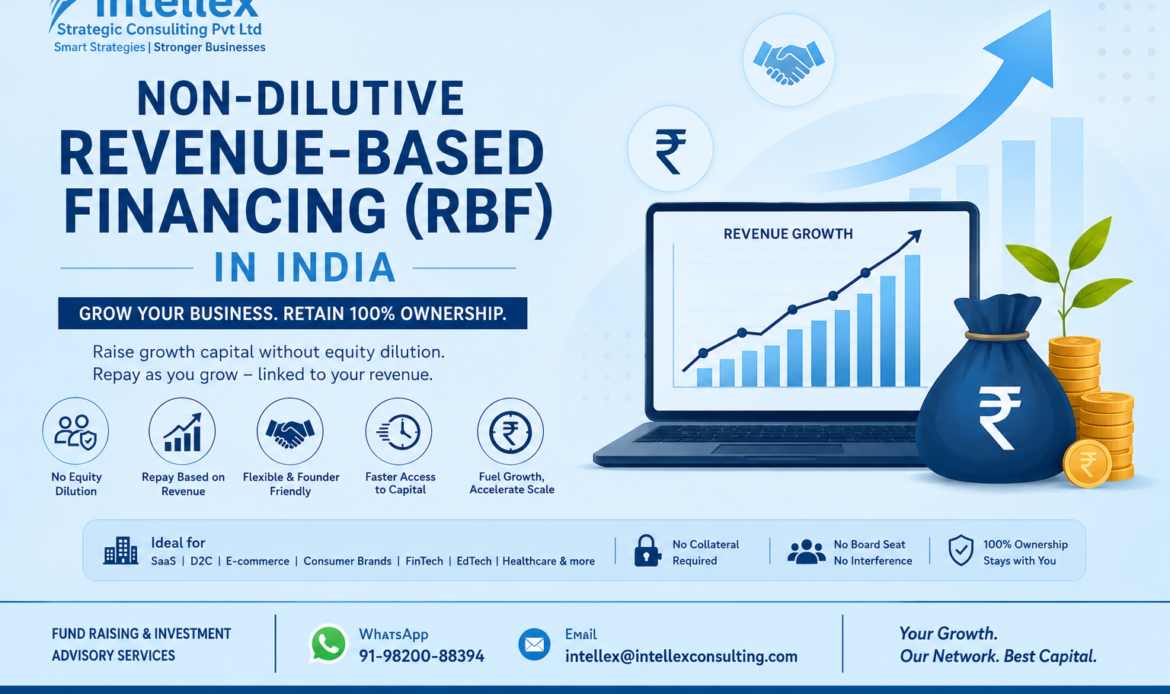
Non-Dilutive Revenue-Based Financing (RBF) in India: A Complete Guide to Revenue-Based Funding, Leading Lenders, Eligibility Criteria & How Startups Can Raise Growth Capital.
Discover everything about Non-Dilutive Revenue-Based Financing (RBF) in India. Learn how Revenue-Based Finance works, eligibility, repayment structure, top RBF providers, investment size, advantages, disadvantages, and how Intellex Strategic Consulting Pvt Ltd and VentureStreets.com help startups raise growth capital.
Non-Dilutive Revenue-Based Financing (RBF) in India: The Future of Startup Funding Without Equity Dilution
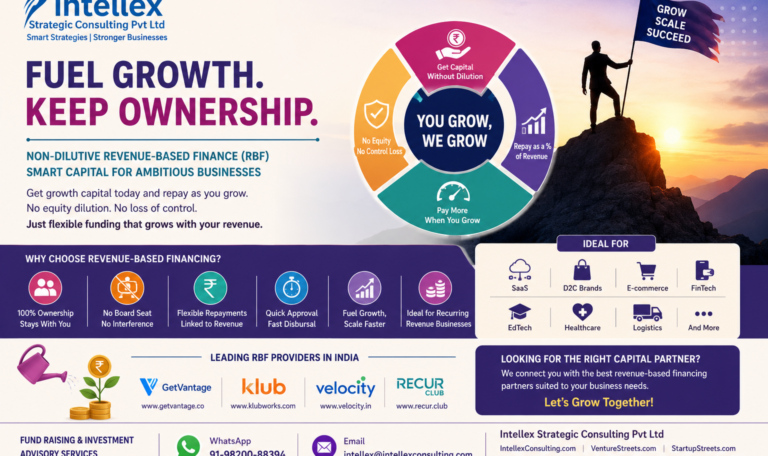
India’s startup ecosystem has traditionally depended on angel investors, venture capital funds, private equity, bank loans, and NBFC financing. While equity funding has helped many startups scale rapidly, it also comes with a significant cost—equity dilution.
Many founders today prefer retaining ownership while still accessing growth capital. This has led to the rapid emergence of Revenue-Based Financing (RBF), one of the fastest-growing forms of non-dilutive funding globally.
Revenue-Based Financing enables businesses to raise capital without giving away equity or providing heavy collateral. Instead, repayment is linked to a percentage of future monthly revenues, making it particularly suitable for companies with predictable cash flows.
This article explains the complete concept of Revenue-Based Financing in India, its benefits, eligibility criteria, leading providers, and how businesses can access this innovative funding option.
What is Revenue-Based Financing (RBF)?
Revenue-Based Financing is a funding model where an investor or financing company provides capital to a business in exchange for a fixed percentage of its future monthly revenues until a predetermined repayment amount has been reached.
Unlike Venture Capital:
- No equity is given away.
- Founders retain complete ownership.
- No board seats are demanded.
- No dilution of promoter shareholding.
- Repayments fluctuate according to business performance.
This makes RBF particularly attractive for founders who are confident about future revenue growth.
Why is it Called Non-Dilutive Funding?
Traditional venture capital requires startups to issue shares.
For example:
A startup raises ₹5 crore by selling 20% equity.
The founder permanently loses ownership of that 20%.
Under Revenue-Based Financing:
- The company receives funding.
- Ownership remains 100% with founders.
- Investors earn returns through revenue sharing instead of equity appreciation.
Hence, RBF is known as Non-Dilutive Capital.
How Revenue-Based Financing Works
A financing company evaluates:
- Monthly recurring revenue (MRR)
- Annual recurring revenue (ARR)
- Customer retention
- Gross margins
- Cash flow
- Unit economics
- Revenue growth
Once approved:
- Capital is disbursed.
- Company pays a fixed percentage of monthly revenue (commonly 2%–10%).
- Payments continue until the agreed repayment cap is reached.
For example:
Funding received: ₹1 crore
Repayment multiple: 1.4×
Total repayment: ₹1.40 crore
Monthly payment depends upon revenue.
Higher revenue means faster repayment.
Lower revenue means lower installments.
Difference Between Venture Capital and Revenue-Based Finance
| Feature | Venture Capital | Revenue-Based Finance |
|---|---|---|
| Equity Dilution | Yes | No |
| Ownership | Reduced | Fully retained |
| Board Seat | Usually Yes | No |
| Fixed EMI | No | No |
| Linked to Revenue | No | Yes |
| Exit Requirement | IPO/Acquisition | Not Required |
| Founder Control | Reduced | Maintained |
| Collateral | Usually No | Usually Not Required |
Which Companies are Ideal for RBF?
Revenue-Based Financing works best for:
- SaaS companies
- D2C brands
- E-commerce businesses
- Subscription businesses
- Consumer brands
- Healthcare startups
- EdTech companies
- FinTech businesses
- Digital agencies
- Logistics companies
- Manufacturing businesses with recurring revenues
Typical Eligibility Criteria
Although each lender has different policies, common requirements include:
- Minimum operating history (often 6–24 months)
- Stable monthly revenues
- Predictable cash flows
- Healthy gross margins
- Positive unit economics
- Strong customer retention
- Digital accounting records
- GST and Income Tax compliance
- Bank statements
- Financial statements
Some providers also assess founder experience and future growth potential.
Typical Funding Size
Revenue-Based Financing providers in India generally offer funding ranging from:
- ₹10 lakh
- ₹25 lakh
- ₹50 lakh
- ₹1 crore
- ₹2 crore
- ₹5 crore
- ₹10 crore or more for larger businesses
The sanctioned amount depends on recurring revenue, repayment capacity, and business performance.
Advantages of Revenue-Based Financing
- No equity dilution
- Founder retains ownership
- Faster approval than traditional loans
- No heavy collateral in many cases
- Flexible repayments linked to revenue
- Suitable for growth marketing
- Useful for inventory expansion
- Supports working capital needs
- No interference in management
- Can complement venture capital or debt funding
Challenges of Revenue-Based Financing
- Suitable mainly for businesses with recurring revenues
- Repayment obligation begins soon after funding
- Cost of capital may be higher than bank loans
- Seasonal businesses may need careful cash-flow planning
- Providers expect transparent financial reporting
Major Revenue-Based Financing Providers in India
1. GetVantage
One of India’s pioneers in Revenue-Based Financing, GetVantage supports digital-first businesses, D2C brands, SaaS companies, and e-commerce ventures. It provides growth capital without taking equity, with repayments linked to future revenues.
Typical focus:
- D2C
- SaaS
- Consumer brands
- Digital businesses
Funding size: From several lakhs to multiple crores, depending on revenue profile.
Website: https://www.getvantage.co
2. Klub
Klub provides growth financing for digital businesses, especially e-commerce brands and consumer startups. The company focuses on flexible capital solutions based on business revenues.
Typical sectors:
- Consumer brands
- D2C
- E-commerce
- Marketplace businesses
Website: https://www.klubworks.com
3. Velocity
Velocity offers revenue-based capital to online businesses, helping founders finance inventory, marketing, and expansion while avoiding equity dilution.
Focus areas:
- E-commerce
- Online sellers
- D2C
- Amazon and marketplace businesses
Website: https://www.velocity.in
4. Recur Club
Recur Club provides growth capital to startups and SMEs using revenue-linked financing structures. It serves businesses with recurring or predictable revenues across multiple sectors.
Website: https://www.recur.club
5. N+1 Capital and Other Alternative Financing Platforms
Several alternative investment platforms, fintech lenders, and private credit providers are also exploring revenue-linked financing structures for high-growth businesses, particularly those with stable recurring income.
Factors Considered by RBF Providers
Before approving funding, providers typically review:
- Monthly revenue trends
- Annual revenue
- EBITDA and gross margins
- Customer acquisition cost (CAC)
- Customer lifetime value (LTV)
- Churn rate
- Cash burn
- GST filings
- Income Tax returns
- Banking transactions
- Management quality
- Scalability
- Industry outlook
How to Improve Your Chances of Approval
Businesses can improve funding prospects by:
- Maintaining accurate financial records
- Filing GST and tax returns on time
- Demonstrating consistent revenue growth
- Building predictable recurring revenues
- Improving customer retention
- Strengthening unit economics
- Preparing a professional investor presentation and financial model
Is Revenue-Based Financing Right for Your Business?
RBF is particularly suitable if:
- You do not want to dilute equity.
- You have recurring revenues.
- You need growth capital quickly.
- You are funding marketing, expansion, or inventory.
- You expect revenues to grow steadily over the coming years.
It may not be ideal for pre-revenue startups or businesses with highly unpredictable cash flows.
The Future of Revenue-Based Financing in India
As India’s startup ecosystem matures, founders are increasingly exploring funding options beyond traditional equity and bank debt. Revenue-Based Financing is expected to play a larger role, especially for profitable or near-profitable startups that value ownership and operational flexibility.
How Intellex Strategic Consulting Pvt Ltd Can Help
Intellex Strategic Consulting Pvt Ltd helps startups, SMEs, and growth-stage companies raise capital through a wide network of investors and funding partners.
Our fundraising advisory services include:
- Revenue-Based Financing (RBF)
- Venture Capital
- Angel Investment
- Private Equity
- Family Offices
- Venture Debt
- Working Capital Finance
- Growth Capital
- Structured Debt
- Business Plan Preparation
- Financial Modelling
- Investor Pitch Decks
- Investment Readiness
- Due Diligence Support
- Investor Introductions through VentureStreets.com
Whether you are an early-stage startup or an established business seeking expansion capital, we can assist in identifying the most suitable funding solution aligned with your growth objectives.
Contact Us
Intellex Strategic Consulting Pvt Ltd
Fund Raising & Investment Advisory Services
WhatsApp: +91-98200-88394
Email: intellex@intellexconsulting.com
Websites:
- IntellexConsulting.com
- VentureStreets.com
- StartupStreets.com
- CreditMoneyFinance.com
- IntellexCFO.com
- EconomicLawsPractice.com
- IncometaxDigest.com
2 replies on “Non-Dilutive Revenue-Based Financing (RBF) in India: A Complete Guide to Revenue-Based Funding, Leading Lenders, Eligibility Criteria & How Startups Can Raise Growth Capital.”
[…] Non-Dilutive Revenue-Based Financing (RBF) in India: A Complete Guide to Revenue-Based Funding, Lead… […]
[…] Non-Dilutive Revenue-Based Financing (RBF) in India: A Complete Guide to Revenue-Based Funding, Lead… […]