
Lavni Ventures Fund II ₹200 Crore Deep-Tech VC Fund for India: Investment Thesis, Funding Criteria, Cheque Size, Sectors, Portfolio, Future Outlook & How Startups Can Apply
Lavni Ventures Fund II is a ₹200 crore deep-tech VC fund focused on Indian startups in healthcare, climate, energy and foundational technologies. Explore its investment thesis, cheque size, startup criteria, portfolio, funding strategy and how founders can prepare for investment.
Lavni Ventures Fund II: What Startups Need to Know
India’s venture-capital ecosystem is gradually developing a much deeper appetite for deep technology, healthcare innovation, climate technology, energy technology and science-led businesses.
For founders operating in these areas, the funding journey can be substantially different from that of a conventional SaaS, consumer internet or marketplace startup. Deep-tech businesses frequently require longer development cycles, specialised talent, regulatory approvals, prototyping, manufacturing infrastructure, clinical validation, intellectual-property development and significant technical expertise before they reach large-scale commercialisation.
Against this backdrop, Lavni Ventures has built an investment platform specifically around technology-driven and sustainable businesses.
Its second fund, Lavni Ventures Fund II, is particularly relevant for founders looking for early institutional capital for deep-tech ventures.
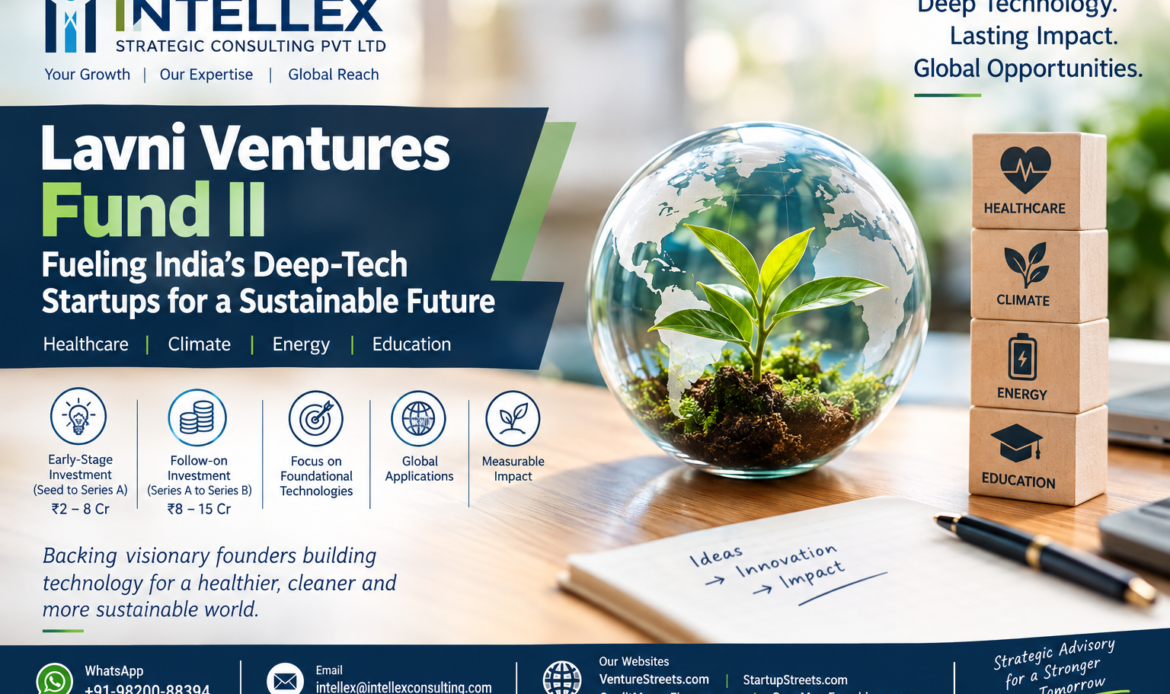
The fund was launched with a target corpus of ₹200 crore, with the stated investment focus on early-stage deep-tech companies. At launch, the fund announced investments of approximately ₹2 crore–₹8 crore at Seed to Series A, with ₹8 crore–₹15 crore reserved for follow-on investments.
More recently, the information shown in the VCCircle report supplied with this article indicates that Lavni has reached its ₹200 crore base target for Fund II while retaining a ₹100 crore greenshoe option. That means the eventual corpus could potentially be larger than the base target, subject to the fund’s fundraising process and applicable approvals/commitments.
For startups, however, the most important question is not simply “How large is the fund?”
The more important question is:
Does your company fit the type of deep-tech opportunity Lavni Ventures is trying to build its portfolio around?
This article examines that question in detail.
1. What Is Lavni Ventures?
Lavni Ventures is an early-stage venture capital investor focused on technology-driven, sustainable and impact-oriented businesses.
The firm was founded by Vasu Guruswamy, Sanjay Kanvinde and Krishna Shivram, with backgrounds spanning technology, operations, energy, finance and investment. Lavni’s first fund was effectively used to develop and validate its thesis around Indian deep-tech companies capable of creating commercially scalable solutions with broader social or environmental impact.
The firm’s current website describes its philosophy around three important themes:
- Foundational innovation with impact
- Funding across multiple stages
- Measurable impact through defined KPIs
Lavni specifically highlights the funding gap that deep-tech companies can face between Seed and Series A and says it seeks to provide capital across funding rounds rather than treating its initial investment as a one-time transaction. Lavni Ventures
This is particularly relevant because deep-tech startups often need more time and capital than conventional software businesses.
2. Lavni Ventures Fund I – The Beginning
To understand Fund II, it is useful to understand the journey behind Fund I.
Lavni Ventures was established around a thesis that Indian technical and scientific talent could create globally relevant technology businesses without requiring the enormous amounts of capital traditionally associated with comparable innovation in developed markets.
The first fund provided the firm with an opportunity to identify companies across areas such as:
- MedTech
- Healthcare technology
- Cleantech
- Agritech
- EdTech
- Energy
- Sustainable technology
Among the companies associated with Lavni’s portfolio are PadCare Labs, Monitra Healthcare and MedPrime Technologies. Lavni’s current portfolio also shows businesses involved in digital microscopy and tele-pathology, AI-enabled cardiac monitoring, portable health diagnostics, menstrual-waste recycling and AI-based teacher training. Lavni Ventures
This gives prospective founders an important insight:
Lavni is not simply looking for another consumer internet company.
Its historical portfolio points toward businesses where technology, science, measurable impact and a potentially large market opportunity intersect.
3. Lavni Ventures Fund II – The ₹200 Crore Fund
Fund II represents the next stage of Lavni’s investment strategy.
When Fund II was announced, Lavni stated that it was targeting a ₹200 crore corpus and would invest in early-stage Indian deep-tech companies. The fund was registered as a SEBI Category II Alternative Investment Fund. Lavni’s website currently identifies Fund II as a scheme of Lavni Ventures Trust and lists SEBI registration number IN/AIF2/24-25/1623. Lavni Ventures
The original fund announcement identified four principal areas:
Healthcare
Including technologies addressing diagnosis, monitoring, medical devices and broader healthcare delivery.
Climate
Technologies designed to address environmental challenges, resource efficiency, waste, sustainability and climate-related problems.
Energy
Technology-led solutions associated with energy generation, storage, efficiency and related infrastructure.
Education
Technology and innovation that can create meaningful improvements in education and learning outcomes.
Lavni’s current website places particular emphasis on foundational technologies in Health and Climate, while its Fund II launch materials also included energy and education within the investment universe.
4. What Is the Investment Stage for Lavni Ventures Fund II?
This is one of the most important points for founders.
Initial investment
₹2 crore to ₹8 crore
Stage
Seed to Series A
Follow-on investment
₹8 crore to ₹15 crore
Follow-on stage
Series A to Series B
These ranges are stated directly by Lavni Ventures on its website. Lavni Ventures
Therefore, startups looking for a ₹25 lakh angel cheque or a ₹50 lakh pre-seed round may not necessarily fit the core cheque profile of Fund II.
Conversely, a company seeking:
- ₹3 crore Seed funding
- ₹5 crore Seed/Pre-Series A capital
- ₹7–8 crore Series A funding
- Additional ₹8–15 crore follow-on capital
may be much closer to the fund’s stated investment range.
The exact investment decision, valuation, ownership structure and terms will naturally depend on the individual opportunity.
5. Lavni Ventures’ Core Investment Thesis
The investment thesis is arguably the most important part of understanding this fund.
Lavni describes its philosophy as investing in impactful, technology-driven and sustainable businesses. Lavni Ventures
Its approach can broadly be understood through several components.
5.1 Foundational Technology
Lavni is interested in technologies that can potentially become fundamental building blocks for larger industries rather than merely incremental consumer applications.
This can include:
- Proprietary technology
- Hardware
- Deep software
- Scientific innovation
- Medical technology
- Advanced materials
- Industrial technology
- Climate technology
- Energy technology
- AI applied to specialised domains
- Technology-enabled scientific solutions
The presence of intellectual property, technological differentiation or a defensible technical advantage can therefore be important.
6. Global Application Potential
One of the strongest themes associated with Fund II is the ambition to back Indian deep-tech founders building solutions with global applications.
This is important.
A startup does not necessarily need to be selling internationally on Day One.
However, founders should be able to explain:
Why can this technology eventually address a global market?
For example:
“We are developing a diagnostic technology for India.”
is a weaker investment narrative than:
“We are developing a diagnostic platform that solves a global diagnostic problem, with India providing the initial market and cost-efficient development environment.”
The second approach establishes a much larger potential market.
Lavni has explicitly discussed supporting startups in international markets and helping portfolio companies with global scaling. Lavni Ventures
7. Impact Is Part of the Investment Philosophy
Another important characteristic is the emphasis on measurable impact.
Lavni’s stated philosophy includes clear impact tracking and KPIs. Lavni Ventures
This means a founder should not merely say:
“Our company is creating impact.”
A stronger presentation would quantify it.
For example:
- Number of patients reached
- Reduction in healthcare costs
- Tonnes of waste recycled
- Reduction in carbon emissions
- Energy saved
- Farmers benefited
- Students trained
- Improvement in diagnostic accuracy
- Reduction in treatment time
- Reduction in industrial resource consumption
Impact should therefore be presented as a measurable business metric, rather than simply a marketing statement.
8. What Kind of Startups Could Fit Lavni Fund II?
Based on Lavni’s publicly stated investment philosophy and portfolio, potential areas include:
Healthcare & MedTech
- Medical devices
- Diagnostics
- Digital healthcare
- Remote monitoring
- Healthcare AI
- Clinical technology
- Medical imaging
- Preventive healthcare
ClimateTech
- Waste management
- Recycling technology
- Carbon reduction
- Sustainable materials
- Circular economy
- Water technology
- Environmental monitoring
EnergyTech
- Energy efficiency
- Energy storage
- Alternative energy technologies
- Industrial energy solutions
- Power management
EdTech
- AI-enabled education
- Teacher technology
- Learning infrastructure
- Technology-driven education systems
The existing portfolio gives examples of the type of technology-led businesses Lavni has backed. Lavni Ventures
9. Examples From the Lavni Portfolio
Understanding actual portfolio companies can help founders understand the investment philosophy better.
Monitra Healthcare
Monitra Healthcare has developed technology for continuous cardiac monitoring.
Lavni has been associated with the company and later participated in its development and funding journey. Lavni’s news section notes Monitra’s subsequent Pre-Series A financing led by Equanimity Ventures and Kotak Alternate Asset Managers. Lavni Ventures
This illustrates an important point:
Lavni’s role can extend beyond the initial cheque.
The firm describes itself as providing strategic and technical guidance, international-market connections and assistance with subsequent fundraising. Lavni Ventures
PadCare Labs
PadCare Labs works on sustainable management and recycling of menstrual hygiene waste.
The company represents another element of the Lavni thesis:
A difficult environmental problem + proprietary technology + commercial opportunity + measurable impact.
Lavni’s news page notes its participation in PadCare’s funding history. Lavni Ventures
MedPrime Technologies
MedPrime focuses on medical imaging and diagnostic technology.
Again, this fits the broader pattern of:
deep technology + healthcare problem + potentially scalable technology platform.
Lavni identifies MedPrime among its portfolio companies. Lavni Ventures
10. What Does Lavni Look for in a Startup?
Lavni’s website describes its opportunity-selection process around:
- Large opportunity funnel
- Early investment
- Long-term engagement
- Values alignment
- Cultural fit
- Trusted founder relationships
- Strategic and technical differentiation
- Scaling potential
The firm also says it prioritises quality over quantity rather than treating the portfolio simply as a volume exercise. Lavni Ventures
For founders, this has several implications.
Technology alone is not enough.
A startup may possess impressive technology but still struggle to raise institutional capital if it lacks:
- A clearly defined market
- Commercial validation
- Strong founders
- A scalable business model
- Regulatory strategy
- IP strategy
- Unit economics
- Manufacturing roadmap
- Customer validation
- Exit potential
11. What Founders Should Prepare Before Approaching Lavni
If your startup potentially fits the Lavni thesis, preparation is critical.
A professional investor-ready package should generally contain the following.
1. Executive Summary
One or two pages covering:
- Problem
- Solution
- Technology
- Market
- Traction
- Revenue
- Funding requirement
- Use of funds
- Founder background
2. Investor Pitch Deck
Typically 15–25 slides covering:
- Company
- Problem
- Solution
- Technology
- Product
- Market
- Competition
- Competitive advantage
- IP
- Business model
- Traction
- Customers
- Revenue
- Unit economics
- Team
- Funding requirement
- Use of funds
- Financial projections
- Future milestones
- Exit possibilities
12. Deep-Tech Startups Need More Than a Conventional Pitch Deck
This is especially important for founders approaching deep-tech investors.
If your company is developing technology, investors may want to understand:
- Technology readiness level
- Patent status
- Proprietary algorithms
- Scientific validation
- Prototype status
- Clinical validation
- Regulatory approvals
- Manufacturing readiness
- Cost of production
- Bill of materials
- Technology development roadmap
- Scalability
- Reliability
- Certification requirements
- Customer pilots
A founder should be able to explain the journey from:
Research → Prototype → Validation → Commercial Product → Scale
with measurable milestones.
13. Revenue and Commercial Traction Still Matter
Being a deep-tech company does not mean commercial discipline is unimportant.
Founders should clearly demonstrate:
Current revenue
What is the company’s present annualised revenue?
Revenue growth
How quickly is revenue increasing?
Customer pipeline
How many customers are currently evaluating the technology?
Repeat business
Are existing customers purchasing again?
Gross margins
Can the product ultimately generate attractive gross margins?
Customer acquisition
How difficult and expensive is it to acquire customers?
Sales cycle
Is the sales cycle three months, twelve months or three years?
For enterprise, healthcare and industrial deep-tech businesses, long sales cycles may be normal—but investors need to understand them.
14. Why Follow-on Capital Matters for Deep-Tech Startups
One of the attractive features of Lavni Fund II’s structure for qualifying startups is its stated ability to invest in subsequent rounds.
The fund has indicated ₹8 crore–₹15 crore for follow-on investments. Lavni Ventures
For a deep-tech startup, this can be strategically significant.
A company may initially require ₹4 crore to:
- Complete product development
- Build prototypes
- Obtain regulatory approvals
- Conduct pilots
- Establish manufacturing capability
Later, it may require another ₹10 crore to:
- Scale manufacturing
- Expand internationally
- Build a sales team
- Enter new markets
- Expand production
- Develop the next-generation product
A fund that understands this progression can potentially remain involved as the company moves through those stages.
15. Quest Global’s Investment in Fund II
Another recent development relevant to the future of Fund II is the strategic investment by Quest Global.
Quest Global announced in August 2026 that it had made a strategic investment in Lavni Ventures Fund II. Quest described the commitment as part of a broader effort to support deep-tech innovation in areas including climate, energy and healthcare.
The strategic relevance goes beyond capital.
According to reporting on the investment, Lavni portfolio companies may gain access to engineering expertise, technical mentorship and opportunities to engage with Quest Global’s enterprise ecosystem.
For deep-tech founders, this can be particularly relevant because the journey from laboratory innovation to a commercially scalable product frequently requires engineering, productisation, validation and industrialisation capabilities.
16. What the Future Could Look Like for Lavni Fund II
The future direction of Fund II appears closely linked to the continued growth of India’s deep-tech ecosystem.
Several structural developments are relevant:
- Growth in India’s deep-tech startup ecosystem
- Increased institutional interest in climate technology
- Healthcare innovation
- AI applied to scientific and industrial problems
- Advanced manufacturing
- Energy transition
- Global demand for cost-efficient technology
- Increasing interest in Indian IP-led businesses
Lavni’s own stated objective is to help founders develop technology that can scale internationally. Lavni Ventures
However, founders should distinguish between:
Fund corpus
and
capital actually available for their particular round.
A fund may have a large corpus while still maintaining sector, stage, portfolio-concentration and reserve-allocation constraints.
17. Who May Not Be a Strong Fit?
Based strictly on the publicly stated thesis, startups may be less aligned if they are primarily:
- Pure trading businesses
- Traditional services companies without proprietary technology
- Low-tech businesses
- Small local businesses
- Conventional agencies
- Businesses without meaningful scalability
- Businesses without a defensible technological advantage
- Companies seeking only short-term working capital
- Companies looking for debt rather than equity
- Businesses with no plausible global application or significant technology-driven growth opportunity
This does not mean such businesses cannot raise capital elsewhere.
It simply means founders should carefully match their company with an investor’s mandate.
18. How Startups Should Position Their Pitch
Instead of saying:
“We are looking for ₹5 crore.”
A more sophisticated pitch is:
“We are raising ₹5 crore to achieve five measurable milestones over the next 18 months.”
For example:
₹1.5 crore — Product development
₹1 crore — Regulatory and certification
₹1 crore — Manufacturing scale-up
₹75 lakh — Sales and marketing
₹50 lakh — International pilots
₹25 lakh — Working capital
The investor should be able to see precisely how the capital transforms the business.
19. The Five Questions Every Founder Should Be Ready to Answer
Before approaching an investor such as Lavni, founders should be able to answer:
1. Why does this technology matter?
What problem is sufficiently important that customers will pay for the solution?
2. Why is your technology difficult to replicate?
What prevents a larger competitor from copying you?
3. Why now?
What technological, regulatory, market or societal change creates the opportunity today?
4. Why your team?
Why are your founders uniquely qualified to build this company?
5. Why can this become a global business?
What is the addressable market outside India?
20. Fundraising Strategy for Deep-Tech Founders
Deep-tech founders should ideally begin fundraising well before their cash runway becomes critical.
A practical fundraising process can be:
Stage 1 — Investment readiness
Financials, cap table, IP, legal, compliance and pitch materials.
↓
Stage 2 — Investor mapping
Identify investors according to:
- Sector
- Stage
- Geography
- Ticket size
- Strategic relevance
↓
Stage 3 — Investor outreach
Approach relevant funds with a targeted investment memorandum.
↓
Stage 4 — Management presentation
Founder and investor discussions.
↓
Stage 5 — Due diligence
Business, financial, legal, technology and commercial diligence.
↓
Stage 6 — Term sheet
Negotiate valuation and investment terms.
↓
Stage 7 — Documentation
SHA, SSA and associated documentation.
↓
Stage 8 — Closing
Investment and share issuance.
21. Why Investor-Fund Matching Matters
One of the biggest mistakes founders make is sending the same pitch deck to hundreds of investors.
The better approach is to understand the investor’s:
- Investment stage
- Sector preference
- Ticket size
- Geography
- Portfolio
- Investment philosophy
- Follow-on strategy
- Strategic capabilities
and then customise the fundraising narrative accordingly.
For example, a deep-tech healthcare company seeking ₹6 crore at Seed/Series A has a very different investor universe from a consumer startup seeking ₹1 crore pre-seed capital.
Lavni Fund II’s published cheque range makes this distinction particularly important. Lavni Ventures
22. Lavni Ventures Fund II – Quick Reference
| Parameter | Lavni Ventures Fund II |
|---|---|
| Fund | Lavni Ventures Fund II |
| Fund type | Category II AIF |
| Base target | ₹200 crore |
| Greenshoe | ₹100 crore, as reported in the supplied VCCircle article |
| Primary focus | Deep technology / impact |
| Key areas | Healthcare, Climate, Energy, Education |
| Initial stage | Seed to Series A |
| Initial cheque | ₹2–8 crore |
| Follow-on stage | Series A to Series B |
| Follow-on cheque | ₹8–15 crore |
| Geography | Indian startups, with global potential |
| Investment philosophy | Technology + sustainability + measurable impact |
| Support | Strategic guidance, technical guidance, global market connections and fundraising support |
| Current status | Fund II is investing, according to Lavni’s website |
The published cheque ranges and current investment status are from Lavni Ventures’ own website. Lavni Ventures
23. How Intellex Strategic Consulting Can Help Startups Seeking Institutional Funding
For startups seeking venture capital, private equity, strategic investment or other forms of institutional capital, Intellex Strategic Consulting Pvt Ltd can assist founders with the broader fundraising process.
Intellex Strategic Consulting Private Limited works with businesses and entrepreneurs on strategic finance, fundraising, investor identification, transaction advisory and growth-related requirements across India and internationally.
The objective is not simply to circulate a pitch deck.
A professional fundraising process should begin with:
Business assessment
Understanding the company’s:
- Business model
- Industry
- Competitive position
- Technology
- Revenue
- Profitability
- Growth potential
- Capital requirement
Investor mapping
Identifying potentially relevant:
- Venture capital funds
- Private equity investors
- Family offices
- HNIs
- Strategic investors
- AIFs
- Institutional investors
Investment documentation
Helping founders organise:
- Investor presentation
- Executive summary
- Financial projections
- Funding requirement
- Use-of-funds plan
- Business information memorandum
Fundraising strategy
Developing a structured approach to investor engagement rather than indiscriminate outreach.
Transaction support
Where appropriate, supporting discussions through the investment process, subject to the specific mandate and transaction requirements.
Intellex can work with businesses across India and international markets, depending on the mandate.
24. A Note for Founders Considering Lavni Ventures
If your startup is in:
DeepTech | HealthTech | MedTech | ClimateTech | EnergyTech | Sustainable Technology | Science-led Innovation | Advanced Technology
and you are raising approximately ₹2 crore–₹8 crore at Seed/Series A, Lavni Ventures Fund II is a fund whose publicly stated investment parameters may be relevant to investigate. Lavni Ventures
The most important step, however, is not simply approaching the fund.
It is determining whether your business genuinely fits the investment thesis and presenting the opportunity in a way that makes the technology, market, economics, scalability and impact easy for an investment team to evaluate.
25. Final Takeaway
Lavni Ventures Fund II represents an important segment of India’s evolving deep-tech investment ecosystem.
Its stated strategy combines:
Early-stage capital + deep technology + sustainability + measurable impact + long-term engagement + global scalability.
The fund’s published investment range of ₹2 crore–₹8 crore initially and ₹8 crore–₹15 crore for follow-ons gives founders a useful indication of the stage and funding requirements it is structured to address. Lavni Ventures
Its earlier portfolio provides examples of healthcare, diagnostics, education and sustainability-oriented technology businesses, while the Fund II strategy places greater emphasis on foundational technologies and global applications. Lavni Ventures
The recent strategic investment by Quest Global also adds an industrial and engineering dimension to the ecosystem surrounding Fund II, particularly for companies that need technical mentorship and pathways toward productisation and global scale. Quest Global
For founders, the central lesson is straightforward:
Do not approach institutional investors simply because they have money. Approach them because your company fits their investment thesis—and then demonstrate that fit with evidence.
Looking for Startup Funding or Strategic Investors?
Intellex Strategic Consulting Pvt Ltd assists startups, SMEs and established businesses with fundraising, investor identification, strategic finance and transaction advisory requirements.
If your company is looking to raise capital from VCs, PE funds, HNIs, Family Offices, Strategic Investors or Institutional Investors, you can contact our team for an initial discussion about your funding requirement and investor profile.
Contact Intellex Strategic Consulting Pvt Ltd
WhatsApp: +91-98200-04701
Email: intellex@intellexconsulting.com
Websites:
VentureStreets.com
StartupStreets.com
CreditMoneyFinance.com
GrowMoreFranchisees.com
Intellex Strategic Consulting Pvt Ltd
Strategic Consulting | Fundraising | Investment Advisory | Business Growth | Corporate Finance
More Featured Articles