
Business Funding for Startups, Entrepreneurs & Project Developers in India: A Practical Guide to Raising Capital in 2026.
Business Funding in India 2026: Startup Capital, Expansion Finance, Project Funding & Government Funding Options
Explore business funding options in India for startups, MSMEs, entrepreneurs and project developers, including startup capital, expansion finance, project funding, government schemes, credit support and investor funding.
Business Funding Is No Longer One-Size-Fits-All
For a startup or growing business, access to the right capital can determine how quickly an idea becomes a viable business.
A founder may need relatively modest capital to develop a prototype. An established company may require working capital to execute a large order. A contractor may need finance to mobilise resources for a project, while a project developer may require substantial funding to acquire assets, complete construction or reach commercial operations.
The important point is that different business requirements require different forms of funding.
In India, entrepreneurs can potentially explore a combination of bank finance, NBFC funding, government-backed credit programmes, grants, incubator funding, venture capital, private equity, strategic investors and structured financing.
The Government’s Startup India platform itself brings together funding programmes, central-government schemes, investor-connect initiatives and other resources for startups.
This guide explains the major funding routes that startups, entrepreneurs, MSMEs and project developers can consider in 2026.
1. Startup Capital for New Businesses
Early-stage businesses often face the most difficult funding gap.
At the idea stage, a business may have limited revenue, limited assets and no established credit history. Conventional lenders may therefore be reluctant to provide substantial debt financing.
For innovative startups, government-supported programmes and incubator-linked funding can be particularly relevant.
Startup India Seed Fund Scheme
The Startup India Seed Fund Scheme (SISFS) was designed to provide financial assistance for activities including:
- Proof of concept
- Prototype development
- Product trials
- Market entry
- Commercialisation
The scheme is administered through eligible incubators and is aimed at DPIIT-recognised startups meeting the applicable eligibility conditions.
Startups should carefully check the latest eligibility and application status before applying because programme windows and application timelines can change.
Useful resources:
Startup India – Official Portal
Startup India Seed Fund Scheme – Apply/Information Portal
National Government Services Portal – SISFS Application Information
2. Equity Funding for High-Growth Startups
Startups with strong technology, intellectual property, market traction and significant scalability may be better suited to equity funding rather than conventional loans.
Potential sources include:
- Angel investors
- Venture capital funds
- Family offices
- Corporate investors
- Strategic investors
- Alternative Investment Funds
- Private equity investors
The Fund of Funds for Startups (FFS) is an important example of how government capital can indirectly support startups. Rather than investing directly into individual startups, SIDBI contributes to eligible SEBI-registered AIFs, which then invest in startups.
SIDBI reports that the FFS has a ₹10,000 crore corpus and, as of December 31, 2025, commitments had been made to 153 AIFs, with those AIFs investing ₹22,942 crore in startups.
For founders, this means that identifying suitable funds and understanding their investment thesis can be more important than simply looking for a government fund to apply to directly.
Useful resource:
SIDBI Fund of Funds for Startups
3. Credit and Loan Funding for MSMEs
Not every business should raise equity.
For businesses with revenues, operating history, predictable cash flows or identifiable assets, debt financing can be an effective way to fund growth while allowing promoters to retain ownership.
Possible forms include:
- Term loans
- Working capital loans
- Cash credit
- Overdraft facilities
- Business loans
- Machinery finance
- Equipment finance
- Letter of Credit facilities
- Bank Guarantees
- Lease Rental Discounting
- Loan Against Property
- Structured working capital facilities
CGTMSE Credit Support
The Credit Guarantee Fund Trust for Micro and Small Enterprises (CGTMSE) facilitates credit guarantees through member lending institutions for eligible MSE borrowers.
The borrower generally approaches a registered member lending institution, such as a bank, NBFC or financial institution. The lender conducts its own credit assessment and, after sanction/disbursement where applicable, seeks guarantee coverage from CGTMSE.
It is important to understand that a credit guarantee does not mean automatic loan approval. The lending institution still evaluates the business, financials, repayment capacity and other applicable parameters.
Official resource:
4. Startup Credit Guarantee Support
Government support is also available through credit-guarantee mechanisms designed specifically for eligible startups.
The Government has reported that the Credit Guarantee Scheme for Startups (CGSS) is intended to facilitate collateral-free loans to eligible startups through participating financial institutions, with the scheme operationalised by the National Credit Guarantee Trustee Company.
Founders should distinguish between:
Equity funding: Investors receive ownership or economic rights in the company.
Debt funding: The business borrows money and is required to repay it according to agreed terms.
Credit guarantee support: A guarantee mechanism can reduce the lender’s credit risk, subject to the applicable scheme and lender’s assessment.
These are fundamentally different financing structures.
5. Project Development Financing
Project developers often have funding requirements that are significantly different from those of conventional startups.
Examples include:
- Infrastructure projects
- Renewable-energy projects
- Manufacturing facilities
- Real-estate-related projects
- Industrial projects
- Warehousing and logistics facilities
- Healthcare projects
- Educational institutions
- Hospitality projects
- Technology infrastructure
- Large equipment-intensive ventures
Project finance may involve a combination of:
Promoter contribution + debt + equity/investor capital + structured finance + working capital facilities
The feasibility of financing generally depends on factors such as:
- Project viability
- Total project cost
- Promoter contribution
- Projected cash flows
- Debt-servicing capacity
- Approvals and licences
- Land/asset position
- Offtake arrangements
- Customer contracts
- Technical feasibility
- Security/collateral
- Sponsor experience
- Industry outlook
A strong project report and realistic financial model can therefore make a substantial difference to the financing process.
6. Supply & Contract Execution Funding
A particularly important funding requirement exists when a company has already secured a purchase order, work order or contract but lacks sufficient working capital to execute it.
For example, a company may receive a ₹10 crore order but need substantial funds to purchase raw materials, pay employees, mobilise equipment and meet supplier obligations before receiving customer payments.
Possible financing structures may include:
- Working capital limits
- Purchase-order financing
- Bill/invoice financing
- Cash credit
- Overdraft
- Bank Guarantee
- Letter of Credit
- Equipment finance
- Structured working capital
- Contract-specific financing
The quality of the underlying customer/order is often an important consideration.
Businesses should maintain complete documentation relating to contracts, purchase orders, invoices, customer acceptance, payment terms and historical execution.
7. Government Schemes Worth Exploring
India has a broad ecosystem of startup and MSME programmes.
The June 2026 Startup India Government Schemes and Initiatives Playbook identifies programmes covering grants, equity investment, loans/credit, incubation, intellectual-property protection, market access and sector-specific support.
Depending on the startup’s sector and stage, founders may explore programmes associated with:
- Startup India
- SIDBI
- CGTMSE
- BIRAC
- MeitY
- Department of Science & Technology
- Ministry of MSME
- iDEX
- IN-SPACe
- GeM
- State startup policies
- Incubators and accelerators
The correct programme depends heavily on the business model and funding requirement.
Start here:
Startup India – Schemes & Funding Resources
Startup India Government Schemes Playbook – June 2026
8. Incubators Can Be an Important Funding Gateway
Many early-stage founders focus exclusively on venture capital and overlook incubators.
Incubators can provide:
- Mentorship
- Business validation
- Technical support
- Product development assistance
- Industry connections
- Investor introductions
- Workspace/laboratory infrastructure
- Access to government programmes
- Seed funding opportunities
For example, the Startup India Seed Fund Scheme operates through eligible incubators, while SIDBI has also developed institutional seed-funding initiatives in partnership with incubation centres.
For an early-stage founder, the right incubator can therefore provide considerably more value than funding alone.
9. What Investors and Lenders Typically Want to See
Before approaching any funding source, founders should prepare a professional funding package.
Corporate & Legal Documents
Typically include:
- Certificate of incorporation
- PAN
- GST registration, where applicable
- MOA/AOA or constitutional documents
- Shareholding pattern
- Details of directors/promoters
- Existing investment agreements
- Material contracts
- Licences and approvals
Financial Information
Depending on the stage:
- Profit & loss statements
- Balance sheets
- Cash-flow statements
- Bank statements
- GST returns
- Income-tax returns
- Debtor/creditor ageing
- Existing borrowing details
- Projected financial statements
- Monthly cash-flow projections
Startup/Investor Information
For equity investors, also prepare:
- Pitch deck
- Business plan
- Cap table
- Valuation expectations
- Customer metrics
- Revenue growth
- Gross margin
- Customer acquisition cost
- Lifetime value
- Monthly recurring revenue, where relevant
- Churn
- Product roadmap
- Competitive analysis
Project Funding Information
For project finance, the package may additionally require:
- Detailed project report
- Project cost
- Means of finance
- Promoter contribution
- Technical feasibility
- Land/asset documents
- Approvals
- Construction schedule
- Vendor quotations
- Customer/offtake agreements
- Projected cash flows
- DSCR and other financial ratios
10. How Startups Can Improve Their Funding Readiness
A funding application should answer five fundamental questions:
1. What problem are you solving?
The problem should be clearly defined and supported by market evidence.
2. Why is your solution better?
Explain the product, technology, business model or competitive advantage.
3. Who will pay?
Investors and lenders need clarity regarding the customer and revenue model.
4. What traction have you achieved?
Where available, demonstrate:
- Revenue
- Customers
- Orders
- Partnerships
- User growth
- Repeat purchases
- Contracts
- Gross margins
- Product adoption
5. What will the funding accomplish?
Avoid simply saying “we need ₹5 crore for growth.”
Instead, explain how the capital will be deployed.
For example:
₹5 crore requirement
- ₹1.5 crore – product development
- ₹1 crore – sales & marketing
- ₹1 crore – working capital
- ₹75 lakh – technology infrastructure
- ₹50 lakh – key personnel
- ₹25 lakh – regulatory/other expenses
A clearly defined use-of-funds plan makes the funding requirement easier to evaluate.
11. Choosing Debt vs Equity
There is no universally superior funding option.
Debt may be suitable when:
- The business has predictable cash flows
- Repayment capacity is demonstrable
- Promoters want to retain ownership
- The funding requirement is linked to working capital/assets
- The business can service interest and principal
Equity may be suitable when:
- The business is growing rapidly
- Cash flows are still developing
- Significant investment is required before profitability
- The company has strong scalability
- Strategic investors can add substantial value
Structured funding may be appropriate when:
- The requirement does not fit conventional lending
- There are significant contracts or receivables
- The project has identifiable cash flows
- Multiple sources of capital need to be combined
The best funding structure is ultimately the one that matches the company’s cash-flow profile and business objectives.
12. A Professional Funding Strategy Can Save Time
One of the biggest mistakes businesses make is approaching every possible investor or lender with the same proposal.
A ₹2 crore working-capital requirement for an established manufacturer is fundamentally different from a ₹2 crore seed round for a technology startup.
Similarly, a ₹50 crore project financing requirement requires a very different approach from a ₹50 crore equity investment proposal.
A professional funding strategy should therefore begin with:
Requirement → Eligibility → Funding structure → Target funders → Documentation → Application → Due diligence → Negotiation → Closure
This approach can reduce wasted effort and improve the quality of conversations with potential financiers.
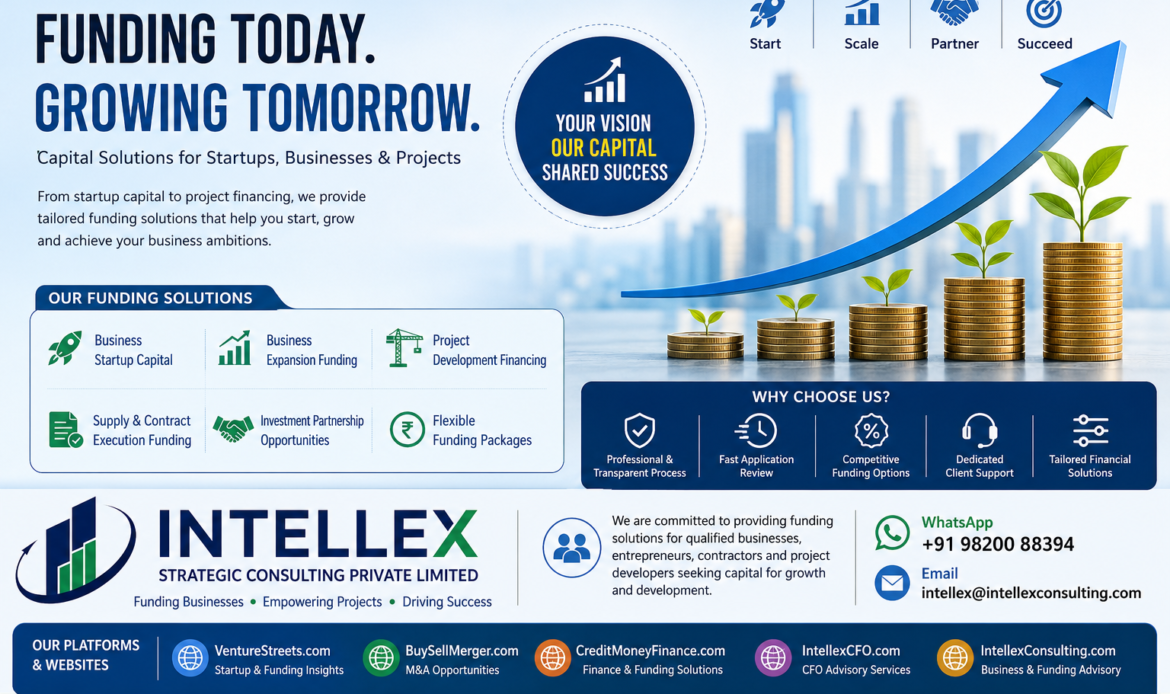
Funding Support for Startups, Businesses & Projects
Intellex Strategic Consulting Private Limited provides professional assistance to businesses, entrepreneurs and project developers seeking appropriate funding solutions.
Our focus is on understanding the funding requirement and helping clients evaluate suitable financing routes based on their business profile, stage, requirement and objectives.
Our Funding Solutions
- Business Startup Capital
- Business Expansion Funding
- Project Development Financing
- Supply & Contract Execution Funding
- Investment Partnership Opportunities
- Flexible Funding Packages
- Working Capital Funding
- Structured Business Funding
- Investor & Funding Advisory
Why Work With a Professional Funding Advisor?
A well-prepared funding proposal can help businesses present their opportunity more effectively to potential financing sources.
Our approach focuses on:
- Professional and transparent process
- Funding requirement assessment
- Preparation and positioning of funding proposals
- Identification of potentially suitable funding channels
- Documentation guidance
- Application support
- Investor/lender communication support
- Negotiation and transaction assistance, where applicable
Important: Funding is subject to eligibility, due diligence, credit/investment appraisal, documentation, regulatory requirements and the independent decision of the relevant bank, NBFC, investor, fund, institution or other financing source. No funding outcome should be assumed merely because an application is submitted.
STRATEGIC SUPERIOR INVESTORS LTD.
Funding Businesses • Empowering Projects • Driving Success
Are you looking for reliable financial support to establish, expand or execute your business or project?
Intellex is committed to providing funding solutions for qualified businesses, entrepreneurs, contractors and project developers seeking capital for growth and development.
Apply today and take the next step toward achieving your business objectives.
WhatsApp: +91 98200 88394
Email: intellex@intellexconsulting.com
Intellex Strategic Consulting Private Limited
Websites:
Building Opportunities. Financing Growth. Creating Success.
Editorial Note
Government schemes, eligibility criteria, application windows and financing policies can change. Startups should verify the latest information on the relevant official government, regulator, bank, NBFC, incubator or fund website before submitting an application.
This article is intended for general informational purposes and should not be interpreted as a guarantee of funding, investment or loan approval.
More Featured Articles:
Top Angel Networks in Singapore: The Ultimate Guide for Startups Seeking Angel Investment in 2026.