
Union Square Ventures Raises $900 Million: Investment Thesis, Funding Criteria, Fund Size and Opportunities for Startups in 2026.
Discover Union Square Ventures’ $900 million fundraising strategy for 2026, its AI investment thesis, funding criteria, portfolio track record and opportunities for startups worldwide, including Indian founders seeking venture capital.
Introduction: A Major Venture Capital Firm Repositions Itself for the AI Revolution
The global venture capital industry is undergoing a significant transformation. Artificial intelligence is changing not only the products startups develop but also how companies are established, how quickly they can scale, how much capital they require and how venture capital firms evaluate investment opportunities.
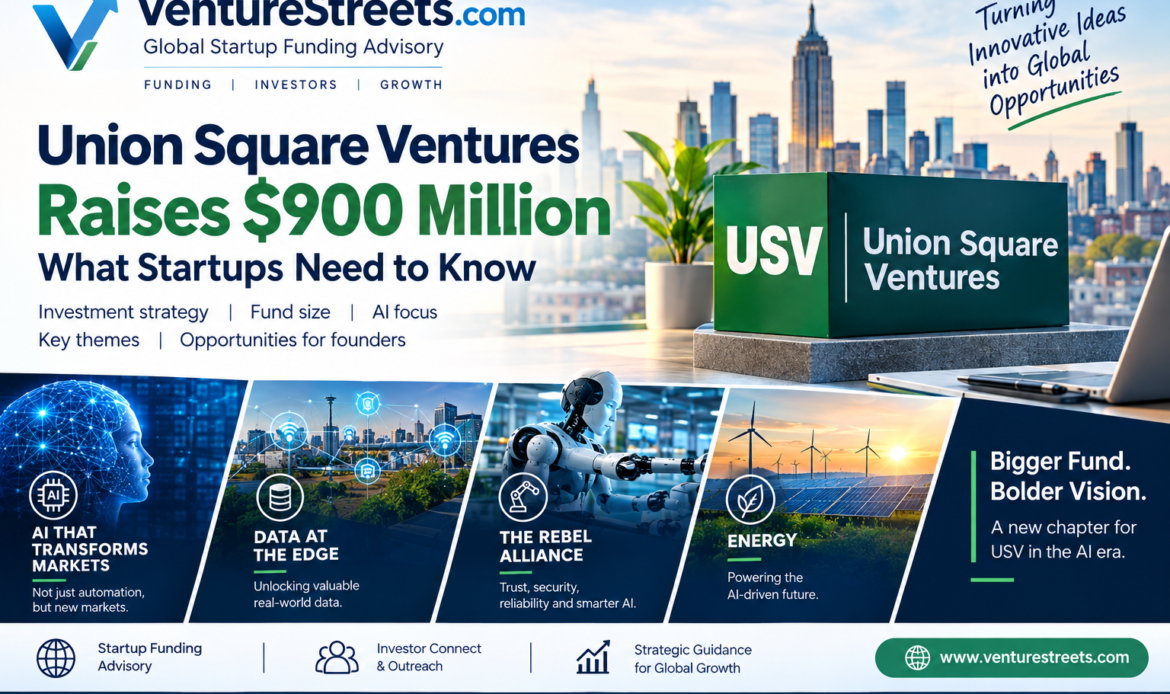
An important development illustrating this shift is the announcement by New York-based venture capital firm Union Square Ventures (USV) that it has raised $900 million in new funds, while restructuring its investment partnership around a smaller core group.
Announced on October 8, 2026, the fundraising comprises a $500 million early-stage fund and a $400 million opportunity fund intended for later-stage investments and additional investments in existing portfolio companies. The new early-stage fund represents a substantial increase from the $275 million raised for comparable early-stage funds in 2024. Bloomberg Law News
For startup founders, this development offers important lessons about where sophisticated venture capital investors believe the next generation of valuable businesses will emerge.
USV is not simply increasing the amount of money it has available. Its investment strategy reflects a broader conviction: the greatest opportunities in artificial intelligence will come from companies that fundamentally transform markets rather than merely make existing processes faster.
This distinction is particularly important for entrepreneurs developing AI applications, enterprise software, robotics, financial technology, healthcare solutions, energy technologies and businesses that combine digital intelligence with physical operations.
For founders seeking investment, understanding USV’s philosophy can help with three important decisions:
- Whether their startup fits the investment thesis of a global venture capital firm.
- How to position their business to attract institutional investors.
- What investors increasingly expect beyond a promising product or an impressive demonstration of artificial intelligence.
This article examines USV’s new funds, investment philosophy, historical track record, relevant investment categories and practical lessons for startups seeking funding in India and internationally.
Editorial note: The fund information and investment thesis discussed below are based on USV’s announcement dated October 8, 2026, and its published investment materials. The practical recommendations for founders are analytical interpretations, not additional funding commitments made by USV.
1. Union Square Ventures: Understanding the Investment Firm
Union Square Ventures is a New York-based venture capital firm that has invested in technology businesses for more than two decades.
Founded by Fred Wilson and Brad Burnham, the firm began investing in 2004. Its approach has historically centred on identifying emerging technologies and societal changes that could reshape large markets.
Rather than investing indiscriminately across every fashionable technology category, USV has developed a reputation for a thesis-driven approach.
This means that the firm develops a clear view of how markets are likely to evolve and looks for entrepreneurs whose businesses are positioned to benefit from those changes.
Historically, its areas of interest have included:
- Internet-based businesses and digital platforms.
- Online marketplaces and network-driven businesses.
- Financial technology and digital currencies.
- Enterprise software and developer tools.
- Education and healthcare technology.
- Climate technology and energy.
- Consumer technology.
- Decentralised systems and emerging digital infrastructure.
According to the firm’s published account of its first 20 years, USV had raised and invested through 14 funds and made more than 230 investments across a range of technology categories. Its historical portfolio includes companies associated with social media, marketplaces, enterprise software, financial technology and digital infrastructure. Union Square Ventures
For entrepreneurs, the key lesson is that USV’s investment interests have evolved as technology and markets have changed.
The firm is now applying that same approach to artificial intelligence.
Why founders should understand USV’s history
A startup seeking venture capital should study more than a fund’s size.
It should understand:
- What kinds of companies the investor has backed.
- Which market transformations the investor recognised early.
- Whether the investor prefers software, physical products or a combination.
- How early the investor generally participates.
- Whether the investor can contribute expertise, relationships and follow-on capital.
- How closely the startup aligns with the investor’s current strategy.
A firm’s past investments provide useful context, but they do not guarantee that it will invest in a similar company today.
The relevant question is not simply whether an investor has funded technology businesses before. It is whether the proposed business fits the investor’s present priorities.
2. The $900 Million Fundraising: What Has USV Announced?
USV’s October 2026 announcement establishes a larger pool of capital for its next investment cycle.
The fundraising is divided into two distinct funds.
| Particulars | New fund | Primary purpose |
|---|---|---|
| Early-stage fund | $500 million | Investing in early-stage startups |
| Opportunity fund | $400 million | Later-stage investments and follow-on funding for existing portfolio companies |
| Total new capital raised | $900 million | Supporting the firm’s next investment cycle |
Source: USV’s October 8, 2026 announcement. Union Square Ventures
These figures represent capital raised by the investment firm, not money that will necessarily be invested in a single company or immediately made available to new applicants.
The distinction between the two funds matters considerably to startup founders.
A. The $500 million early-stage fund
This fund is intended to support USV’s early-stage investment strategy.
For entrepreneurs, early-stage venture capital can be particularly valuable because it allows a company to develop its product, establish market traction, recruit talent and prepare for expansion before it generates enough cash flow to finance growth independently.
However, the phrase early stage covers several different situations.
A venture capital firm might invest in a company that has:
- A founding team and a clearly articulated market opportunity.
- A working prototype but limited commercial revenue.
- An initial product with early customers.
- Demonstrated product-market fit and recurring revenue.
- A business ready to expand through a Series A round.
USV has historically invested at early stages, sometimes very early in a company’s development. Its latest strategy also places greater emphasis on founder-led product development and new approaches to seed investing. Union Square Ventures
What this means for founders: A company should not assume that it must already be large to interest USV. However, founders need to demonstrate why their business could become important in a large market and why their approach is meaningfully different from existing alternatives.
A promising idea alone is not the same as an investable opportunity.
B. The $400 million opportunity fund
The second fund is designed for later-stage investments and follow-on investments in companies already in USV’s portfolio. Bloomberg Law News
Follow-on investments enable venture capital firms to provide additional capital to existing portfolio companies as their businesses develop.
This matters because successful startups frequently need several rounds of funding.
An initial investment may finance product development and early customer acquisition. Subsequent rounds might support international expansion, research and development, acquisitions, infrastructure or entry into new markets.
An opportunity fund can allow an investor to maintain or increase its exposure to companies it believes have strong prospects.
Important distinction for founders: The $400 million opportunity fund should not be interpreted as a pool exclusively available to new startups seeking their first institutional investor. A substantial part of its stated purpose is to support existing portfolio companies.
New companies should therefore establish which USV investment vehicle and stage are relevant to their circumstances rather than treating the entire $900 million as available for fresh investments.
3. Why Is USV Increasing Its Fund Size in the AI Era?
The increase in fund size reflects an important change in the economics of technology businesses.
Artificial intelligence has reduced some of the costs and time involved in building software products.
A small team can now use AI-assisted development tools to create prototypes, automate workflows and develop products that previously required substantially larger engineering teams.
In some cases, a founder can move from an idea to a functional product in a matter of days.
But there is a second side to this development.
When building products becomes easier, competition increases—and the cost of building a durable, defensible business may rise.
Thousands of companies can now develop products with similar features. The challenge is distinguishing a useful demonstration from a business that customers will continue paying for.
USV’s October announcement highlights several consequences of this changing environment.
3.1 More companies can be built with smaller teams
AI tools allow founders to accomplish more before hiring large teams.
This can improve capital efficiency and reduce the amount of money required to reach an initial commercial milestone.
For example, an entrepreneur developing an AI-powered compliance platform might use AI-assisted coding to build a working product, test it with a small number of customers and refine the product before expanding the engineering team.
This approach can make a startup more attractive to investors because it reduces the risk of committing substantial capital before validating the business.
However, capital efficiency varies significantly by industry.
A software startup may be able to validate its product relatively cheaply. A robotics, semiconductor, manufacturing or energy startup may require specialised equipment, testing facilities, certification and substantial working capital.
3.2 The strongest startups may require larger investments
Although AI reduces certain development costs, it does not eliminate the cost of establishing a market-leading company.
High-growth businesses may need significant capital for:
- Computing infrastructure and AI inference.
- Access to specialised datasets.
- Research and development.
- Technical and commercial talent.
- Enterprise sales and distribution.
- Cybersecurity and regulatory compliance.
- International expansion.
- Physical infrastructure and manufacturing.
USV has stated that its larger funds will allow it to support companies for longer and invest in categories such as robotics, manufacturing and energy that may require more capital to succeed. Union Square Ventures
This is an important signal for founders.
Investors are increasingly interested in understanding the relationship between capital raised and the competitive advantage it will create.
A founder should be able to explain not merely how much funding is required, but also what that funding will enable the business to accomplish.
3.3 The firm wants to maintain investment discipline
Despite raising more money, USV has indicated that it intends to make roughly the same number of investments as in previous funds. Union Square Ventures
This suggests that the firm is not necessarily planning to invest in a much larger number of startups.
Instead, it wants to support selected companies with greater financial capacity.
For entrepreneurs, this has an important implication: a larger venture capital fund does not automatically mean a higher probability of receiving funding.
If an investor maintains a selective approach, the quality of the opportunity and its fit with the investment thesis remain critical.
4. USV’s Four Investment Themes: What Startups Should Understand
One of the most useful aspects of USV’s announcement is its explanation of the market transformations the firm wants to invest in.
The firm has articulated four major themes:
- AI that transforms markets rather than merely automating existing activities.
- Data at the Edge.
- The Rebel Alliance.
- Energy as a critical enabler of AI-driven economic growth.
These themes provide a practical framework for founders evaluating whether their companies might fit USV’s strategy.
Theme 1: AI That Transforms Markets, Rather Than Merely Automating Them
USV describes its first theme through the idea that AI should obliterate markets, not automate them.
The underlying argument is that the most valuable AI businesses may not be those that simply improve the efficiency of existing products.
Instead, they may be companies that change how an entire service is delivered, how customers access it or how a market is organised.
What is the difference?
Consider two hypothetical startups in the legal services market.
Startup A: AI-assisted legal document preparation
This company develops software that helps lawyers prepare documents more quickly.
It might reduce the time spent drafting contracts, reviewing documents and conducting preliminary research.
This can be a useful business. However, its value proposition primarily involves improving the efficiency of an existing service.
Startup B: An AI-native legal services platform
This company develops a platform that combines AI, verified legal workflows, document automation, compliance monitoring and specialist human review where necessary.
Rather than simply selling drafting software to lawyers, it seeks to change how businesses access routine legal services.
Its customers might include small businesses that previously could not afford comprehensive legal support.
The second company potentially addresses a broader market transformation.
That does not automatically make Startup B the better investment. Its regulatory exposure, reliability, customer acquisition costs and ability to deliver commercially acceptable outcomes would still require careful evaluation.
The distinction is that the second startup is attempting to redesign the service rather than simply accelerate one part of it.
Other examples
| Sector | Conventional automation | Potentially transformative AI model |
|---|---|---|
| Healthcare | Software that assists with appointment scheduling | A platform that redesigns access to selected healthcare services through AI and clinical oversight |
| Accounting | AI-assisted bookkeeping | An integrated financial operations platform that continuously manages routine accounting workflows |
| Education | AI-generated practice questions | A personalised learning system that adapts teaching methods and support to individual students |
| Financial services | Automated data entry | An AI-native platform that changes how eligible customers access financial analysis or selected services |
| Manufacturing | AI-based defect detection | An integrated production system that redesigns manufacturing workflows around AI and robotics |
| Enterprise software | AI assistants added to existing software | A new product that replaces multiple disconnected workflows with a unified, AI-native service |
These are illustrative examples, not confirmed USV investments or endorsements.
What founders should demonstrate
If your startup uses AI, explain:
- Which customer problem is being addressed.
- How customers solve that problem today.
- Why existing solutions are inadequate.
- How AI changes the economics or delivery of the service.
- Whether the business creates a new market or significantly expands access to an existing one.
- What prevents competitors from reproducing the product.
- How the company will generate revenue and retain customers.
A pitch that says, “We use AI to make businesses more efficient,” is usually less informative than one that explains exactly how the technology changes customer behaviour, operating costs or market structure.
Practical lesson: Do not make AI the entire investment proposition. Explain why your product creates a commercially meaningful advantage that would be difficult or uneconomic to deliver without your approach.
Theme 2: Data at the Edge—Unlocking Information That Was Previously Inaccessible
USV’s second theme is called Data at the Edge.
The firm is interested in businesses that make valuable data accessible when that data has historically been difficult to collect, interpret or use.
The opportunity extends beyond conventional software.
It includes physical intelligence, robotics, manufacturing systems and sensor networks that connect the digital world with real-world activity. Union Square Ventures
Why does this matter?
Many industries generate enormous amounts of information that remain fragmented, inaccessible or difficult to process.
Consider a manufacturing plant.
Machines may generate data about temperature, vibration, energy consumption, production speed and component wear.
However, this information may be spread across different systems or recorded in formats that are difficult to analyse collectively.
A startup that combines sensor data, machine histories and AI-based analysis could potentially help manufacturers predict equipment failures and improve production planning.
The business opportunity is not simply the development of an AI dashboard.
It may involve building the data infrastructure required to understand how an entire physical operation behaves.
Startup opportunities in this category
Potential applications include:
Industrial intelligence
AI systems that combine equipment data, production information and maintenance records to improve industrial performance.
Agricultural intelligence
Platforms that use field sensors, satellite imagery and other data sources to improve irrigation, crop monitoring and resource utilisation.
Supply chain visibility
Solutions that combine information from warehouses, transport networks, suppliers and production facilities to improve planning and reduce disruptions.
Robotics and physical automation
Systems that enable machines to perceive their surroundings, learn from operational data and perform tasks in complex environments.
Energy management
Platforms that combine equipment data, energy consumption and grid information to improve efficiency and coordinate energy resources.
An opportunity for Indian startups
India has substantial industrial, agricultural, logistics and infrastructure markets.
Entrepreneurs developing solutions for these sectors may be able to create valuable datasets through real-world deployments.
For example, a startup that develops AI-based quality control for manufacturing could initially serve Indian factories and subsequently expand to other manufacturing markets.
Similarly, a logistics technology company might develop proprietary operational intelligence by integrating data from vehicles, warehouses and supply chains.
However, collecting data alone does not guarantee a competitive advantage.
Founders must demonstrate that they have lawful access to relevant data, that the information improves the product and that competitors cannot easily reproduce the resulting capabilities.
Practical lesson: If your startup relies on data, explain what makes the data valuable, how you obtain it, how it improves over time and why the resulting product becomes more useful as adoption increases.
Theme 3: The Rebel Alliance—Intelligence, Trust, Security and Incentive Alignment
USV’s third theme is called The Rebel Alliance.
The firm anticipates that consumers and enterprises will seek increasingly powerful AI systems while demanding stronger alignment around trust, security, memory and cost. Union Square Ventures
This is particularly relevant as AI moves from experimental applications into systems that influence important business decisions.
The next phase of AI is not just about intelligence
An AI product may perform impressively in a demonstration but still fail to become a sustainable business.
Customers may worry about:
- Whether its outputs are accurate.
- Whether confidential information is protected.
- Whether the system can explain or document important decisions.
- Whether it behaves consistently across different situations.
- Whether the product creates unacceptable legal or operational risks.
- Whether its pricing is sustainable as usage increases.
These concerns become particularly important when AI is used in finance, healthcare, legal services, enterprise operations and other sensitive applications.
Where startups can find opportunities
AI security and governance
Products that help businesses monitor AI usage, control access to information, test system behaviour and maintain appropriate oversight.
Privacy-preserving AI
Solutions designed to enable useful analysis while protecting confidential or sensitive information.
Enterprise AI reliability
Tools that evaluate model performance, identify errors, monitor outputs and support human review.
AI agents for business operations
Systems that can complete defined tasks across multiple applications while operating within appropriate permissions and controls.
AI cost optimisation
Platforms that help businesses monitor computing expenditure, choose appropriate models and reduce unnecessary processing costs.
Identity and authorisation
Infrastructure that helps determine which users or software agents may access systems, data and business processes.
These categories can offer opportunities to build valuable businesses, but competition is substantial in many of them.
Founders should identify a specific customer segment and demonstrate why their solution is materially better than the alternatives.
What investors will want to know
A startup in this category should be prepared to answer questions such as:
- What specific risk or operational problem does the product solve?
- Who is responsible for purchasing it?
- How does the product integrate with existing systems?
- How is its effectiveness measured?
- What happens when the AI makes an error?
- How does the company protect customer data?
- What evidence shows that customers are willing to pay for the solution?
For enterprise AI companies, credibility can be as important as technical sophistication.
Theme 4: Energy—The Infrastructure Behind AI Growth
USV’s fourth theme concerns energy.
The firm argues that the expansion of AI and the associated technological transformation will require substantially more energy.
USV began investing through a dedicated energy-focused fund in 2021 and has stated that its energy thesis will now be incorporated into its core investment strategy. Union Square Ventures
This is significant because AI growth depends on more than algorithms and software.
It also depends on data centres, computing equipment, electricity supply, cooling systems, grid infrastructure and other physical resources.
Potential investment opportunities
Energy management software
AI-driven systems that help businesses optimise electricity consumption.
Grid technology
Solutions that improve electricity distribution, monitoring, reliability and the integration of new energy sources.
Energy storage
Technologies that address the challenges of storing electricity and making it available when required.
Industrial energy efficiency
Systems that reduce energy consumption in manufacturing, commercial buildings and other energy-intensive operations.
Data centre infrastructure
Technologies that improve power utilisation, cooling efficiency and the economics of computing infrastructure.
New energy technologies
Businesses developing scalable technologies for electricity generation, storage or other critical energy applications.
What this means for Indian founders
India’s energy demand, industrial expansion and digital infrastructure requirements create potential opportunities for technology companies.
Startups working on grid intelligence, energy storage, industrial efficiency and advanced materials may find relevant opportunities among global investors.
Nevertheless, founders must distinguish between an attractive sector and an investable company.
Energy businesses may face long development cycles, significant capital requirements, regulatory approvals and complex customer procurement processes.
A convincing fundraising proposal should therefore explain the technology, commercial application, development milestones, capital requirements and expected route to market.
Practical lesson: If you are building an energy technology startup, show how your solution improves measurable outcomes such as cost, efficiency, reliability, capacity or emissions—not merely how it contributes to a broad sustainability objective.
5. What Is USV’s Investment Geography?
USV describes itself as an early-stage investor that supports entrepreneurs in many parts of the world.
Its official website identifies its approach as investing in companies at the edge of large markets undergoing technological transformation. It also lists areas including AI, robotics, energy, consumer businesses, money and biotechnology. Union Square Ventures
This establishes that the firm’s stated investment approach is not limited to a single narrow technology category or one local industry.
However, a global investment outlook should not be interpreted as a guarantee that every country, company or transaction structure is eligible for investment.
USV’s public materials do not establish a blanket commitment to invest in every geography.
What Indian startups should understand
An Indian startup should not assume that a US-based venture capital firm will invest simply because its product uses AI or addresses a large market.
The company needs to establish a convincing fit with the investor’s thesis and commercial requirements.
Founders should consider the following questions.
1. Where is the company incorporated?
Investors may have preferences concerning corporate structure, ownership arrangements and the jurisdiction in which the investment will be made.
2. Where are the customers?
A startup may operate from India while serving customers in the United States, Europe, Southeast Asia or other markets.
The geographic distribution of customers can influence the investor’s assessment of market size and expansion potential.
3. Can the company scale internationally?
A product developed in India may have significant global potential if it addresses a common problem and can be adapted to different markets.
4. Does the business require a local operating presence?
Some businesses can expand internationally through software distribution. Others require local teams, regulatory approvals, infrastructure or customer relationships.
5. Is the corporate structure suitable for the proposed investment?
Cross-border investments can involve company law, taxation, foreign investment rules, intellectual property ownership and other legal considerations.
Founders should obtain appropriate professional advice before restructuring a company or moving intellectual property between jurisdictions.
Should Indian startups approach USV?
Indian founders working in AI, enterprise technology, robotics, energy or other areas aligned with USV’s published thesis may consider the firm as a potential investor.
The appropriate next step is to study its current portfolio, published investment thinking and recent transactions.
A company should approach USV only when it can articulate a credible connection between its business and the firm’s investment priorities.
It is equally important to verify the firm’s current stage, geographic preferences and appetite for new investments before dedicating substantial time to outreach.
6. USV’s Investment Criteria: How Should Startups Assess Their Fit?
USV’s published investment philosophy provides a useful starting point, but it is important to distinguish its stated strategic priorities from formal investment criteria.
The firm’s public announcement does not provide a comprehensive checklist covering minimum revenue, mandatory profitability, fixed investment amounts or universal eligibility conditions.
Consequently, founders should not assume that the following analytical framework represents official USV requirements.
Instead, it can be used to assess whether a startup is likely to present a compelling venture capital opportunity.
A. A large and expanding market
Venture capital firms typically seek companies capable of generating substantial growth.
A startup may have a useful product and a profitable business without necessarily having the scale potential required by a venture capital investor.
For example, a software company serving a narrow group of local customers might be an excellent small business.
However, if the addressable market is limited and the business cannot expand into adjacent markets, it may not fit a venture capital strategy focused on very large outcomes.
Founders should demonstrate:
- The size of the addressable market.
- The problem’s importance to customers.
- The market’s expected direction of growth.
- The potential to expand into adjacent customer segments.
- The competitive advantages that could support long-term growth.
Market-size estimates should be based on credible data and realistic assumptions rather than simply quoting a large global industry figure.
B. A genuinely differentiated product
A startup should explain why customers would choose its product over existing alternatives.
This is especially important in AI, where competitors can sometimes reproduce visible features quickly.
Differentiation may come from:
- Proprietary technology.
- Unique or difficult-to-access data.
- Superior product performance.
- Deep integration into customer workflows.
- Strong distribution capabilities.
- Regulatory or technical expertise.
- A business model that changes the economics of delivering a service.
- Network effects or other advantages that strengthen with scale.
A startup does not need every advantage on this list.
However, it should identify the one or two advantages most likely to sustain its business over time.
C. Evidence of customer demand
Investors generally need evidence that customers value the product.
Depending on the startup’s stage, relevant evidence may include:
- Paid pilot projects.
- Paying customers.
- Repeat purchases.
- Subscription renewals.
- Growth in active users.
- Customer retention.
- Expansion revenue.
- Letters of intent from credible customers.
- Documented results from commercial deployments.
These indicators are not interchangeable.
For example, a signed letter of intent is not equivalent to recurring revenue, and a free pilot does not establish willingness to pay.
Founders should report commercial progress accurately and distinguish contracted revenue, recognised revenue, bookings, pipeline and non-binding expressions of interest.
D. Strong founders and a capable team
A large market and promising technology do not automatically produce a successful business.
Investors also evaluate whether the founding team can build the product, recruit talent, attract customers and respond to changing market conditions.
A strong founding team typically demonstrates:
- Deep understanding of the problem.
- Relevant technical or industry expertise.
- Ability to execute quickly.
- Clear decision-making responsibilities.
- Willingness to learn from customer feedback.
- Realistic understanding of competition.
- Ability to recruit and retain capable employees.
For AI startups, investors may also examine the team’s understanding of model limitations, data requirements, computing costs and the practical challenges of deploying AI in real-world environments.
E. A credible business model
A startup should explain how it intends to generate revenue and eventually create an economically sustainable business.
This is important even when the immediate objective is rapid customer acquisition.
Founders should understand:
- How customers are charged.
- What drives revenue growth.
- Gross margins and major operating costs.
- Customer acquisition costs.
- Customer lifetime value, where meaningful.
- Sales cycles.
- Retention and renewal rates.
- Computing and infrastructure costs.
- The amount of capital required to reach the next milestone.
AI startups need to pay particular attention to the relationship between usage and cost.
A company may acquire customers rapidly but lose money on every interaction if computing expenditure increases faster than revenue.
The economics should improve as the business scales, or there should be a credible explanation for why the current cost structure will change.
7. How Much Could USV Invest in an Individual Startup?
This is an important question for founders planning a fundraising round.
The $500 million early-stage fund and $400 million opportunity fund represent total fund commitments, not individual investment limits.
The public announcement does not establish a universal minimum or maximum cheque size for every prospective startup.
The amount available to a company may depend on its stage, the firm’s assessment of the opportunity, the investment structure and whether the investment is made through the early-stage fund or another vehicle.
Founders should therefore avoid assuming that USV will invest a particular amount solely because the firm has raised $900 million.
How to determine an appropriate fundraising target
Instead of beginning with the question, “How much money can we raise?”, founders should begin with:
“What milestones must we achieve before the next funding round?”
Suppose a startup has developed an AI-powered industrial inspection product.
It might need funding to:
- Complete product development.
- Deploy the solution at five customer sites.
- Demonstrate measurable improvements in inspection costs or defect detection.
- Convert pilot customers into recurring contracts.
- Establish a repeatable sales process.
- Expand into a second market.
The fundraising requirement should be based on the cost and timing of these activities, together with an appropriate contingency.
This gives investors a clearer understanding of how the capital will be used.
A practical fundraising calculation
A founder can estimate the required capital using the following framework:
Required funding = Planned operating expenditure + Product development expenditure + Capital expenditure + Working capital + Contingency − Available cash and committed non-equity funding.
This is a planning framework rather than an accounting formula.
The calculation should cover the period needed to reach the next meaningful milestone, not just the next few months.
Founders should also assess how much dilution they are prepared to accept and whether the proposed round leaves enough ownership and flexibility for future fundraising.
8. USV’s Track Record: Lessons From Its Historical Investments
USV’s history is relevant because the firm has previously backed companies operating in markets that later became significant parts of the technology economy.
Its published investment history includes companies such as Twitter, Twilio, Etsy, MongoDB and Coinbase, which it cites as examples of businesses backed in the early stages of the modern internet and mobile ecosystems. Union Square Ventures
These companies operate in different markets, but they illustrate several recurring characteristics of venture-scale businesses.
Lesson 1: The market can change faster than established companies expect
Internet platforms, digital marketplaces and developer-focused infrastructure have altered how people communicate, transact and build software.
Startups that anticipate such shifts may have opportunities to establish new categories before established competitors fully respond.
The implication for founders is that a product should be positioned around a meaningful market change, not just an incremental feature improvement.
Lesson 2: Infrastructure and applications can both create value
Some successful technology businesses provide services directly to consumers or enterprises.
Others supply infrastructure that allows other businesses to operate.
For example, a startup may build an application used by thousands of customers, while another develops tools that help other software companies build, deploy or operate their products.
Both models can be valuable, but their customer acquisition strategies, economics and capital requirements may differ significantly.
Founders should understand which type of business they are building and why it has the potential to achieve substantial scale.
Lesson 3: Timing matters
A technically impressive product may fail if customers are not ready to adopt it or if the supporting infrastructure is not sufficiently developed.
Conversely, a change in technology, regulation, consumer behaviour or cost structure may create an opening for a new business model.
AI is an example of a technological shift that is creating new opportunities while simultaneously increasing competition.
Lesson 4: A good business must evolve
The requirements for building a successful internet company in 2004 differ from those for building an AI-native company in 2026.
USV’s strategy reflects its view that investors must adapt their approach as the economics of building and scaling companies change.
Founders should therefore avoid copying historical startup playbooks without considering the current competitive environment.
A note on performance: Historical portfolio examples demonstrate investment experience, not the performance of the new fund. They do not establish the new fund’s expected returns, nor do they mean that every historical investment was successful.
9. What Does USV’s Smaller Investment Partnership Mean?
Alongside the fundraising announcement, USV has outlined a smaller core investment partnership.
The firm identifies Fred Wilson, Rebecca Kaden, Nick Grossman and Michael Mignano as the four general partners in its core investment leadership. Other experienced investors and operating professionals will continue supporting the firm and its portfolio companies in different capacities. Union Square Ventures
The change is noteworthy because it illustrates how a venture capital firm is adapting its organisation to the AI era.
Why might a smaller core partnership be useful?
Faster product-focused discussions
A closely coordinated investment team may be able to evaluate emerging opportunities and make decisions efficiently.
Greater emphasis on product development
USV’s announcement highlights the value of product-oriented experience and a builder’s mindset.
More focused investment decisions
A smaller core partnership may help the firm maintain a consistent investment philosophy even as its funds grow.
Closer engagement with founders
The firm intends to maintain a selective approach rather than simply increasing the number of investments in proportion to the increase in fund size.
However, a smaller partnership does not automatically guarantee faster decisions or better outcomes. Execution depends on how the organisation operates in practice.
What founders should take away
When approaching a venture capital firm, founders should understand who evaluates investments and what expertise the firm can contribute.
The relevant question is not simply how many investment professionals work at a fund.
It is whether the people responsible for the decision understand the market, can assess the technology and are likely to become useful long-term partners.
10. How Startups Should Prepare Before Approaching USV
Founders who believe their companies fit USV’s thesis should prepare a focused investment proposal.
A generic presentation containing market-size estimates, product screenshots and ambitious revenue forecasts is unlikely to communicate the full strength of a sophisticated business.
The goal should be to demonstrate why the opportunity is attractive, why the company is well positioned to capture it and what additional capital will accomplish.
Step 1: Identify the precise connection with USV’s thesis
Explain whether the startup fits one or more of the following areas:
- AI-native businesses transforming existing markets.
- Data-driven products unlocking previously inaccessible information.
- AI infrastructure focused on trust, security, reliability or cost.
- Robotics and physical intelligence.
- Manufacturing technology.
- Energy technology and enabling infrastructure.
Do not force the company into a category simply because the category is fashionable.
The connection should be clear from the product, customer problem and business model.
Step 2: Build a concise investment presentation
A practical pitch deck should cover the following areas.
| Slide | Information to include |
|---|---|
| 1. Company introduction | Company name, one-line description and contact details |
| 2. Problem | The specific problem customers face |
| 3. Solution | How the product solves the problem |
| 4. Product and technology | Product demonstration, architecture and key capabilities |
| 5. Market opportunity | Addressable market and expansion potential |
| 6. Business model | Pricing, revenue sources and unit economics |
| 7. Traction | Customers, revenue, retention, pilots and other relevant evidence |
| 8. Competition | Existing alternatives and differentiation |
| 9. Competitive advantage | Technology, data, distribution or other defensible strengths |
| 10. Go-to-market strategy | Customer acquisition and sales process |
| 11. Founding team | Relevant experience and execution capabilities |
| 12. Financial projections | Historical performance and forward-looking estimates |
| 13. Fundraising requirement | Amount sought, proposed use of funds and runway |
| 14. Milestones | Measurable objectives to be achieved with the funding |
The presentation should be concise enough for an investor to understand the opportunity quickly, while supporting documents can provide additional detail.
Step 3: Demonstrate real traction
Where applicable, include:
- Monthly and annual revenue.
- Revenue growth over time.
- Number of paying customers.
- Repeat usage or renewal rates.
- Customer acquisition costs.
- Gross margins.
- Sales pipeline, clearly distinguished from contracted revenue.
- Evidence of measurable customer benefits.
For pre-revenue startups, traction may instead consist of technical milestones, pilot deployments, customer validation, product performance or other evidence appropriate to the company’s stage.
The key is to provide verifiable evidence rather than unsupported claims.
Step 4: Explain why now is the right time
This question is particularly important for AI startups.
Founders should explain what has changed to make the opportunity commercially viable now.
Possible factors include:
- Improvements in model capability.
- Lower computing costs for a particular application.
- Availability of previously inaccessible data.
- Changes in customer behaviour.
- New regulatory requirements.
- Improvements in sensors or robotics.
- Changes in energy economics.
- A shift in the willingness of businesses to adopt AI.
The explanation should identify a real change in market conditions rather than simply asserting that AI is growing rapidly.
Step 5: Be ready for due diligence
Investors may examine the company’s financial, commercial, technical and legal position.
Depending on the business, this may involve reviewing:
- Corporate records and ownership.
- Historical financial statements.
- Revenue contracts and customer concentration.
- Intellectual property ownership.
- Technology architecture.
- Data licensing and privacy practices.
- Employment and founder agreements.
- Material liabilities.
- Existing investors and securities.
- Financial projections and assumptions.
Startups should ensure that their pitch deck, financial statements and supporting records are consistent.
For an AI company, intellectual property rights, data provenance, security and dependence on third-party models or infrastructure can be particularly important.
Step 6: Make the introduction relevant
Where possible, founders should seek an introduction through an investor, founder or professional contact who understands the company.
However, a warm introduction does not replace investment fit.
The message should explain, in a few sentences:
- What the company does.
- Why the market opportunity is important.
- What evidence supports the business.
- Why the company fits the investor’s published thesis.
- How much funding it seeks and what the capital will accomplish.
Founders can review USV’s own materials through its official website: Union Square Ventures.
11. Common Fundraising Mistakes Startups Should Avoid
The USV announcement provides an opportunity to reconsider several common mistakes made by founders seeking venture capital.
Mistake 1: Assuming that every AI startup is attractive to investors
AI is a broad technology category, not a complete investment thesis.
A startup needs to identify a commercially important problem and explain why its approach offers a sustainable advantage.
Mistake 2: Confusing a working prototype with a business
A prototype can demonstrate technical feasibility.
It does not necessarily establish that customers will pay for the product, that the company can acquire customers economically or that the business can scale.
Founders should distinguish technical progress from commercial validation.
Mistake 3: Overstating the market opportunity
Investors are unlikely to be impressed by a market estimate that includes every customer who might conceivably use the product.
A more credible approach is to identify the initial customer segment, estimate its size and explain how the business can expand.
Mistake 4: Ignoring competition
Saying that a startup has no competitors is rarely persuasive.
Customers already have alternatives, even if those alternatives involve manual work, spreadsheets, consultants or legacy software.
Founders should explain what customers currently do and why the proposed solution is better.
Mistake 5: Raising too much or too little
An excessively large round can lead to unnecessary dilution or pressure to spend before the business is ready.
An insufficient round can leave a company unable to reach the milestones required for its next financing.
The fundraising target should reflect a credible operating plan.
Mistake 6: Failing to understand AI economics
For AI businesses, revenue growth alone may not indicate financial strength.
Investors may examine model costs, inference expenditure, gross margins, pricing and the economics of serving additional customers.
Founders should understand how these variables affect profitability as usage scales.
Mistake 7: Approaching investors without researching their current strategy
A firm that invested in a particular sector several years ago may have changed its priorities.
Before making contact, founders should review current investment announcements, portfolio companies and the firm’s published thesis.
The objective is to identify investors whose present strategy aligns with the company’s needs.
12. What Can Indian Startups Learn From USV’s Strategy?
USV’s announcement has implications beyond the United States.
Indian startups increasingly have access to AI tools, technical talent and opportunities to serve international customers.
However, founders need to decide whether their competitive advantage will come from developing a technology, serving a particular market, acquiring customers more efficiently or combining several of these elements.
Three opportunities deserve particular attention.
Opportunity A: AI applications designed for large, underserved markets
India has substantial markets in healthcare, education, financial services, logistics, agriculture and manufacturing.
Startups may find opportunities to use AI to improve access, reduce costs or deliver services in ways that existing providers cannot easily replicate.
However, a large population does not automatically create a large profitable market.
Founders must demonstrate customer willingness to pay, workable distribution and sustainable economics.
Opportunity B: AI combined with physical industries
Manufacturing, logistics, energy and agriculture may offer opportunities for companies combining software with physical operations.
For example, an industrial startup could use AI to optimise production processes, improve maintenance or reduce waste.
Such companies may be able to build competitive advantages through operational experience, customer relationships and proprietary data.
Their capital requirements may be higher than those of conventional software companies, so fundraising plans must reflect the realities of deployment.
Opportunity C: Indian engineering serving global customers
A startup can be headquartered in India and still build products for global markets.
India-based teams may be able to develop specialised technology and deliver it to customers in several countries.
Nevertheless, international expansion requires more than a globally accessible website.
Founders may need to address sales, customer support, local regulations, data protection, contractual requirements and market-specific product adaptation.
The ability to demonstrate international customer demand can strengthen a fundraising proposal.
An important qualification
USV’s published strategy creates a basis for identifying possible areas of alignment. It does not establish that Indian startups in these sectors will automatically qualify for investment.
Founders should verify the firm’s current geographic preferences and transaction requirements before treating it as a concrete fundraising prospect.
13. How Intellex Strategic Consulting Can Help Startups Prepare for Fundraising
For many entrepreneurs, the most difficult part of fundraising is not identifying a large number of investors.
It is determining which investors are genuinely relevant, presenting the opportunity professionally and managing the process from initial outreach to investment discussions.
A startup may have an excellent product but still struggle to communicate its commercial potential.
Another company may have strong revenue growth but approach investors whose mandates do not match its stage, geography or industry.
Both situations can result in wasted time and missed opportunities.
Intellex Strategic Consulting Pvt Ltd provides advisory support to startups and businesses seeking to improve their fundraising readiness and connect with relevant funding opportunities in India and internationally.
Its services can support founders through several stages of the fundraising process.
1. Fundraising readiness assessment
Before approaching investors, a startup should understand its strengths, weaknesses and funding requirements.
An assessment can help identify gaps in the pitch deck, financial projections, commercial evidence and supporting documentation.
The objective is to help the founder present a credible investment proposition.
2. Pitch deck and business plan preparation
A fundraising presentation should explain the business clearly, demonstrate the market opportunity and establish why the company is positioned to succeed.
Intellex can assist startups in presenting their business models, market opportunities, financial projections and proposed use of funds in a structured format.
3. Investor identification and targeting
Investor selection should take account of factors such as:
- Industry and sector focus.
- Investment stage.
- Typical investment size.
- Geographic preferences.
- Business model.
- Relevant portfolio experience.
- Potential conflicts or competitive overlaps.
A targeted approach can help founders prioritise investors whose investment mandates align with the opportunity.
4. Investor outreach support
A well-prepared investor introduction should communicate the opportunity succinctly and professionally.
Support may include preparing introductory communications, organising fundraising materials and helping founders manage investor discussions.
5. Financial and commercial preparation
Investors may require detailed information about revenue, costs, customer concentration, margins, cash flow and future capital requirements.
Preparing this information in advance can make discussions more productive and reduce avoidable delays during due diligence.
6. India and international fundraising
Different investors have different requirements concerning geography, stage, sector and investment structure.
Intellex can assist startups in evaluating potential fundraising avenues in India and overseas, subject to the suitability of the business and the relevant investor’s mandate.
Who may benefit?
The services may be relevant to:
- Technology startups seeking seed or Series A funding.
- AI and deep-tech companies.
- Enterprise software businesses.
- Manufacturing and industrial technology ventures.
- Energy and sustainability startups.
- Businesses preparing for institutional fundraising.
- Established companies seeking growth capital.
Fundraising outcomes depend on the quality of the business, investor appetite, commercial evidence, valuation, market conditions and other factors. Advisory support cannot guarantee that a company will receive funding.
Contact Intellex Strategic Consulting Pvt Ltd
Startups interested in professional fundraising assistance can contact:
Intellex Strategic Consulting Pvt Ltd
- Website: Intellex Consulting
- Startup funding and investor discovery: VentureStreets.com
- Startup ecosystem and business resources: StartupStreets.com
- Business and financial information: CreditMoneyFinance.com
- Franchise opportunities and business expansion: GrowMoreFranchisees.com
- WhatsApp: +91-98200-04701
- Email: intellex@intellexconsulting.com
Intellex works with businesses seeking funding and strategic opportunities across India and internationally.
14. Final Analysis: What Does USV’s $900 Million Fundraising Really Signal?
USV’s new fundraising is significant not merely because of the amount raised, but because of what it reveals about the firm’s view of the next phase of technological development.
Its strategy suggests that the firm expects AI to change how companies are built and how entire markets operate.
The larger early-stage fund provides additional capacity to support selected companies. The opportunity fund provides capital for later-stage investments and follow-on financing. Meanwhile, the firm’s emphasis on a smaller core investment partnership reflects its intention to maintain a focused, thesis-driven approach.
For founders, several conclusions stand out.
First, AI is not a substitute for a strong business model. A startup needs to demonstrate that its technology solves a valuable problem and can produce sustainable commercial results.
Second, the most interesting opportunities may involve fundamental changes to existing industries. Startups that redesign workflows, unlock valuable data or make previously inaccessible services practical may have opportunities to create new markets.
Third, capital efficiency remains important even when investors have substantial funds available. Founders should demonstrate what the funding will accomplish and how it will improve the company’s prospects.
Fourth, geography alone should not define ambition. Indian startups can pursue global opportunities, provided they understand customer requirements, regulatory obligations and the practical demands of international expansion.
Finally, fundraising is a process of matching the right company with the right investor. The size of a venture capital fund is only one part of that equation. Investment thesis, stage, sector, geography, commercial evidence and strategic fit all matter.
USV’s strategy is therefore worth studying even for founders who may never receive an investment from the firm. It provides a useful illustration of how sophisticated venture capital investors are thinking about AI, market transformation and the next generation of technology businesses.
For entrepreneurs preparing to raise capital, the most valuable question is not simply whether investors have money to deploy.
It is whether the startup is building something important enough, differentiated enough and commercially credible enough to justify that investment.
That is the foundation of a stronger fundraising proposition—whether the target is Union Square Ventures or another venture capital investor in India or anywhere in the world.
More Interesting Articles: