

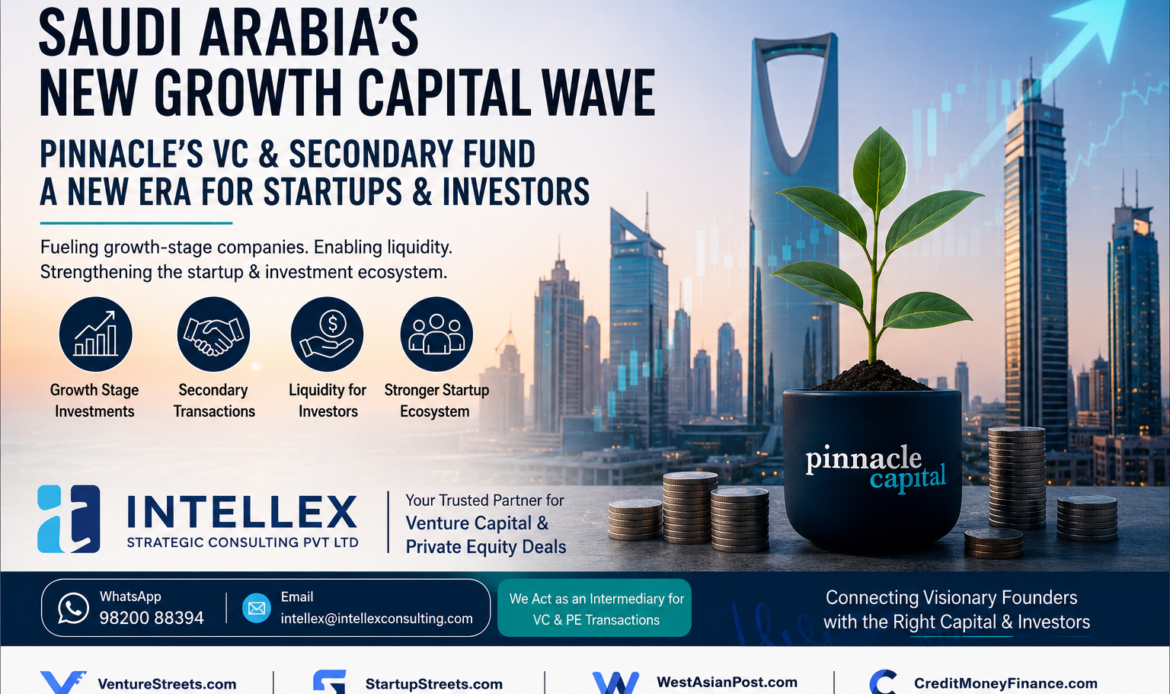
Saudi Arabia’s New Growth Capital Wave: Why Pinnacle’s VC and Secondary Fund Matters for Startups, Investors and the MENA Ecosystem.
Pinnacle Capital has launched a Saudi-focused VC strategy targeting growth-stage technology companies and secondary transactions. Discover what it means for startups, founders, investors, VCs, PE funds and the wider MENA ecosystem.
Introduction: A Significant Development for Saudi Arabia’s Startup Ecosystem
Saudi Arabia’s startup and investment ecosystem is entering a more mature phase.
The latest signal comes from Pinnacle Capital, a Saudi Arabia-based investment firm that has launched a venture capital strategy focused on growth-stage technology companies and secondary investments in the Kingdom.
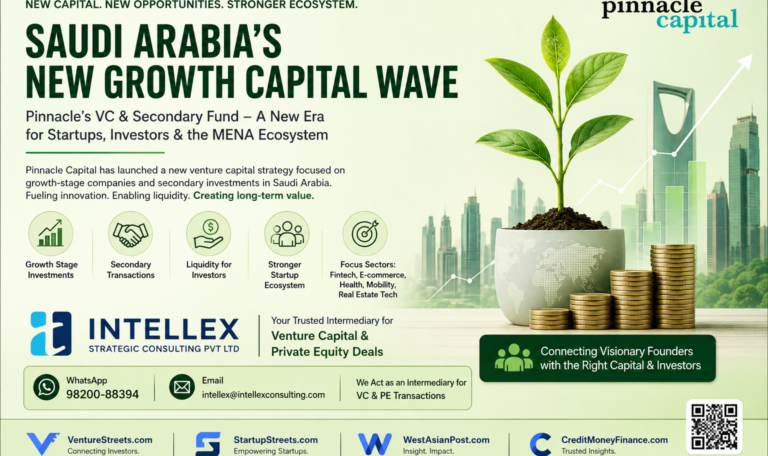
The strategy is designed to invest through both primary funding rounds and secondary transactions, providing capital to established technology companies while also creating liquidity for existing shareholders and investors. Key areas identified include fintech, e-commerce, health and lifestyle, and technology businesses connected with urban living, mobility and real estate.
This development is important because it represents something broader than another venture capital fund entering the market.
It reflects the evolution of Saudi Arabia’s startup ecosystem from an environment primarily focused on early-stage company creation toward one increasingly capable of supporting companies through growth, scale, shareholder liquidity and eventual exits.
For founders, venture capital funds, angel investors, family offices, private equity firms, employees holding startup shares and strategic investors, this evolution could create a substantially deeper capital market.
What Is Pinnacle Capital’s New VC Strategy?
Pinnacle Capital’s investment-management platform already includes venture capital, a Catalyst strategy focused on strategic stakes in public companies, and plans around private equity aggregation and infrastructure investments. Its official website describes the VC division as being focused on technology startups and building the next generation of industry leaders in Saudi Arabia.
The new strategy is particularly interesting because it combines two investment approaches:
1. Primary Venture Capital Investments
In a conventional primary investment, a VC fund invests fresh capital into a company.
For example:
A Saudi technology company raises a Series B round of $20 million.
A new investor invests $5 million into the company.
The company receives the money, increasing its cash resources and enabling it to:
- Expand into new markets
- Hire senior talent
- Develop technology
- Increase marketing expenditure
- Build infrastructure
- Acquire customers
- Make strategic acquisitions
- Strengthen working capital
- Prepare for a larger future funding round
This is traditional growth capital.
2. Secondary Transactions
The second component is potentially even more significant.
A secondary transaction involves the purchase of existing shares from an existing shareholder rather than simply investing new money into the company.
The seller could be:
- An early-stage investor
- An angel investor
- A venture capital fund
- A founder
- An employee
- A family office
- Another institutional shareholder
Instead of the money going into the company’s bank account, the capital generally goes to the selling shareholder.
This creates liquidity without necessarily requiring the company to conduct a large primary capital raise.
That distinction is extremely important as startup ecosystems mature.
Why Secondary Investments Matter
In the early stages of a startup ecosystem, most attention is directed toward raising money.
As companies become larger, another problem emerges:
How do existing shareholders eventually realize value from their investments?
A startup may have raised several rounds and reached a substantial valuation, but it may still be several years away from an IPO or strategic acquisition.
Founders and employees may have significant paper wealth but limited liquidity.
Early investors may have held shares for seven, eight or ten years.
VC funds may be approaching the end of their investment periods.
This creates demand for secondary transactions.
A secondary investor can purchase existing shares, providing liquidity to the seller while allowing the buyer to gain exposure to an established company.
The result can be a more flexible capital ecosystem.
Why This Is Different From Traditional Early-Stage VC
Traditional venture capital generally involves investing at a relatively early stage where the investor is underwriting significant future growth.
Growth-stage and secondary investing can offer a different risk-return profile.
By the growth stage, an investor may have access to:
- Several years of financial history
- Revenue trends
- Customer retention data
- Unit economics
- Gross margins
- EBITDA or contribution margins
- Market-share information
- Previous institutional investor validation
- Established management teams
- Product-market fit
- Expansion history
This does not eliminate investment risk.
However, it can provide investors with significantly more information than an early-stage investment.
The secondary component can also provide an additional avenue for investors to access companies that may otherwise have limited share availability.
The Strategic Importance of Saudi Arabia
Saudi Arabia has been actively developing its technology, entrepreneurship and investment ecosystem as part of the Kingdom’s broader economic diversification agenda.
Pinnacle describes its investment activities as aligned with Saudi Vision 2030, with a focus on alternative investments and economic transformation. The firm states that it was established in 2021 and is licensed by the Saudi Capital Market Authority.
The emergence of growth and secondary capital is therefore significant.
A mature startup ecosystem needs more than seed capital.
It needs a complete capital lifecycle:
Idea → Seed → Series A → Series B → Growth Capital → Secondary Liquidity → Strategic Investment → IPO / M&A / Exit
The development of investors capable of participating in multiple stages helps strengthen that entire chain.
Sectors That Could Benefit
Pinnacle’s stated areas of interest include several sectors that are already central to technology-led economic transformation in the region.
Fintech
Fintech remains one of the most important sectors in the MENA startup ecosystem.
Saudi Arabia has developed a large digital financial-services market covering:
- Digital payments
- Consumer finance
- BNPL
- SME finance
- Wealthtech
- Insurtech
- Banking technology
- Financial infrastructure
- RegTech
Growth-stage capital can help successful fintech companies expand while secondary capital can provide liquidity to earlier investors.
Pinnacle has previously participated in major regional technology investments, including the $340 million Series C financing of Saudi BNPL platform Tamara, which included both primary capital and secondary share transactions.
E-Commerce and Consumer Technology
Saudi Arabia’s increasingly digital consumer economy creates opportunities for:
- E-commerce marketplaces
- D2C brands
- Retail technology
- Logistics technology
- Digital payments
- Consumer platforms
- Subscription businesses
- AI-enabled commerce
For companies that have achieved meaningful scale, growth capital can be particularly useful for geographic expansion and operational infrastructure.
Health and Lifestyle Technology
Technology-enabled healthcare and lifestyle businesses are another important area.
Investment opportunities can include:
- Digital healthcare
- Health platforms
- Wellness technology
- Fitness technology
- Healthcare marketplaces
- Consumer health
- Medical technology
- Digital diagnostics
Growth-stage investors can help such companies move from product validation toward larger-scale commercialization.
Mobility, Urban Living and Real Estate Technology
Technology connected to mobility, urban infrastructure and real estate is particularly relevant to Saudi Arabia’s transformation.
Opportunities can include:
- PropTech
- Smart-city platforms
- Mobility technology
- Transportation marketplaces
- Property management technology
- Construction technology
- Real estate marketplaces
- Urban infrastructure solutions
These sectors can potentially benefit from both private capital and strategic partnerships.
What This Means for Startup Founders
For founders, the emergence of growth-stage and secondary investors creates several potential advantages.
Greater Choice of Capital
Founders may no longer need to depend entirely on traditional VC funds for each financing round.
The capital ecosystem can include:
- Angels
- Seed funds
- Venture capital funds
- Growth investors
- Family offices
- Strategic investors
- Private equity funds
- Secondary investors
- Sovereign-linked investment platforms
Potential Liquidity Without a Full Exit
A secondary transaction can potentially allow founders or early shareholders to sell part of their holdings while remaining invested in the company.
This can be particularly valuable for founders who have spent many years building a business but want some personal liquidity.
However, founders must carefully evaluate the implications of any secondary sale, including control, future dilution, valuation and shareholder agreements.
What This Means for Existing VC Investors
The development of a secondary market can be equally important for venture capital investors.
Consider an early-stage VC fund that invested in a company six years ago.
The company is performing well, but an IPO may still be several years away.
A secondary investor could potentially purchase part of the VC fund’s stake.
The VC fund receives liquidity.
The startup does not necessarily need to raise a large new round.
The secondary buyer obtains exposure to a mature growth company.
This can create a win-win structure when properly priced and negotiated.
What This Means for Startup Employees
Employee stock options and equity participation become more meaningful when a secondary market develops.
One of the major challenges with startup equity is that it can remain illiquid for many years.
A developing secondary ecosystem can potentially create opportunities for eligible employees to monetize part of their holdings, subject to:
- Company approval
- Shareholder agreements
- Applicable regulations
- Vesting requirements
- Transfer restrictions
- Tax implications
- Valuation
- Transaction documentation
This can also improve employee retention by making startup equity more tangible.
Implications for Angel Investors and Family Offices
For angel investors and family offices, growth-stage secondary opportunities can provide another route into the technology ecosystem.
Instead of investing exclusively in an unproven startup, investors may consider companies with:
- Established revenues
- Strong customer acquisition
- Proven business models
- Institutional investors
- Demonstrated market demand
- Experienced management
- Clear expansion plans
This does not necessarily mean lower risk, but it can change the nature of the underwriting process.
For sophisticated investors, the ability to evaluate both primary and secondary opportunities can become an increasingly important part of private-market portfolio construction.
What Private Equity Investors Should Watch
The development is also relevant to the PE ecosystem.
Some growth-stage technology companies eventually become candidates for larger private equity transactions.
A mature ecosystem can create a pipeline:
VC → Growth Capital → PE → Strategic Acquisition / IPO
Private equity investors can potentially benefit from companies that have already established:
- Product-market fit
- Revenue scale
- Management depth
- Corporate governance
- Financial controls
- Market leadership
- Repeatable growth
This creates opportunities for PE investors to enter at later stages while helping businesses professionalize further.
A New Opportunity for Cross-Border Investors
The Saudi opportunity should not be viewed only through a domestic lens.
As the Kingdom’s technology ecosystem becomes deeper, investors from India, UAE, Singapore, Europe, the United States and other markets may increasingly explore opportunities in Saudi Arabia.
Cross-border investment, however, requires more than identifying an attractive company.
Investors must consider:
- Local regulations
- Foreign investment requirements
- Tax considerations
- Corporate structures
- Shareholder rights
- Currency exposure
- Due diligence
- Governance
- Exit mechanisms
- Local partnerships
Professional financial and legal advisory therefore becomes increasingly important as transaction complexity increases.
Why the Secondary Market Could Become a Major Growth Area
The maturation of the secondary market could be one of the most important developments in the next phase of the MENA venture ecosystem.
A startup ecosystem becomes significantly stronger when investors have confidence that there are multiple potential liquidity routes.
Those routes may include:
- Strategic acquisition
- IPO
- Founder-led buyback
- Secondary share sale
- PE investment
- Merger
- Sale to another financial investor
The availability of multiple exit mechanisms can make private-market investing more attractive.
It can also encourage investors to commit capital earlier because they know that liquidity does not necessarily depend on an IPO.
What Indian Startups and Investors Can Learn
There is also an important lesson for the Indian startup ecosystem.
India has a large and sophisticated startup market, but liquidity remains a major consideration for private-market investors.
The growing importance of secondary transactions demonstrates how the next generation of startup finance may increasingly move beyond the simple question:
“Who will fund the next round?”
The more sophisticated question becomes:
“How can capital be structured efficiently throughout the entire lifecycle of the company and its shareholders?”
That includes primary funding, structured growth capital, secondary transactions, strategic investments, PE investments and eventual exits.
Indian founders and investors can therefore watch the Saudi market closely for innovations in growth capital and private-market liquidity.
What Founders Should Do Now
Founders preparing for growth-stage investment should begin building investor readiness well before approaching institutional investors.
A strong preparation process should include:
Financial Readiness
- Clean financial statements
- Monthly MIS
- Audited financials
- Detailed financial projections
- Working-capital analysis
- Revenue and margin analysis
Investor Readiness
- Updated pitch deck
- Investment memorandum
- Cap table
- Previous funding history
- Shareholder information
- Valuation analysis
Business Readiness
- Clear market opportunity
- Competitive positioning
- Customer metrics
- Unit economics
- Growth strategy
- Technology roadmap
Due Diligence Readiness
- Corporate documents
- Material contracts
- Intellectual property documentation
- Employee records
- Tax compliance
- Statutory compliance
- Litigation disclosures
- Regulatory approvals
The better prepared a company is, the more efficiently investors can evaluate the opportunity.
The Bigger Picture: From Startup Ecosystem to Capital Ecosystem
The significance of Pinnacle’s strategy is ultimately larger than one fund.
A successful startup ecosystem needs a complete capital ecosystem.
Entrepreneurs need capital.
Investors need quality opportunities.
Employees need liquidity.
VC funds need exits.
Family offices need diversification.
Private equity funds need growth companies.
Strategic investors need acquisition targets.
Governments need innovation and economic diversification.
Secondary markets can help connect many of these participants.
Pinnacle’s stated venture capital strategy, combined with its broader investment-management activities, illustrates how the Saudi financial ecosystem is developing beyond traditional early-stage investing toward a broader alternative-investment architecture.
What We Can Expect Next
The next phase of the MENA investment market could see greater activity in:
- Growth-stage VC
- Venture secondaries
- Employee liquidity
- Founder secondaries
- PE-backed consolidation
- Cross-border investments
- Family-office investments
- Strategic corporate investments
- Pre-IPO transactions
- Technology-focused M&A
For founders, the message is clear:
Building a valuable company is only one part of the journey. Understanding capital structures, shareholder liquidity and exit strategies is becoming equally important.
For investors, the opportunity is equally compelling:
The next generation of MENA investment opportunities may increasingly be found not only in early-stage startups, but also in established technology businesses entering their next phase of growth.
How Intellex Strategic Consulting Pvt Ltd Can Help
For entrepreneurs, shareholders, investors and businesses exploring Venture Capital, Private Equity, Growth Capital, Strategic Investment, M&A or secondary transactions, professional transaction preparation and investor matching can be critical.
Intellex Strategic Consulting Pvt Ltd works with entrepreneurs and businesses on financial advisory, fundraising and investment-related requirements, including venture capital and private equity opportunities.
Intellex can act as an intermediary/advisory facilitator for suitable Venture Capital and Private Equity transactions, subject to investor mandate, transaction suitability, due diligence and applicable regulatory requirements.
If you are:
- A startup looking for VC or growth capital
- A scale-up seeking PE investment
- A founder considering partial secondary liquidity
- An existing investor exploring a secondary sale
- A family office looking for private-market opportunities
- A company seeking strategic investors
- An investor looking for suitable growth businesses
- A business considering M&A or structured equity transactions
you can contact:
Intellex Strategic Consulting Pvt Ltd
WhatsApp: +91 98200 88394
Email: intellex@intellexconsulting.com
Website: IntellexConsulting.com
Explore Our Startup, Finance and Investment Platforms
For additional information on startup funding, investment opportunities, finance, business opportunities and the wider MENA ecosystem, visit:
- VentureStreets.com — Startup investment, funding and investor ecosystem
- StartupStreets.com — Startup advisory, fundraising and entrepreneurship
- WestAsianPost.com — Business, investment and economic developments across West Asia
- CreditMoneyFinance.com — Credit, finance and funding-related information
Conclusion
Pinnacle Capital’s focus on growth-stage venture capital and secondary investments in Saudi Arabia is an important indicator of the increasing sophistication of the Kingdom’s private capital market.
The significance goes beyond one investment strategy.
As Saudi startups mature, the demand for growth capital, shareholder liquidity, secondary transactions, private equity and structured exits is likely to become increasingly important.
For founders, this means thinking about capital strategy beyond the next funding round.
For investors, it means looking beyond early-stage opportunities.
For VC and PE funds, it means considering new routes to liquidity and portfolio management.
And for the broader MENA ecosystem, it represents another step toward building a mature, interconnected capital market capable of supporting companies from their earliest stages through scale, liquidity and eventual exit.
The future of startup finance is not only about raising capital. It is about creating a complete capital lifecycle and Saudi Arabia is rapidly building that ecosystem.
Editorial note: This article is an independent analysis based on publicly available information. The mention of Pinnacle Capital does not imply any partnership, mandate, endorsement or representation by Pinnacle Capital unless separately confirmed in writing. Investment opportunities are subject to applicable laws, regulations, investor eligibility, due diligence and transaction-specific terms.
More Featured Articles:
Consulting Beyond Just Capital: Why Startups Need Strategic Advisors to Scale Successfully.
Top Angel Networks in Singapore: The Ultimate Guide for Startups Seeking Angel Investment in 2026.
3 replies on “Saudi Arabia’s New Growth Capital Wave: Why Pinnacle’s VC and Secondary Fund Matters for Startups, Investors and the MENA Ecosystem.”
[…] Crore Grand Anicut Seed Fund: A Major Boost for India’s Early-Stage Startup Ecosystem.Saudi Arabia’s New Growth Capital Wave: Why Pinnacle’s VC and Secondary Fund Matters for Startup…AWS Startup Credits & Cloud Services: Helping Eligible Startups Reduce Cloud Costs -A […]
[…] Saudi Arabia’s New Growth Capital Wave: Why Pinnacle’s VC and Secondary Fund Matters for Startup… […]
[…] Saudi Arabia’s New Growth Capital Wave: Why Pinnacle’s VC and Secondary Fund Matters for Startup… […]