
IIT Madras Unicorn Frontier Fund I: ₹1,000 Crore Deep-Tech Fund Opens New Funding Opportunities for Indian Startups.
Explore the IITM Unicorn Frontier Fund I, its ₹1,000 crore target corpus, ₹450 crore first close, investment criteria, founders, four portfolio startups and funding opportunities for Indian deep-tech businesses. Learn how Intellex Strategic Consulting Pvt Ltd supports startup fundraising.
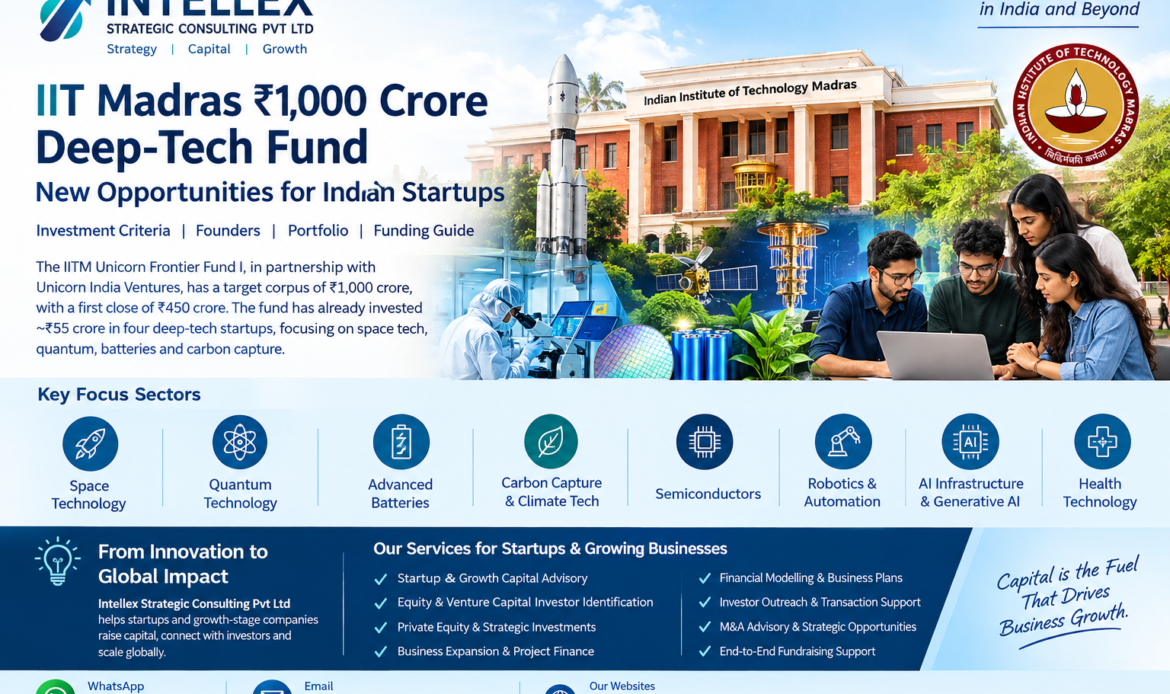
India’s deep-tech startup ecosystem has received a significant boost with the IIT Madras–Unicorn India Ventures partnership announcing a first close of approximately ₹450 crore for the IITM Unicorn Frontier Fund I, a fund targeting a total corpus of ₹1,000 crore. The fund has already deployed nearly ₹55 crore across four startups working in space technology, quantum instrumentation, advanced batteries and carbon capture.
For entrepreneurs developing intellectual property-led technologies, advanced engineering products and globally competitive industrial solutions, this development highlights the growing availability of institutional capital for businesses that require substantial research, product development, testing and commercialisation investment.
The fund is particularly relevant for founders working in sectors where conventional venture capital investors may be reluctant to finance long development cycles, complex engineering requirements and the time required to achieve commercial-scale deployment.
This article examines the fund’s investment strategy, founders and management team, funding structure, investment criteria, portfolio companies, historical track record and practical implications for startups seeking funding in India and international markets.

1. IITM Unicorn Frontier Fund I: Key Details at a Glance
Target fund corpus
₹1,000 crore
Including the reported ₹400 crore greenshoe option.
First close
₹450 crore
Reported in September 2026; some coverage gives a figure of ₹453 crore.
IIT Madras Research Park and Unicorn India Ventures
IIT Madras provides the research and innovation ecosystem, while Unicorn India Ventures manages the fund.
Portfolio objective
Around 25 startups
Focused on IP-led, engineering-intensive deep-tech businesses.
Fund life
10 years, with a potential two-year extension
A long-duration structure suited to technology development and commercialisation.
The fund’s first close and investment announcements were reported on 26 September 2026. The final close was expected by December 2026, according to contemporaneous reporting. These are announced targets, not guarantees of completion.
2. Who Is Behind the Fund?
The fund combines the research capabilities and startup ecosystem of IIT Madras with the venture capital experience of Unicorn India Ventures.
IIT Madras and IIT Madras Research Park
Indian Institute of Technology Madras is one of India’s major engineering and research institutions. Its entrepreneurial ecosystem connects faculty, researchers, students, alumni, technology companies and investors.
The institute’s commercialisation ecosystem includes IIT Madras Research Park, IITM Incubation Cell and specialised incubators that support businesses in areas such as healthcare technology, advanced manufacturing, energy, robotics, software and aerospace.
The fund is intended to address a persistent financing challenge: research-driven startups can demonstrate a promising technical concept but still need substantial capital to establish manufacturing capabilities, complete product validation, obtain certifications and win their first major customers.
Prof. V. Kamakoti Veezhinathan, Director of IIT Madras, has been a prominent advocate of building technology companies from the institute’s research base. The fund partnership is designed to provide startups with both capital and strategic guidance.
Natarajan “Nat” Malupillai, Group CEO of IIT Madras Research Park, Incubation Cell and RTBI, has described the initiative as a means of bringing patient capital into the IIT Madras innovation ecosystem and helping Indian companies develop globally competitive intellectual property.
Unicorn India Ventures: Founders and Investment Leadership
Unicorn India Ventures is an early-stage venture capital firm founded in 2016 by Anil Joshi and Bhaskar Majumdar.

Anil Joshi — Founder and Managing Partner
Anil Joshi has experience in the Indian angel-investing ecosystem, including leadership roles associated with Mumbai Angels and Bangalore Angels. His investment background includes early-stage company financing, investor networks and startup mentoring.

Bhaskar Majumdar — Founder and Managing Partner
Bhaskar Majumdar is an entrepreneur and investor with a background in media, technology and business development. He founded Recreate Solutions and has experience supporting startups in India and the UK, including businesses seeking to expand into international markets.
The firm’s investment approach combines capital with mentoring, business development support and assistance in building companies capable of scaling beyond their initial markets.

3. The Fund’s Size, Structure and Investment Capacity
The fund was initially announced in February 2026 as a ₹600 crore vehicle, with a ₹400 crore greenshoe option that could increase its potential size to ₹1,000 crore. Its September first-close announcement reported approximately ₹450 crore raised against the expanded target.
The distinction between the first close and the target corpus is important for entrepreneurs. The ₹1,000 crore figure represents the intended overall fund size, not the amount available to any single applicant.
Indicative investment parameters
Parameter | Reported details |
|---|---|
Target fund size | ₹1,000 crore, including greenshoe |
First close | Approximately ₹450–453 crore |
Intended portfolio | Around 25 startups |
Investment focus | Early-stage, IP-led deep tech |
Technology maturity | Emphasis on TRL 3–4 |
Fund duration | 10 years, potentially extendable by 2 years |
Follow-on funding | A substantial reserve for subsequent rounds |
Geography | India-focused, with global commercial potential |
Published descriptions of the fund have referred to average investment cheques of ₹8–10 crore at launch, while subsequent reporting has cited a ₹15–25 crore average cheque size. These figures may reflect different stages of fund planning and deployment. They should not be treated as a guaranteed cheque range for every company.
The fund’s definitive investment terms, eligibility requirements, ownership expectations and deployment plans should be confirmed directly with the fund manager.
4. The Four Startups That Have Received Approximately ₹55 Crore
The fund’s initial investments provide a useful indication of the types of businesses it intends to support. Rather than concentrating exclusively on consumer-facing software companies, the portfolio spans complex technologies with applications across aerospace, industrial infrastructure, electric mobility and environmental management.

1. Hathor — Space Technology
Chennai-based Hathor is developing specialised semi-cryogenic and cryogenic rocket engines for small- and medium-satellite launch vehicles.
Its technology addresses a critical part of the space supply chain: propulsion systems that must meet demanding performance, reliability and engineering requirements.
Potential opportunity: Launch vehicle manufacturers, private space companies and organisations seeking access to domestic propulsion technology.

2. Quanstra — Quantum Technology
Delhi-based Quanstra is developing single-photon detection systems and advanced quantum instrumentation for research and emerging industrial applications.
Such equipment can be relevant to quantum communication, photonics research and other applications that require the detection and measurement of extremely weak light signals.
Potential opportunity: Research institutions, quantum technology developers and specialised scientific equipment markets.

3. Triolt Energy — Advanced Batteries
Triolt Energy is developing high-performance lithium-ion battery cells optimised for drones and fast-charging electric mobility applications.
The company’s earlier funding history includes a ₹71 lakh round led by Campus Angels Network in 2024, following an earlier reported ₹1.29 crore raised from Little Angels Network and SIDBI.
Potential opportunity: Drone manufacturers, electric mobility companies, battery integrators and energy-storage businesses.

4. Carbelim — Climate Technology
Carbelim is developing bio-integrated carbon capture and air-purification systems using proprietary microalgae technology.
Its approach uses biological processes and engineered systems to capture carbon dioxide and address air-quality challenges, with potential applications in buildings, industrial environments and urban infrastructure.
The company identifies Dr. Karthika Gopi as its founder and CEO. Public company profiles also identify Gopakumar Gopalan and Rahul Babu among its founders.
Potential opportunity: Industrial decarbonisation, green buildings, environmental infrastructure and carbon-management solutions.
The four investments and their principal technologies were reported by Business Standard and other business publications. Triolt Energy’s earlier financing is documented in a separate funding announcement, while Carbelim’s published company profile describes its technology and leadership.
What about the founders and investment amounts?
Public reporting on the fund’s announcement identifies the four portfolio companies and their technology areas, but does not provide a complete, verified breakdown of the ₹55 crore among the individual companies.
Similarly, the public reports reviewed do not establish a complete founder-by-founder profile for Hathor and Quanstra. Founders considering an investment or partnership should verify the relevant company’s leadership, shareholding, intellectual property ownership and corporate records directly.
It would be inappropriate to infer that each startup received an equal investment or to assign individual investment amounts without an announcement supporting those figures.
5. The Six Core Investment Sectors
The fund’s strategy is built around technology areas in which India could develop domestic capabilities, reduce reliance on imported technologies and compete in international markets.

1. Defence technology
Indigenous defence systems, specialised components, electronics, sensors and technologies that can reduce import dependence. Startups should be prepared for lengthy qualification and procurement cycles.

2. Space technology
Space-qualified hardware, propulsion systems, satellite technologies and engineering products for the expanding commercial space sector.

3. Semiconductors
Fabless chip design, semiconductor intellectual property and technologies that strengthen domestic capabilities in electronics and computing.

4. Manufacturing technology, robotics and automation
Industrial automation, precision engineering, robotics, advanced production systems and technologies that improve manufacturing productivity.

5. AI infrastructure and generative AI
Computing infrastructure, enabling technologies and enterprise AI systems, with an emphasis on building strategic technological capabilities.

6. Health technology
Medical devices, healthcare technologies and scalable innovations intended to improve access, affordability and delivery of healthcare.
The fund has stated that it will evaluate opportunities for global export potential, strategic import substitution and technological advantages for India. Its investment strategy also highlights quantum technology and critical materials for batteries and electric mobility.
6. Investment Thesis: What Kind of Startup Could Be a Fit?
The fund’s stated emphasis on intellectual property, engineering-heavy businesses and early-stage technology maturity provides several clues for founders preparing an application.
A. Proprietary technology and defensible intellectual property
A company should be able to explain what it has developed that is technically distinctive.
This may include:
Patented inventions or patent applications.
Proprietary product designs, processes or materials.
Specialised software, hardware or engineering architectures.
Technical know-how that is difficult to replicate.
Research-backed improvements in performance, cost, reliability or efficiency.
A patent is not necessarily the only way to establish defensibility. However, founders should be able to explain ownership of the underlying technology and how the company will protect its competitive position.
B. A demonstrable technical milestone
The fund has highlighted Technology Readiness Levels 3–4 as an important area of focus.
A simplified interpretation is:
Technology readiness | What it generally means |
|---|---|
TRL 1–2 | Basic principles identified; technology concept formulated |
TRL 3 | Experimental proof of concept demonstrated |
TRL 4 | Technology validated in a laboratory environment |
TRL 5–6 | Validation or demonstration in a relevant environment |
TRL 7–9 | System demonstration, qualification and operational deployment |
TRL definitions can vary slightly by framework and sector. Founders should describe their actual validation milestones rather than relying on a number alone.
For example, a battery startup could present cell test results, cycle-life data and safety assessments. An aerospace company could document prototype testing, performance characteristics and qualification plans.
C. A credible commercialisation strategy
Deep-tech investors need to understand how scientific or engineering innovation becomes a viable business.
A strong commercialisation plan should address:
The customer problem being solved.
The initial target market and customer segments.
The product’s technical and commercial advantages.
The price customers may be willing to pay.
Manufacturing and supply-chain requirements.
Certification, regulatory and product-qualification needs.
The route from prototype to commercial deployment.
D. A substantial and identifiable market
The opportunity should extend beyond an interesting technical demonstration.
Investors will want to understand the size of the addressable market, the number of potential customers, the competitive landscape and the company’s ability to expand into additional products or geographies.
E. Potential to build a globally competitive company
The fund’s stated emphasis on exports and strategic technological advantage suggests that founders should explain how their products could serve customers outside India.
A business may initially focus on the Indian market while developing internationally relevant products, certifications, partnerships and distribution channels.
7. Geography: Where Does the Fund Invest?
The IITM Unicorn Frontier Fund I is anchored in India’s innovation ecosystem. The fund’s public investment thesis emphasises building globally competitive technology companies from India, rather than describing a conventional multi-country venture capital mandate.
For founders, the distinction is important:
India: The primary ecosystem for sourcing and building companies, including ventures emerging from IIT Madras and the wider Indian deep-tech community.
International markets: Relevant where a startup can demonstrate export potential, international demand, strategic partnerships or a competitive technological advantage.
Global expansion: A potential growth pathway for portfolio companies, not evidence that the fund has a published mandate to invest directly in startups headquartered in every international market.
The fund’s published announcements do not provide a definitive country-by-country investment allocation. Overseas founders or businesses should obtain confirmation from the fund manager about geographic eligibility, Indian incorporation requirements and any cross-border investment restrictions.
8. Past Track Record: IIT Madras’ Startup Ecosystem
One of the important advantages of this initiative is its connection with an established research, incubation and technology-commercialisation ecosystem.
IIT Madras has supported startups across multiple generations, including companies developing electric vehicles, enterprise AI, aerospace systems, industrial technology and healthcare solutions.
According to the institute’s April 2026 announcement, IITM Incubation Cell incubated 112 startups during FY 2025–26, bringing its cumulative portfolio to 567 startups. The institute also reported 431 patent filings during the financial year.
Notable companies associated with the IIT Madras ecosystem

Ather Energy — Electric mobility
Ather illustrates the potential for an engineering-led startup to move from product development to large-scale manufacturing and a publicly listed business. Its founders are Tarun Mehta and Swapnil Jain.

Uniphore — Enterprise AI
Uniphore demonstrates how technology originating in India can address international enterprise markets. Its co-founders include Umesh Sachdev and Ravi Saraogi.

Agnikul Cosmos — Space technology
Agnikul represents the development of private-sector launch vehicle technology, an area closely related to the broader opportunity in domestic aerospace engineering.

GalaxEye — Earth observation
GalaxEye is developing satellite-based Earth observation technology, illustrating the opportunity to commercialise advanced research for industrial, environmental and strategic applications.
These companies are examples from the broader IIT Madras innovation ecosystem. They should not be interpreted as investments made by IITM Unicorn Frontier Fund I itself.
The distinction matters because the new fund’s investment performance will depend on its own portfolio, entry valuations, follow-on investments and eventual exits.
IIT Madras’ history provides evidence of a substantial technology-building ecosystem, but it does not guarantee financial returns from the new fund or any individual portfolio company.
9. Unicorn India Ventures: Investment History and Track Record
Unicorn India Ventures has operated across multiple venture capital funds and has invested in early-stage businesses across technology-oriented sectors.
Its portfolio and published fund information indicate activity in areas including:
Enterprise software and SaaS.
Financial technology.
Deep tech and hardware.
Artificial intelligence and software.
Health technology.
Technology-enabled business services.
The firm’s public materials identify investments and exits across earlier funds. Examples include Genrobotics, Inntot Technologies and FutureCure/NeuroEquilibrium, with disclosed exits or acquisitions in its portfolio history.
The firm has also reported a broader investment history across India and the UK, while its new IIT Madras partnership places a more explicit emphasis on deep-tech ventures.
What should founders learn from this history?
The experience of a venture capital manager can be relevant in several ways:
Capital raising: Experienced fund managers may help companies prepare for subsequent funding rounds.
Business development: Investor networks can facilitate introductions to customers, strategic partners and industry participants.
Governance: Institutional investors generally expect regular financial reporting, board-level oversight and clear operating metrics.
Follow-on capital: A company’s initial investment is only one part of its financing requirements.
Exit planning: Investors ultimately need a credible route to liquidity, whether through an acquisition, secondary sale or public listing.
However, historical investment activity is not the same as a verified fund-level return. Founders and co-investors should distinguish between the number of investments made, the number of successful exits, realised proceeds and the actual returns generated for investors.
10. How Much Funding Should a Startup Seek?
The amount a startup should raise depends on its technology, stage of development, commercial opportunity and capital requirements.
Although the fund has been reported to make substantial investments in deep-tech companies, entrepreneurs should not automatically seek the largest possible cheque.
A well-structured funding request should be based on a clearly defined plan.
Funding requirement | Examples of expenditure |
|---|---|
Research and development | Engineering teams, laboratory work and materials |
Prototype development | Design, fabrication and testing |
Product validation | Performance trials, reliability and safety testing |
Manufacturing readiness | Equipment, tooling and pilot production |
Certifications | Regulatory approvals and technical qualification |
Commercialisation | Customer acquisition, sales and deployment |
Working capital | Inventory, receivables and operating expenses |
Illustrative funding scenarios
These are hypothetical planning examples, not disclosed investment offers from IITM Unicorn Frontier Fund I.
Startup profile | Illustrative capital requirement |
|---|---|
Hardware startup completing prototype validation | ₹3–8 crore |
Deep-tech startup preparing pilot production | ₹8–20 crore |
Advanced manufacturing company scaling operations | ₹15–30 crore |
Technology company with substantial commercial deployment requirements | ₹25 crore or more |
A funding proposal should connect the amount requested to measurable milestones. Investors should be able to see what the capital will achieve and what additional financing may be required afterwards.
11. How Startups Can Prepare an Investor-Ready Proposal
A founder approaching a deep-tech fund should prepare a professional investment package that answers the questions likely to arise during due diligence.
Startup funding readiness checklist
Use this checklist to assess your fundraising preparation.
For deep-tech companies, investors may examine the underlying science and engineering in considerable detail.
Founders should be ready to explain:
Why the technology works and what has been demonstrated.
How its performance compares with competing solutions.
Whether the intellectual property belongs to the company.
What additional technical milestones remain.
How manufacturing costs and unit economics will evolve.
What evidence supports the commercial demand.
How the business will manage technology, regulatory and execution risks.
A technically promising product may still struggle to attract institutional capital if it lacks a clear commercialisation strategy. Equally, a company with early revenue may need to demonstrate that its technology can be defended against competitors.
12. Funding Alternatives for Startups That May Not Fit This Fund
Not every startup will meet the investment profile of an engineering-heavy deep-tech fund. Entrepreneurs should consider multiple financing routes rather than relying on one investor.
Funding route | Potentially suitable businesses |
|---|---|
Angel investors | Early-stage ventures with a strong founding team and initial proof of concept |
Seed and early-stage VC funds | Startups demonstrating product validation and a scalable market |
Specialist deep-tech funds | IP-led businesses with substantial technical development requirements |
Corporate strategic investors | Companies whose technology complements an established industry |
Government grants and innovation programmes | Eligible R&D, prototyping and technology-development projects |
Venture debt | Businesses with an existing equity base and the ability to service debt |
Equipment or project finance | Companies with identifiable assets, contracts or project cash flows |
Private equity | More mature companies with established operations and expansion plans |
The appropriate financing structure depends on the company’s maturity, cash flows, asset base, regulatory position and risk profile.
For example, a company developing an unproven scientific technology may be better suited to patient equity capital or a research grant than conventional debt. A manufacturing company with confirmed purchase orders may have additional options involving working capital, equipment finance or contract-backed funding.
13. Why Deep-Tech Startups Need Patient Capital
Deep-tech businesses often face a different financial trajectory from software startups.
A software business may be able to launch a product and acquire customers without investing in a physical manufacturing facility. A battery, aerospace, semiconductor or industrial robotics company may need years of engineering, testing, tooling and qualification before reaching meaningful commercial scale.
This creates several funding challenges.
Long development cycles: Revenue may arrive only after multiple technical milestones.
High capital expenditure: Equipment, laboratories, specialised machinery and pilot production can consume substantial capital.
Certification requirements: Aerospace, defence, medical and industrial technologies may need extensive testing and approvals.
Customer qualification: Large enterprises and government customers may require lengthy vendor approval processes.
Follow-on capital: The first funding round may not be sufficient to complete development and scale manufacturing.
A fund that reserves capital for subsequent investment can potentially provide continuity. However, follow-on funding remains subject to investment decisions, company performance, fund availability and the terms agreed with investors.
14. International Expansion: Building Global Technology Businesses from India
The fund’s focus on globally competitive companies creates opportunities for Indian founders to build businesses serving customers in multiple countries.
Potential international markets vary by sector.
Sector | Potential international customer segments |
|---|---|
Space technology | Satellite operators, launch companies and aerospace suppliers |
Quantum technology | Research laboratories, photonics businesses and specialised equipment manufacturers |
Battery technology | Drone manufacturers, mobility companies and energy-storage integrators |
Carbon capture | Industrial operators, building developers and environmental technology companies |
Semiconductors | Electronics manufacturers, chip companies and technology developers |
Robotics and automation | Manufacturers, logistics operators and industrial groups |
These are potential customer segments, not confirmed customers or contracts of the four funded companies.
For international expansion, founders should assess product certification, intellectual property protection, export controls, local distribution, technical support and the commercial requirements of each target market.
A startup with a strong domestic technology base may be able to develop an international business, but export readiness needs to be built into the product and operating strategy.
15. How Intellex Strategic Consulting Pvt Ltd Can Assist Startups Seeking Funding

Intellex Strategic Consulting Private Limited
Startup Funding • Growth Capital • Investment Advisory Support
Intellex Strategic Consulting Pvt Ltd provides professional services relating to fundraising, business finance, investment opportunities and strategic growth.
For startups and growth-stage companies across India and international markets, Intellex can assist with fundraising preparation, investor identification, financial modelling and the development of a structured capital-raising strategy.
Our services for startups and growing businesses
- Startup fundraising and early-stage capital-raising support.
- Equity funding and venture capital investor identification.
- Private equity and strategic investment opportunities.
- Business expansion funding and growth capital.
- Project finance and structured funding solutions.
- Financial modelling, business plans and investor presentations.
- Fundraising strategy, investor outreach and transaction support.
- Mergers and acquisitions advisory and strategic business opportunities.
Funding outcomes depend on investor appetite, due diligence, commercial viability and the terms negotiated. Intellex does not represent that any particular fund or investor has committed to finance a client unless formally confirmed.
Helping deep-tech founders build a credible funding proposition
For a company developing advanced manufacturing technology, battery cells, aerospace components, industrial automation or climate technology, fundraising requires more than a pitch deck.
Intellex can support the preparation of an investment proposition that connects the company’s technology, commercial opportunity, financial requirements and growth plans.
This may include:
Identifying the appropriate investor categories for the company’s stage and sector.
Assessing equity funding requirements and potential capital structures.
Preparing financial projections and a funding deployment plan.
Developing investor presentations and supporting documentation.
Evaluating strategic investment and business partnership opportunities.
Supporting discussions with prospective investors, subject to engagement scope and investor interest.
Capital is the Fuel That Drives Business Growth.
For startups seeking capital to develop technology, establish manufacturing operations, expand their businesses or enter international markets, a structured fundraising process can help bring greater clarity to the investment proposition.
Contact Intellex Strategic Consulting Pvt Ltd
WhatsApp 91-98200-88394
Email : intellex@intellexconsulting.com
Our websites
16. Important Considerations Before Approaching the Fund
Entrepreneurs should verify the latest application process, investment mandate and transaction terms before preparing a formal proposal.
In particular:
Confirm whether the fund is accepting proposals from companies outside the IIT Madras ecosystem.
Establish whether the company’s sector and technology maturity fit the current investment strategy.
Confirm the expected investment cheque size and any minimum or maximum thresholds.
Understand the fund’s valuation expectations and proposed ownership requirements.
Clarify intellectual property, incorporation and technology-transfer requirements.
Determine whether the fund can participate in follow-on rounds.
Establish whether the company needs additional co-investors to complete its funding round.
The fund’s public announcements provide a useful overview of its strategy, but they are not a substitute for its formal investment documents or direct confirmation from the fund manager.
Conclusion: A Significant Development for India’s Deep-Tech Funding Ecosystem
The IITM Unicorn Frontier Fund I represents a substantial new source of potential institutional capital for technology businesses emerging from India.
Its first close of approximately ₹450 crore, target corpus of ₹1,000 crore and initial deployment of nearly ₹55 crore across four deep-tech startups demonstrate a commitment to sectors where engineering capabilities, proprietary technology and long-term development are central to commercial success.
The fund’s focus on space technology, quantum instrumentation, batteries, carbon capture, semiconductors, robotics, AI infrastructure and health technology provides a useful indication of the types of innovation receiving institutional attention.
For founders, the central lesson is that successful fundraising requires a combination of technical credibility, defensible intellectual property, a commercially viable market, a strong management team and a disciplined capital deployment plan.
Startups that can demonstrate these characteristics may find opportunities across specialist venture capital funds, strategic investors, government innovation programmes and other sources of growth finance.
Intellex Strategic Consulting Pvt Ltd works with startups and established businesses on fundraising preparation, investor identification, financial modelling, business expansion funding and strategic investment opportunities across India and internationally.
Entrepreneurs seeking capital to develop innovative technologies, scale manufacturing or expand into new markets can contact Intellex to discuss their funding requirements and potential financing pathways.
Intellex Strategic Consulting Pvt Ltd
More Featured Articles: