


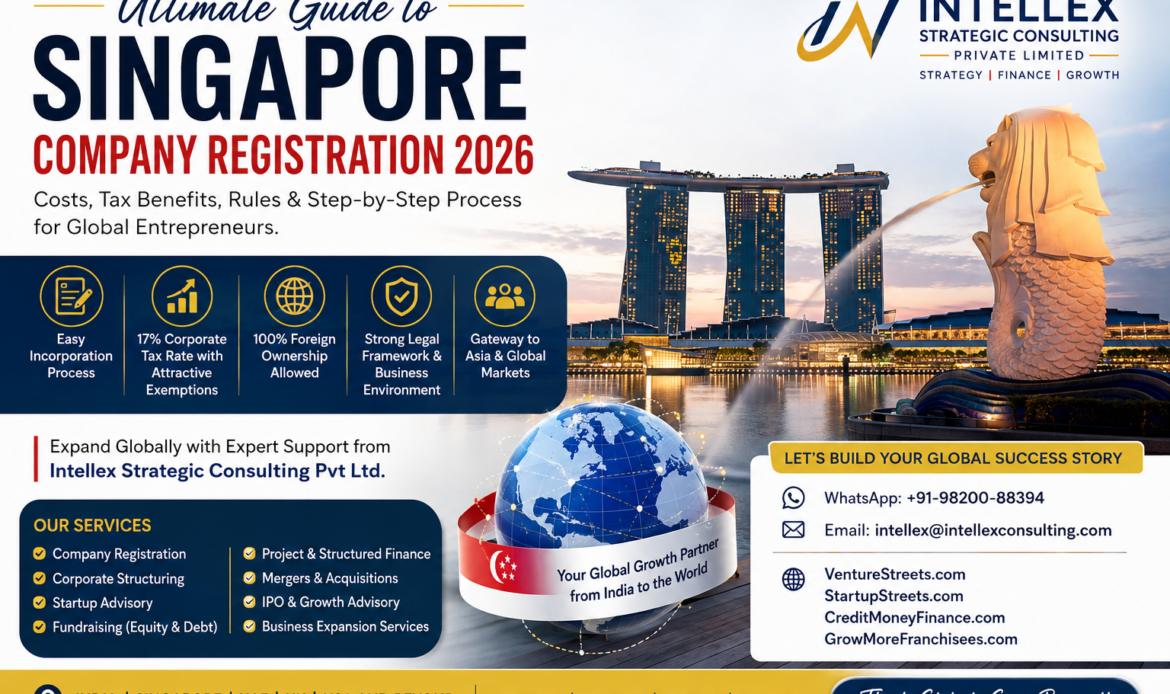
Ultimate Guide to Singapore Company Registration 2026: Costs, Tax Benefits, Rules & Step-by-Step Process for Global Entrepreneurs.
Singapore Company Registration 2026 | Incorporation Costs | Corporate Tax | Compliance | Foreign Entrepreneurs | Business Expansion | Global Company Setup
Learn how to register a company in Singapore in 2026. Explore incorporation costs, 17% corporate tax, tax exemptions, foreign ownership, compliance, banking and the complete registration process.
Singapore continues to rank among Asia’s most attractive jurisdictions for entrepreneurs, investors, technology companies, trading businesses, professional-service firms and multinational enterprises looking to establish an international presence.
For Indian entrepreneurs and businesses in particular, Singapore can offer a strategically located gateway to Southeast Asia and other international markets, supported by a sophisticated financial ecosystem, strong infrastructure, a predictable legal framework and an established reputation as a global business centre.
However, incorporating a company in Singapore is not simply about filling out an online registration form. Entrepreneurs need to understand the legal structure, local-director requirements, registered-office requirements, corporate secretary obligations, tax rules, accounting requirements, annual filings, banking considerations and industry-specific licences.
This Ultimate Guide to Singapore Company Registration 2026 explains the process in practical terms—from selecting the appropriate structure and reserving a company name to incorporation, taxation, banking and ongoing compliance.
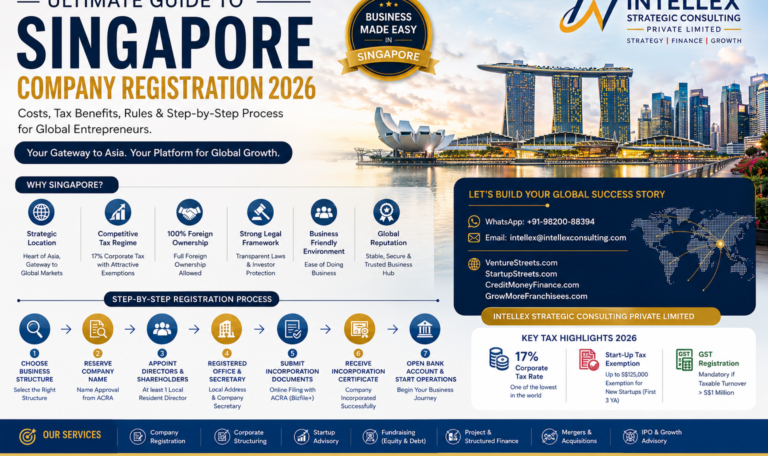
Why Consider Registering a Company in Singapore in 2026?
Singapore has developed into one of Asia’s leading destinations for international business.
Its advantages include:
- Strategic access to Asian markets
- Strong financial and banking infrastructure
- Stable regulatory and legal environment
- Business-friendly corporate framework
- Competitive corporate tax regime
- Extensive network of international businesses
- Strong intellectual-property protection
- Sophisticated digital infrastructure
- Access to Southeast Asian markets
- Potential eligibility for tax incentives and exemptions depending on circumstances
- A well-developed ecosystem for startups, investors and multinational corporations
For entrepreneurs who want to build an international business rather than operate exclusively in their domestic market, Singapore can provide an attractive corporate base.
That said, company registration should be based on the actual business model, ownership structure, tax position and intended markets—not simply on the perception that Singapore is a low-tax jurisdiction.
What Type of Singapore Company Should You Register?
For many entrepreneurs, the most commonly considered structure is a Private Company Limited by Shares, broadly comparable to a private limited company in India.
This structure provides limited liability and allows the company to have shareholders and directors.
Depending on the circumstances, businesses may also consider:
- Singapore subsidiary
- Singapore branch of a foreign company
- Representative office
- Limited Liability Partnership (LLP)
- Other specialised structures
The right structure depends on factors such as:
- Whether the business already exists overseas
- Whether the Singapore entity will conduct trading activities
- Whether Singapore will become the regional headquarters
- Ownership and investment requirements
- Tax considerations
- Fundraising plans
- Intellectual-property ownership
- Employment plans
- Regulatory requirements
- Long-term expansion strategy
A foreign company may establish a Singapore subsidiary or branch, but these structures have materially different legal and compliance implications.
Singapore Company Registration Requirements in 2026
Entrepreneurs should understand several fundamental requirements before beginning the incorporation process.
1. Company Name
The proposed company name must be submitted for approval before incorporation.
The official ACRA fee for applying for a new business entity name is currently S$15. Registration of a new business entity is currently S$300.
The proposed name should be checked for:
- Availability
- Similarity to existing names
- Potential trademark conflicts
- Restricted or regulated words
- Approvals that may be required for certain sectors
Entrepreneurs should not assume that an available company name automatically provides trademark protection.
A separate intellectual-property strategy may therefore be necessary.
2. At Least One Locally Resident Director
A Singapore company must have at least one director who meets Singapore’s local residency requirements.
ACRA states that company directors must be at least 18 years old, mentally fit and ordinarily resident in Singapore.
This is one of the most important considerations for overseas entrepreneurs.
A foreign entrepreneur can own shares in a Singapore company, but if the proposed shareholder/director does not meet Singapore’s residency requirements, an appropriate local-director arrangement may be necessary.
Professional advice should be obtained before using a nominee or local resident director arrangement, because directors have genuine legal responsibilities and cannot simply be treated as nominal names on incorporation documents.
3. Shareholders
A Singapore private company can have shareholders who are individuals or corporate entities.
This makes the structure potentially suitable for:
- Indian founders
- International entrepreneurs
- Overseas holding companies
- Venture-backed startups
- Family-owned businesses
- Foreign corporations establishing Asian subsidiaries
The appropriate ownership structure should be considered carefully where there are multiple founders, investors, holding companies or cross-border tax considerations.
4. Registered Office Address
A Singapore company needs an appropriate registered office in Singapore.
The registered office is the official address for statutory communications and company records.
For foreign entrepreneurs who do not maintain a physical office in Singapore, a professional corporate-services provider may be able to provide an appropriate registered-office solution, subject to applicable Singapore requirements.
5. Company Secretary
A company secretary must be appointed within six months of successful registration. ACRA states that the company secretary position cannot remain vacant beyond the permitted period.
The company secretary plays an important role in maintaining statutory records and supporting corporate compliance.
For international founders, using a competent corporate-secretarial provider can significantly reduce the risk of missed statutory obligations.
6. Company Constitution
The company must have a constitution setting out important rules governing its operation.
It typically addresses matters such as:
- Share structure
- Shareholder rights
- Directors
- Meetings
- Decision-making
- Share transfers
- Company administration
A carefully drafted constitution can become particularly important where there are several shareholders or external investors.
7. Beneficial Ownership and Corporate Registers
Singapore has strengthened its corporate transparency framework.
Companies are required to maintain relevant registers and provide information to ACRA as required.
The Register of Registrable Controllers (RORC) contains information concerning individuals or entities that ultimately own or control a company. ACRA states that, unless exempt, companies must file relevant RORC information with ACRA.
This means international entrepreneurs should expect appropriate ownership and control disclosures during the incorporation and compliance process.
Singapore Company Registration: Step-by-Step Process
The incorporation process can be broken down into several practical stages.
Step 1: Define Your Business Structure
Before registration, determine whether you require:
- A new Singapore private limited company
- A subsidiary
- A branch
- A representative office
- Another legal structure
This decision should be made after considering ownership, tax, operations and expansion plans.
Step 2: Select and Reserve the Company Name
Choose a suitable name and submit it through Singapore’s corporate-registration system.
ACRA’s current official fee is:
Name application: S$15
Name approval does not necessarily mean that the name is protected as a trademark.
Step 3: Decide the Shareholding Structure
Determine:
- Number of shareholders
- Percentage ownership
- Number and class of shares
- Founder ownership
- Investor ownership
- Corporate shareholders, if applicable
For startups, this step is especially important because the initial cap table can affect future fundraising and dilution.
Step 4: Appoint the Required Director(s)
At least one director must satisfy Singapore’s local-residency requirements.
Foreign founders should address this issue before incorporation rather than treating it as an afterthought.
Step 5: Arrange a Singapore Registered Office
The company requires a registered office in Singapore.
The address must meet applicable requirements for receiving official communications and maintaining statutory records.
Step 6: Prepare Incorporation Information
The incorporation application generally requires information concerning:
- Company name
- Registered office
- Directors
- Shareholders
- Share capital
- Controllers
- Company constitution
- Business activities
- Other prescribed information
ACRA’s current Bizfile registration process includes entering company details, adding position holders and shareholders, providing controller information, entering share-capital details, submitting the constitution and completing final review and payment.
Step 7: Submit the Application
Once the required information and documents are prepared, the incorporation application can be submitted through the appropriate ACRA process.
The current official ACRA registration fee is:
S$300
Therefore, the basic official government fees for a straightforward incorporation are currently:
| Item | Official ACRA Fee |
|---|---|
| Company name application | S$15 |
| Company registration | S$300 |
| Total basic government fees | S$315 |
These are official registration fees only.
They do not represent the total cost of establishing and operating a Singapore company.
How Much Does It Cost to Register a Company in Singapore in 2026?
The actual cost can be considerably higher than the S$315 government filing fees because entrepreneurs may need professional and operational services.
Potential costs include:
Government Fees
- Name reservation: S$15
- Company incorporation: S$300
Professional Services
Depending on the arrangement, businesses may incur fees for:
- Corporate secretary
- Registered office
- Local resident/nominee director arrangements where required
- Accounting
- Annual tax filing
- Bookkeeping
- Payroll
- Corporate compliance
- Legal documentation
- Corporate bank-account assistance
- Business licences
- Regulatory applications
Important Cost Consideration
There is no single universal “Singapore company registration package price.”
The total cost depends on:
- Whether the founders are Singapore residents
- Whether a local director is required
- Number of shareholders
- Business sector
- Complexity of ownership
- Accounting requirements
- Annual transaction volume
- Banking requirements
- Licensing requirements
- Immigration/work-pass requirements
- Professional support required
Therefore, entrepreneurs should request a transparent quotation showing government fees separately from professional fees and recurring annual costs.
Singapore Corporate Tax Rate in 2026
Singapore’s standard corporate income tax rate is 17% of chargeable income for both local and foreign companies.
However, the effective tax position of a particular company can be different because Singapore provides various exemptions, deductions, incentives and tax schemes.
Therefore, entrepreneurs should not interpret the 17% headline rate as an automatic 17% tax on revenue.
Corporate income tax is generally calculated on taxable/chargeable income after applying applicable deductions, exemptions and adjustments.
Tax Benefits for New Singapore Companies
One of Singapore’s notable features is its tax exemption scheme for qualifying new startup companies.
IRAS states that qualifying new companies can receive exemptions on their normal chargeable income for their first three consecutive Years of Assessment.
For qualifying companies under the current scheme:
- 75% exemption applies to the first S$100,000 of normal chargeable income
- 50% exemption applies to the next S$100,000
This produces a maximum exemption of S$125,000 per qualifying Year of Assessment under the current scheme.
However, important eligibility conditions apply.
The startup exemption is not universally available to every newly incorporated company. Among other requirements, the company must be incorporated in Singapore and be a Singapore tax resident for the relevant Year of Assessment. Certain investment-holding and property-development companies are excluded.
This is an important distinction for international entrepreneurs.
Incorporating in Singapore does not automatically guarantee eligibility for every Singapore tax incentive.
Singapore Corporate Tax: What Entrepreneurs Should Understand
A Singapore company should consider:
Corporate income tax
The standard rate is 17%.
Tax residency
Tax residency can be important when determining eligibility for certain tax exemptions, incentives and treaty benefits.
Foreign-source income
Cross-border income needs to be analysed carefully because Singapore’s tax rules can apply differently depending on the nature and circumstances of the income.
Double Taxation Agreements
Singapore has an extensive network of tax treaties, which may help address double-taxation issues where the relevant conditions are satisfied.
Withholding taxes
Cross-border payments such as interest, royalties and certain service-related payments may trigger withholding-tax considerations.
Dividend taxation
Singapore currently does not impose withholding tax on dividends paid by Singapore companies.
This can be relevant when considering international ownership and profit distribution, although the tax position in the shareholder’s home country must also be examined.
GST in Singapore
Goods and Services Tax, or GST, is an important consideration for growing companies.
Singapore’s GST registration requirements should be reviewed based on taxable turnover and expected turnover.
ACRA currently states that a company generally must register for GST where taxable turnover exceeds S$1 million at the end of a calendar year or where it reasonably expects taxable turnover to exceed S$1 million in the next 12 months.
Businesses should separately determine whether voluntary GST registration is appropriate.
Singapore Company Annual Compliance Requirements
Incorporation is only the beginning.
A Singapore company must continue meeting its corporate and tax obligations after registration.
Important areas include:
- Annual return filing
- Financial statements
- Corporate income-tax filing
- Company registers
- Accounting records
- Corporate-secretarial compliance
- AGM requirements where applicable
- Beneficial-ownership information
- GST compliance where applicable
- Payroll and employment compliance
- Business licences where required
ACRA confirms that local companies have annual obligations including holding an AGM where applicable, filing annual returns and filing taxes with IRAS.
Do Singapore Companies Need an Audit?
Not every Singapore company necessarily needs a statutory audit.
Singapore provides an audit exemption for qualifying small companies.
A private company may qualify if it meets at least two of three quantitative criteria for the immediate past two consecutive financial years:
- Revenue of S$10 million or less
- Total assets of S$10 million or less
- 50 or fewer employees
Additional rules apply to groups and newly incorporated companies.
Therefore, businesses should assess their audit requirements annually rather than assuming that every company must or need not be audited.
Opening a Corporate Bank Account
Once incorporated, many entrepreneurs will want to establish a corporate bank account.
The bank-account process is separate from company incorporation.
Banks may conduct their own:
- KYC checks
- Beneficial-owner verification
- Business-model assessment
- Source-of-funds checks
- Management verification
- Document review
- Risk assessment
Documents commonly requested may include:
- Certificate/incorporation information
- Company profile
- Constitution
- Directors’ identification
- Shareholder information
- Proof of address
- Business plan
- Contracts or invoices
- Source-of-funds information
In some circumstances, banks may request directors or authorised signatories to be physically present.
Therefore, entrepreneurs should not assume that incorporation automatically guarantees bank-account approval.
Singapore Company Registration for Indian Entrepreneurs
Singapore can be particularly interesting for Indian entrepreneurs seeking an international or Southeast Asian base.
Potential use cases include:
- Technology startups
- SaaS companies
- IT services
- Consulting businesses
- Export-oriented businesses
- Trading companies
- E-commerce businesses
- Fintech businesses
- Professional services
- Family businesses
- Investment structures
- Regional headquarters
- International holding structures
However, Indian promoters must also consider Indian tax and foreign-exchange regulations.
The Singapore incorporation decision should therefore be examined together with:
- Indian tax implications
- FEMA considerations
- Overseas investment regulations
- Transfer pricing
- Controlled foreign company-related considerations where relevant
- Repatriation
- Dividend taxation
- Related-party transactions
- Intellectual-property ownership
- Management and control
- Permanent-establishment risks
Singapore company formation should be treated as a cross-border structuring decision—not merely a registration exercise.
Can Foreigners Own 100% of a Singapore Company?
Foreign ownership is possible in Singapore structures, subject to applicable legal, regulatory and sector-specific requirements.
However, the practical setup for a foreign founder can involve additional considerations, particularly around:
- Local-resident director requirements
- Corporate secretary
- Registered office
- KYC
- Banking
- Business licences
- Employment/work passes
- Tax residency
- Source of funds
Foreigners without the necessary Singapore credentials generally need to engage an appropriate corporate service provider for company-registration processes. ACRA specifically states that foreign businesses must engage a corporate service provider to register their business in Singapore.
Singapore Company Registration for Startups
Singapore can also be considered by startups looking for:
- International credibility
- Regional investors
- Asian market access
- Venture capital
- Strategic investors
- International partnerships
- Regional headquarters
- Future fundraising
A startup should ideally design its corporate structure with future fundraising in mind.
Before incorporation, founders should consider:
- Founder shareholding
- Employee ESOP pool
- Investor rights
- Convertible instruments
- Intellectual-property ownership
- Parent/subsidiary structure
- Future fundraising
- Exit strategy
- Cross-border tax implications
Getting these issues right at the beginning can save substantial restructuring costs later.
Singapore Company Registration for Global Businesses
For established businesses, Singapore can potentially function as:
Regional Headquarters
A Singapore entity can be used to coordinate operations across Asia, depending on the business model.
Trading Hub
Singapore’s strategic location can be useful for businesses involved in international trade and distribution.
Investment Platform
Certain investment businesses may consider Singapore structures, subject to applicable regulatory and tax requirements.
Technology Base
Singapore’s sophisticated digital and financial infrastructure can be attractive for technology-driven businesses.
Fundraising Platform
International businesses may establish Singapore structures when seeking investment from regional or international investors, depending on investor requirements and regulatory considerations.
Licences and Regulatory Approvals
Company incorporation does not automatically mean that the company is authorised to conduct every type of business.
Certain activities may require licences or regulatory approvals.
Potentially regulated sectors include:
- Financial services
- Payment services
- Insurance
- Employment agencies
- Education
- Healthcare
- Food and beverage
- Import/export
- Travel
- Real estate
- Telecommunications
- Certain professional services
ACRA advises companies to check whether additional business licences or permits are required before commencing operations.
This is why entrepreneurs should identify their business activity accurately during the incorporation process.
Common Mistakes to Avoid When Registering a Singapore Company
Mistake 1: Choosing Singapore Only Because of the Tax Rate
Tax is important, but it should not be the sole reason for incorporation.
Business substance, management, operations and cross-border taxation matter.
Mistake 2: Ignoring the Local Director Requirement
Foreign entrepreneurs should resolve the local-director issue before incorporation.
Mistake 3: Assuming Incorporation Guarantees a Bank Account
Bank approval is a separate process.
Mistake 4: Ignoring Annual Compliance
A company can be incorporated quickly but still have significant recurring compliance obligations.
Mistake 5: Poor Shareholding Planning
Changing ownership later can create legal, tax and investor complications.
Mistake 6: Not Checking Licences
Certain industries require regulatory approval beyond ACRA incorporation.
Mistake 7: Confusing Company Registration With Tax Residency
Incorporation and tax residency are related but distinct concepts.
Mistake 8: Ignoring Home-Country Tax Rules
International entrepreneurs must consider the laws of their country of residence as well as Singapore regulations.
Singapore Company Registration Checklist 2026
Before starting the process, entrepreneurs should ideally have the following information ready:
Corporate Information
☐ Proposed company name
☐ Business activities
☐ Singapore registered office
☐ Company constitution
☐ Share capital
☐ Shareholders
☐ Directors
☐ Beneficial-owner/controller information
Foreign Founder Documentation
☐ Passport/identity documents
☐ Residential address
☐ Proof of address where required
☐ Corporate documents for corporate shareholders
☐ Source-of-funds information where requested
☐ Business plan where relevant
Post-Incorporation
☐ Corporate bank account
☐ Company secretary
☐ Accounting system
☐ Tax registration/assessment
☐ GST assessment
☐ Business licences
☐ Payroll arrangements
☐ Annual compliance calendar
☐ Beneficial ownership records
How Intellex Strategic Consulting Pvt Ltd Can Help
Setting up a company overseas can appear straightforward on paper, but international entrepreneurs often need support across several interconnected areas.
Intellex Strategic Consulting Pvt Ltd provides business and financial advisory support to entrepreneurs, startups, SMEs, promoters, investors and growth-stage companies across India and international markets.
For entrepreneurs considering Singapore, Intellex can assist in coordinating and advising on areas such as:
Singapore Company Registration Support
Assistance with understanding the incorporation process, documentation, structure and professional requirements.
International Business Setup Advisory
Helping Indian and international entrepreneurs evaluate Singapore as a potential base for international expansion.
Corporate Structuring
Advisory around ownership, subsidiaries, holding structures and business expansion considerations.
Startup Advisory
Support for founders developing their business model, financial strategy, investor proposition and growth plans.
Fundraising Advisory
Intellex Strategic Consulting Pvt Ltd can also support businesses seeking:
- Equity Funding
- Debt Funding
- Project Finance
- Working Capital Finance
- Structured Finance
- Real Estate & Inventory Financing
- Startup Fundraising
- Strategic Investors
- Mergers & Acquisitions
- Financial Modelling
- Investor Pitch Decks
- IPO & Growth Advisory
For businesses establishing an international presence, these services can complement the broader corporate-setup and expansion strategy.
Important: Singapore incorporation, tax and regulatory matters should be handled in coordination with appropriately qualified Singapore professionals where Singapore-specific legal, tax or regulated corporate-service work is required.
Why Work With an Experienced International Business Advisor?
International expansion involves more than establishing a legal entity.
Entrepreneurs need to consider the complete commercial ecosystem:
Company Formation → Banking → Tax → Compliance → Operations → Funding → Expansion → Exit
A professional advisory approach can help founders evaluate the complete picture before committing capital.
For example, a company considering Singapore may need to answer:
- Why Singapore?
- What will the Singapore company actually do?
- Who will own it?
- Who will manage it?
- Where will key decisions be made?
- Where will customers be located?
- Where will employees be located?
- How will money move between countries?
- What taxes may apply?
- Does the company need a licence?
- How will the company raise capital?
- What is the long-term exit strategy?
These questions are often more important than the registration form itself.
Singapore Company Registration: A Strategic Decision for 2026
Singapore remains a compelling jurisdiction for many international businesses, but successful incorporation requires proper planning.
The headline government incorporation cost is relatively modest—currently S$315 for the basic name application and company-registration fees—but the real cost of establishing and maintaining an international company depends on professional services, local-director arrangements, registered-office requirements, accounting, taxation, banking and business-specific compliance.
Likewise, Singapore’s 17% corporate income-tax rate and available tax exemptions can be attractive, but eligibility depends on the company’s circumstances.
For entrepreneurs, the most important objective should therefore not simply be “register a Singapore company.”
The objective should be:
Build the right Singapore structure for the right international business strategy.
Frequently Asked Questions
How much does it cost to register a company in Singapore?
The official ACRA fees currently include S$15 for the company-name application and S$300 for registering a new business entity. Professional and recurring costs are additional.
What is Singapore’s corporate tax rate?
The standard corporate income-tax rate is 17% of chargeable income.
Can an Indian entrepreneur establish a Singapore company?
Yes, subject to Singapore’s incorporation requirements and applicable cross-border regulations. Foreign entrepreneurs without the necessary Singapore credentials generally need to work through an appropriate corporate service provider.
Is a Singapore resident director required?
A Singapore company must have at least one director who meets the applicable local residency requirements.
Is a company secretary required?
Yes. A company secretary must generally be appointed within six months of incorporation.
Does every Singapore company require an audit?
No. Qualifying small companies may be exempt from statutory audit requirements if they satisfy the applicable criteria.
Does Singapore impose withholding tax on dividends?
Singapore currently does not impose withholding tax on dividends paid by Singapore companies.
Does incorporation automatically provide a Singapore bank account?
No. Bank account opening is a separate process and banks conduct their own KYC and risk assessments.
Conclusion: Build Your Singapore Business With the Right Strategy
Singapore company registration in 2026 can be an important step for entrepreneurs seeking international expansion, Asian market access, investment opportunities and a sophisticated corporate environment.
But incorporation should be approached as part of a larger international business strategy.
The right structure should consider ownership, tax, banking, compliance, operations, funding, intellectual property, regulation and future expansion.
Whether you are an Indian entrepreneur looking to establish an international business, a startup seeking global investors, an SME entering Southeast Asia or an established company exploring a regional headquarters, professional planning can help make the process more efficient and commercially meaningful.
Looking to Register a Company in Singapore?
Intellex Strategic Consulting Pvt Ltd supports entrepreneurs, startups, SMEs, investors and businesses across India and global markets with strategic business, corporate, financial and fundraising advisory.
If you are considering Singapore Company Registration, International Business Setup, Corporate Structuring, Fundraising, Project Finance, M&A or Growth Advisory, connect with our team.
Contact Intellex Strategic Consulting Pvt Ltd
WhatsApp: +91-98200-88394
Email: intellex@intellexconsulting.com
Websites:
VentureStreets.com
StartupStreets.com
CreditMoneyFinance.com
GrowMoreFranchisees.com
Intellex Strategic Consulting Private Limited
Your strategic partner for business expansion, fundraising, finance and growth.
More Featured Articles:
1 reply on “Ultimate Guide to Singapore Company Registration 2026: Costs, Tax Benefits, Rules & Step-by-Step Process for Global Entrepreneurs.”
[…] Ultimate Guide to Singapore Company Registration 2026: Costs, Tax Benefits, Rules & Step-by… […]