

MSH GENESIS Matching Startup Investment 2.0: How Tier-2 and Tier-3 Startups Can Unlock Up to ₹50 Lakh in Additional Funding simply based on a matching investment from a VC.
MSH GENESIS Matching Investment 2.0 offers eligible Tier-2 and Tier-3 technology startups the opportunity to secure up to ₹50 lakh in matching investment after raising capital from investors. Learn eligibility, funding process, term sheet requirements and how startups can prepare.
A New Funding Opportunity for India’s Tier-2 and Tier-3 Startups
For many Indian startups, raising the first significant institutional or angel investment is one of the most difficult stages of the entrepreneurial journey.
The problem is often not that the business lacks potential. A startup may have a good product, paying customers, intellectual property, a strong technology platform and an experienced founding team, but still struggle to close an investment round.
This is particularly true for startups based outside India’s major startup hubs such as Bengaluru, Mumbai, Delhi-NCR and Hyderabad.
The MeitY Startup Hub (MSH) GENESIS programme was created partly to address this geographical imbalance and strengthen technology entrepreneurship in Tier-II and Tier-III cities. The official GENESIS framework specifically focuses on supporting technology startups in these cities and includes an Investment Support component for startups raising funds from the market.
The latest MSH GENESIS Matching Investment Component 2.0 communication from AIC RAISE presents an especially interesting opportunity for eligible startups.
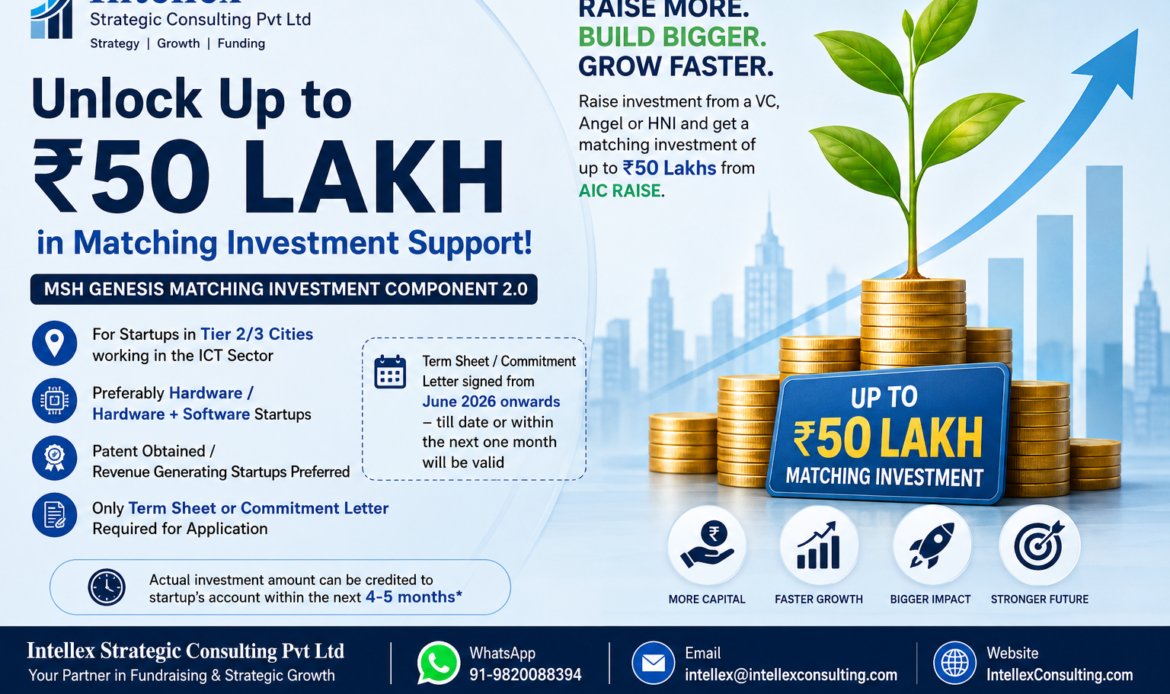
Under the opportunity announced by AIC RAISE, a qualifying startup that raises investment from a VC, Angel Investor or HNI may be able to receive a matching investment of up to ₹50 lakh.
In simple terms, a startup that successfully raises external capital may potentially be able to bring additional capital into the business through the GENESIS matching-investment mechanism.
That makes this opportunity particularly relevant for startups that are already in active fundraising discussions.
What Is MSH GENESIS?
GENESIS stands for Gen-Next Support for Innovative Startups.
It is a flagship startup initiative of the Ministry of Electronics and Information Technology (MeitY), implemented through MeitY Startup Hub (MSH).
The programme has an approved budgetary outlay of ₹490 crore over five years and is designed to strengthen India’s technology startup ecosystem, with particular emphasis on Tier-II and Tier-III cities.
The programme covers several forms of startup support, including:
- Entrepreneur-in-Residence support
- Pilot funding
- Investment support
- Deep-tech startup support
The investment component is particularly relevant to startups that have moved beyond the pure idea stage and are looking to raise capital for growth.
The original GENESIS framework provides for 1:1 private-sector matching funding for the investment component, with funding of up to ₹50 lakh.
This is important because the programme is not simply designed to replace private investment. Rather, the underlying philosophy is to use private investment as a catalyst for additional institutional support.
What Is the GENESIS Matching Investment Opportunity?
The concept is relatively straightforward.
Suppose an eligible technology startup is raising capital and an Angel Investor, HNI or Venture Capital fund agrees to invest in the company.
Under the matching-investment mechanism, the startup can potentially receive an additional investment from the GENESIS programme, subject to eligibility, evaluation and approval.
A simple example
Imagine that:
Private investor investment: ₹40 lakh
GENESIS matching investment: ₹40 lakh
Total potential capital available: ₹80 lakh
Similarly:
Private investment: ₹50 lakh
GENESIS matching investment: ₹50 lakh
Total potential capital: ₹1 crore
The maximum matching support under the GENESIS investment framework is ₹50 lakh.
This can significantly improve a startup’s ability to finance product development, manufacturing, hiring, sales expansion, technology development and market penetration.
However, founders should understand an important point:
This should not be viewed as a guaranteed ₹50 lakh grant.
The GENESIS investment component is structured around matching investment, and the programme framework contemplates equity-based/private-sector matching support. Actual funding remains subject to the applicable eligibility criteria, evaluation, documentation and approval process.
What’s New in Matching Investment Component 2.0?
According to the latest communication shared by AIC RAISE, the current Matching Investment Component 2.0 is particularly relevant to startups that are already negotiating an investment round.
The communication states that:
- The startup should be registered in a Tier-II or Tier-III city.
- The startup should operate in the ICT sector.
- Hardware and Hardware + Software businesses are preferred.
- Startups with a patent are preferred.
- Revenue-generating startups are preferred.
- A valid Term Sheet or Commitment Letter is sufficient for the application at this stage.
- Term Sheets or Commitment Letters signed from June 2026 onwards, up to the current date or within the following month, are considered valid under the communication.
- The actual investment may be credited to the startup’s bank account within approximately 4–5 months, subject to the relevant process and approvals.
These specific timelines and documentation requirements should be verified with the relevant implementing agency before a startup relies upon them for its fundraising plan.
The broader GENESIS framework itself confirms that the investment component is intended for startups raising funds from the market and is focused on bringing domestic capital into technology startups in Tier-II and Tier-III cities.
Who Should Seriously Consider Applying?
This opportunity is particularly interesting for startups that fall into one or more of the following categories.
1. Hardware Startups
Hardware startups often require considerably more capital than software startups.
Money may be required for:
- Product engineering
- Prototyping
- Tooling
- Manufacturing
- Testing
- Certification
- Inventory
- Supply-chain development
- Hardware R&D
A matching investment can therefore have a meaningful impact on the company’s ability to reach commercial scale.
2. Hardware + Software Startups
Startups combining physical products with software, AI, IoT, cloud platforms or analytics may be particularly well positioned.
Examples could include:
- IoT devices
- Industrial automation
- Smart manufacturing
- Connected healthcare devices
- Electronics
- Robotics
- Agritech hardware
- Smart mobility
- Energy technology
- Semiconductor-related solutions
- AI-enabled hardware
3. Revenue-Generating Technology Startups
A startup that has already demonstrated that customers are willing to pay for its product is generally in a stronger position than a company that has only developed a concept.
Revenue demonstrates some level of:
Product → Customer → Market → Commercial Validation
The AIC RAISE communication specifically indicates a preference for revenue-generating startups.
4. Startups With Intellectual Property
Patents and other forms of intellectual property can strengthen a startup’s investment proposition.
A proprietary technology can potentially provide:
- Competitive differentiation
- Barriers to entry
- Licensing opportunities
- Strategic value
- Higher defensibility
GENESIS-related implementing agencies have also indicated preference for startups with granted or filed patents.
Why the Investor’s Term Sheet Is So Important
One of the most interesting aspects of the current opportunity is the emphasis on an existing Term Sheet or Commitment Letter.
This changes the fundraising strategy for founders.
Instead of waiting until every aspect of the funding process is completed, an eligible startup that already has a serious investor commitment may be able to use that investment commitment as the starting point for accessing the matching-investment process.
For example:
Startup receives investor commitment → Startup submits eligible documentation → GENESIS process → Matching investment → Additional capital for growth
This creates a powerful incentive for founders to focus on getting a credible investor to the table.
It also means that startups should not treat fundraising as simply a search for money.
They need to build a compelling investment case.
What Investors Will Want to See Before Signing a Term Sheet
A government-backed matching opportunity does not eliminate the need for investor due diligence.
In fact, founders should assume that the private investor will conduct its own evaluation before making a commitment.
A startup seeking funding should therefore have a well-organised investment package covering:
Business Plan
Clearly explain:
- What problem you solve
- Who your customers are
- Why the problem matters
- How your solution works
- Why customers will choose you
Market Opportunity
Investors want to understand the size and growth potential of the market.
Explain:
- TAM
- SAM
- SOM
- Market growth
- Competitive landscape
- Target customers
Product & Technology
For technology startups, explain:
- Technology architecture
- Product development stage
- Proprietary technology
- Patents/IP
- Competitive advantages
- Product roadmap
Traction
Where possible, demonstrate:
- Revenue
- Customer numbers
- Repeat customers
- Purchase orders
- Partnerships
- Pilot projects
- User growth
- Gross margins
- Retention
Financials
Founders should have realistic:
- Revenue projections
- Expense projections
- Cash-flow projections
- Working-capital requirements
- Funding requirements
- Use-of-funds plan
Founding Team
Investors frequently invest as much in the team as in the product.
Explain why the founders are uniquely qualified to build the company.
How Much Should a Startup Raise?
One of the biggest mistakes founders make is deciding the fundraising amount simply because a particular funding programme offers a particular amount.
The correct approach is the opposite.
First determine:
How much capital does the company actually need to reach its next meaningful milestone?
For example, perhaps ₹75 lakh is required to:
- Complete product development
- Manufacture the first 1,000 units
- Obtain certifications
- Hire sales personnel
- Establish distribution
- Reach ₹2 crore annual revenue
The funding requirement should be built around these milestones.
If the startup raises too little, it may have to return to the market before achieving meaningful traction.
If it raises substantially more than required, unnecessary dilution may occur.
A Powerful Fundraising Strategy for Eligible Startups
For a startup that fits the GENESIS criteria, the following approach can be particularly effective.
Step 1: Establish Eligibility
Check:
- Location
- Sector
- Corporate structure
- DPIIT/startup recognition where applicable
- Ownership requirements
- Existing government support
- Product stage
- Revenue
- IP
- Other programme-specific conditions
Published GENESIS programme FAQs and implementing-centre guidelines indicate additional eligibility conditions may apply, including Indian incorporation/ownership and restrictions relating to certain previous government programmes.
Step 2: Prepare an Investor-Ready Pitch Deck
Do not prepare a pitch deck merely for the government programme.
Prepare it for investors.
It should answer the fundamental question:
Why should someone invest in this company today?
Step 3: Identify Appropriate Investors
Approaching hundreds of random investors is generally less effective than approaching investors whose:
- Ticket size
- Sector preference
- Geography
- Stage preference
- Investment philosophy
match the startup.
Step 4: Negotiate the Investment
The objective should be to secure a credible investment commitment from an eligible investor.
Step 5: Obtain a Valid Term Sheet or Commitment Letter
Under the current AIC RAISE communication, this is particularly important because a valid Term Sheet or Commitment Letter is required for the application at this stage.
Step 6: Apply Through the Appropriate Channel
The startup should follow the application and documentation process specified by the relevant implementing agency.
Step 7: Complete Due Diligence and Evaluation
Founders should be prepared for scrutiny of:
- Corporate documents
- Financials
- Cap table
- Investor commitment
- IP
- Revenue
- Technology
- Business model
- Promoter background
- Compliance
Step 8: Plan the Use of Funds
Once the funding is secured, every rupee should have a purpose.
A good funding plan should connect capital expenditure and operating expenditure to measurable milestones.
Why Tier-2 and Tier-3 Startups Should Pay Attention
India’s startup ecosystem has historically been concentrated around a handful of major cities.
But some of India’s most interesting technology businesses are emerging from smaller cities.
GENESIS was specifically designed to strengthen the startup ecosystem in Tier-II and Tier-III locations. The official scheme states that its objective is to create Tier-II/III-focused funding support for pilot, investment, early-stage and deep-tech startups.
This is significant.
A startup does not necessarily need to relocate to Bengaluru, Mumbai or Delhi to build a technology company.
With the right:
Technology + Team + Customers + Capital + Ecosystem Support
a startup based in a smaller city can potentially build a national or international business.
The Opportunity Is More Than Just ₹50 Lakh
Founders should also understand the strategic value of a matching-investment programme.
Suppose an investor is prepared to invest ₹50 lakh.
The startup may potentially be able to access another ₹50 lakh through matching investment, subject to programme approval.
The significance is not simply that the company receives ₹1 crore.
It is that:
Private investor confidence + institutional matching capital = stronger funding base
The additional capital can give the startup more runway to reach its next milestone.
It can also reduce the pressure on founders to return to the fundraising market too quickly.
What Founders Should Do Right Now
If you are a Tier-II or Tier-III technology startup and are already discussing investment with an Angel Investor, HNI or VC, this opportunity deserves immediate attention.
Do not wait until the investor transfers the money before investigating the matching-investment route.
Instead, discuss the opportunity with the investor while negotiating the round.
A founder can effectively approach the situation as:
“If we structure and document the investment appropriately, the startup may potentially qualify for a matching investment under the GENESIS programme.”
This can make the funding proposition more attractive to both sides.
At the same time, founders must avoid presenting the matching investment as guaranteed. Eligibility, evaluation, documentation and approval remain critical.
A Checklist for Startups
Before pursuing the opportunity, ask yourself:
- Is my startup registered in a qualifying Tier-II or Tier-III city?
- Does my business fall within the relevant technology/ICT focus?
- Is my company developing a technology product rather than simply providing conventional services?
- Do I have a working product or validated solution?
- Am I generating revenue?
- Do I have a patent or other defensible intellectual property?
- Am I currently raising capital?
- Do I have a credible VC, Angel or HNI investor interested?
- Can I obtain a valid Term Sheet or Commitment Letter?
- Is the proposed investment properly documented?
- Do I have clean financial and corporate records?
- Can I clearly explain how the funding will be deployed?
- Have I checked whether previous government assistance affects eligibility?
If the answer to most of these questions is yes, the opportunity could be worth exploring seriously.
Don’t Wait Until You Need Money to Become Fundable
One of the most important lessons for startup founders is that fundraising preparation should begin months before the actual requirement for capital.
A startup that starts looking for investors only after its bank balance becomes critical is already under pressure.
Investors prefer companies that have:
- A clear business model
- Strong founders
- Demonstrable traction
- Financial discipline
- Defensible technology
- A scalable market
- A realistic valuation
- A clear use-of-funds plan
Government-backed programmes such as GENESIS can complement this process, but they cannot substitute for investor readiness.
The strongest position for a startup is therefore:
Investor-ready + Programme-ready + Documentation-ready
Final Takeaway
The MSH GENESIS Matching Investment Component 2.0 could be a significant funding opportunity for eligible technology startups operating from Tier-II and Tier-III cities.
The fundamental attraction is simple: a startup that successfully raises private investment may potentially be able to access matching investment of up to ₹50 lakh, subject to the applicable GENESIS framework and current implementing-agency requirements. The official GENESIS scheme itself provides for 1:1 matching investment support up to ₹50 lakh.
For startups that already have an investor at the table, this can potentially turn a ₹50 lakh fundraising round into a much larger capitalisation opportunity.
For investors, it may provide another avenue to support promising technology businesses.
And for founders outside India’s traditional startup hubs, it represents an important reminder:
You do not necessarily have to be based in a major metropolitan startup hub to build an investable technology company.
What matters is the quality of the technology, the strength of the business, the market opportunity, the founding team and the ability to demonstrate genuine traction.
How Intellex Strategic Consulting Can Help Startups Raise Capital
Intellex Strategic Consulting Pvt Ltd works with startups and entrepreneurs on fundraising and strategic business requirements, helping them prepare for and approach suitable investors across Angel Investors, HNIs, Family Offices, Venture Capital and other sources of growth capital.
Our startup fundraising services can include fundraising strategy, investor identification, investor profiling, pitch-deck and investment-readiness support, preparation of fundraising material, investor outreach and assistance in navigating the funding process.
For startups looking to raise capital, the objective is not simply to find an investor, but to identify the right investors for the business, funding requirement, sector, stage and growth plans.
If your startup is currently raising funds—or has received investor interest and would like to explore whether a matching-investment opportunity such as GENESIS could complement the fundraising round—Intellex Strategic Consulting Pvt Ltd can assist you in evaluating the opportunity and strengthening your overall fundraising strategy.
Whatapp No: 91-9820088394
Email: intellex@intellexconsulting.com
Website: IntellexConsulting.com
Important Disclaimer: The GENESIS programme is a Government of India/MeitY initiative implemented through MeitY Startup Hub and designated implementing agencies. Eligibility, funding structure, documentation, timelines and application windows can vary by component and implementing agency and may be updated from time to time. The specific Matching Investment Component 2.0 dates and requirements mentioned in this article are based on the AIC RAISE communication provided for this article and should be independently confirmed with AIC RAISE/MSH or the relevant implementing agency before taking any funding decision.
VentureStreets.com
More Featured Posts:
Strategic Growth Capital for Manufacturing Businesses in India.
3 replies on “MSH GENESIS Matching Startup Investment 2.0: How Tier-2 and Tier-3 Startups Can Unlock Up to ₹50 Lakh in Additional Funding simply based on a matching investment from a VC.”
[…] MSH GENESIS Matching Startup Investment 2.0: How Tier-2 and Tier-3 Startups Can Unlock Up to ₹50 L… […]
[…] MSH GENESIS Matching Startup Investment 2.0: How Tier-2 and Tier-3 Startups Can Unlock Up to ₹50 L… […]
[…] MSH GENESIS Matching Startup Investment 2.0: How Tier-2 and Tier-3 Startups Can Unlock Up to ₹50 L… […]