


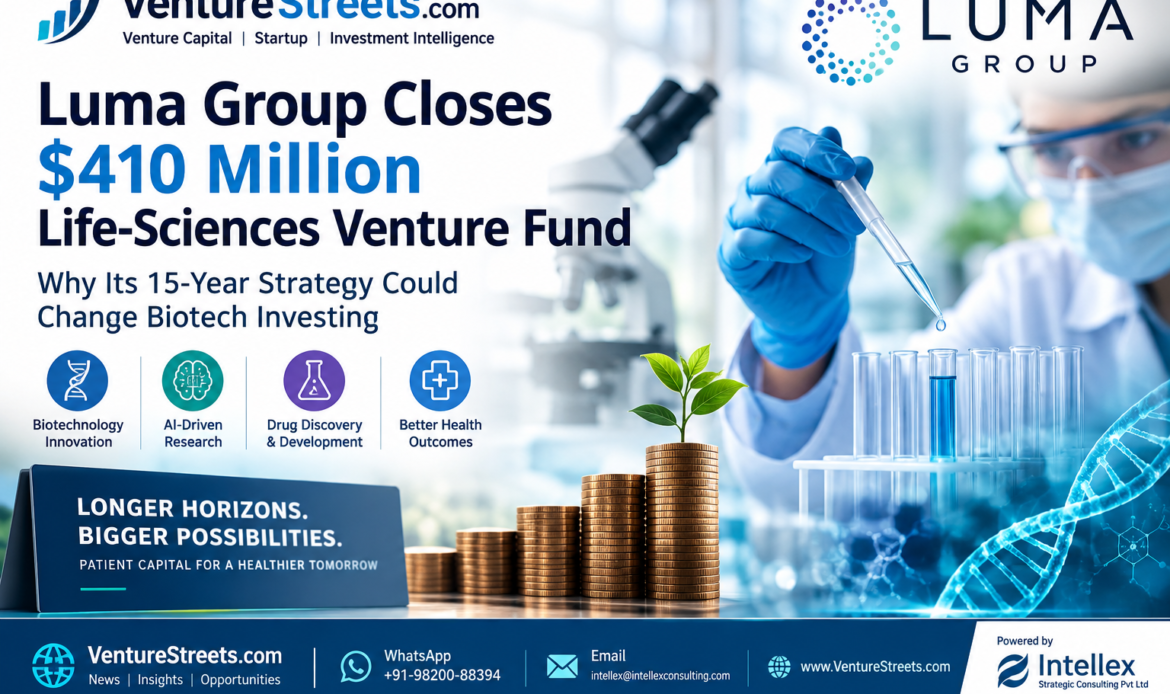
Luma Group Closes $410 Million Life-Sciences Venture Fund: Why Its 15-Year Strategy Could Change Biotech Investing.
VentureStreets.com | Venture Capital, Startup & Investment Intelligence
Published: September 2026
Luma Group has closed its $410 million LumaBio Fund I with a 15-year investment horizon. Explore its life-sciences VC strategy, AI focus, portfolio and implications for biotech investors.
The life-sciences venture-capital market has received a significant vote of confidence with the closing of LumaBio Fund I, the inaugural venture fund of New York-based Luma Group, with $410 million in committed capital.
What makes the development particularly notable is not simply the size of the fund, but its 15-year investment structure. At a time when conventional venture-capital funds often operate around a 10-year lifecycle, Luma is deliberately giving itself a longer runway to back companies developing medicines, diagnostics and medical technologies whose scientific and commercial journeys can take many years.
For venture investors, biotech founders and institutional capital allocators, the Luma strategy highlights a fundamental issue in healthcare investing: scientific innovation does not always follow the timetable of traditional venture capital.
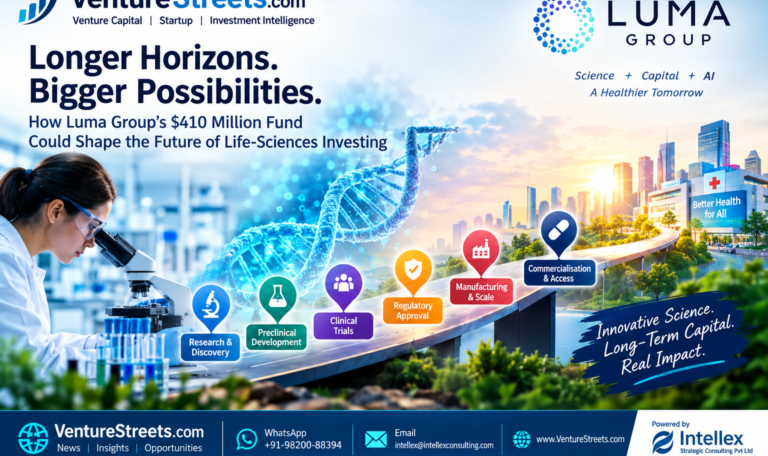
Luma Group’s $410 Million Fund
Luma Group announced the final close of LumaBio I LP on September 9, 2026, describing it as its inaugural life-sciences venture-capital fund.
The $410 million fund has attracted a global investor base comprising financial institutions, sovereign wealth funds, insurance companies, family offices and ultra-high-net-worth individuals.
The firm was founded in 2023, during a difficult period for biotechnology financing. Rather than treating the downturn as a reason to avoid the sector, Luma built its investment strategy around the belief that advances in biology, chemistry, physics, computation and artificial intelligence could significantly change the future of medicine.
Its new fund therefore represents more than another large pool of venture capital. It is effectively a bet that patient capital combined with scientific expertise and AI-enabled research can generate outsized outcomes in life sciences.
Why the 15-Year Fund Structure Matters
Perhaps the most interesting aspect of LumaBio Fund I is its 15-year investment horizon.
Traditional venture-capital structures can create pressure around fundraising cycles, portfolio maturation and exits. That model can work well for software and other technology businesses capable of scaling rapidly.
Biotechnology is different.
A promising therapeutic may require years of:
- Laboratory research
- Preclinical development
- Clinical trials
- Regulatory approvals
- Manufacturing development
- Commercialisation
- Post-approval expansion
A medical-device company or diagnostic platform can face similarly long development and regulatory cycles.
Luma’s longer structure is therefore designed to give the investor greater flexibility to remain involved as portfolio companies progress from scientific discovery toward commercialisation.
This is an important development for the venture-capital industry because it challenges the idea that every successful venture investment must mature within a relatively compressed fund cycle.
From Discovery to Commercialisation
Luma says the fund intends to invest early alongside entrepreneurs and scientific teams and retain the flexibility to support its highest-conviction companies through important milestones.
The strategy is particularly relevant to companies working at the intersection of:
Biotechnology + Artificial Intelligence + Computational Biology + Drug Discovery + Diagnostics + Medical Technology
The firm says its investment philosophy is based on the convergence of biology, chemistry, physics and AI.
Its approach combines scientific expertise with computational capabilities and a proprietary AI platform designed to inform investment decisions and support portfolio companies.
This suggests that Luma is positioning itself not merely as a financial investor but as a specialist scientific and strategic capital partner.
Luma’s Early Portfolio and Track Record
Although LumaBio Fund I has only now reached its final close, the fund has already been active.
Companies associated with Luma’s portfolio and investment activities include:
- Aeovian Pharmaceuticals
- Altos Labs
- Arsenal Biosciences
- Character Biosciences
- Coultreon Biopharma
- Curve Biosciences
- Integrated Biosciences
- Rome Therapeutics
- SciThera
- Vaccine Company
Luma has also backed additional companies operating in stealth.
The portfolio demonstrates that the strategy is not restricted to a single therapeutic category. Instead, Luma appears to be building exposure across different areas of scientific and technological innovation.
An Early Exit Provides an Important Validation
One of the most significant developments for Luma came from Vaccine Company, a business associated with the firm’s investment and company-building activities.
Earlier in 2026, Eli Lilly acquired Vaccine Company in a transaction valued at up to $1.55 billion. Luma described this as its first exit and an example of its strategy of identifying differentiated scientific platforms early and supporting them through important value-creation milestones.
For a new venture firm, achieving a meaningful strategic exit relatively early provides an important proof point.
It also demonstrates why long-term capital can be particularly valuable in biotechnology: investors need to identify promising science well before the ultimate commercial opportunity becomes obvious.
The Bigger Venture-Capital Trend
Luma’s fund comes at a time when specialist investors are continuing to raise substantial amounts of capital for biotechnology and life sciences.
The underlying investment argument is straightforward.
Healthcare represents one of the world’s largest economic sectors, while advances in:
- AI
- Gene editing
- Computational biology
- Precision medicine
- Cell and gene therapies
- Novel drug-delivery technologies
- Diagnostics
- Medical devices
could create entirely new categories of companies.
However, these opportunities frequently involve considerably more technical, regulatory and capital risk than conventional technology startups.
That creates an opportunity for investors with longer investment horizons and specialist scientific capabilities.
Luma’s 15-year fund structure can therefore be interpreted as a response to the economics of the underlying asset class rather than simply a fund-raising innovation.
Patient Capital Could Become Increasingly Important
The Luma model raises an important question for the broader venture-capital industry:
Should investment funds be structured around the needs of financial markets—or around the development timelines of the companies they finance?
In software, a startup can potentially move from seed funding to global scale in a relatively short period.
Developing a new medicine is fundamentally different.
A company can spend years generating scientific evidence before it reaches the stage where pharmaceutical companies, public markets or strategic acquirers place significant value on the technology.
A 15-year fund therefore gives investors the possibility of supporting a company across multiple stages rather than being forced toward an exit simply because the fund is approaching the end of its conventional lifecycle.
That does not eliminate risk. In fact, biotechnology remains one of the most uncertain areas of venture investing.
But it may allow investors to manage time risk more effectively.
AI Could Change How Life-Sciences Investors Conduct Due Diligence
Another important component of Luma’s strategy is the integration of artificial intelligence and computational analysis.
The firm has developed LABI — Luma AI Brain Initiative, a research platform designed to use large-scale datasets, analytical software and computational approaches to support scientific and investment research. Luma says the platform provides access to trillions of curated data points and is intended to improve the speed and depth of analysis.
For venture capital, this development could be significant.
Investment decisions in biotechnology require analysis of:
Scientific literature + clinical data + patents + competitive landscapes + regulatory developments + company teams + market opportunities.
AI can potentially help investors analyse these enormous information sets more efficiently.
However, AI does not eliminate the need for scientific expertise. Instead, the most powerful model may be AI-assisted investment decision-making combined with deep human scientific judgment.
What Luma’s Fund Means for Entrepreneurs
For life-sciences entrepreneurs, the emergence of long-duration funds could expand the pool of potential capital partners.
Founders developing highly technical businesses may benefit from investors who understand that value creation may occur over several scientific and commercial milestones.
The ideal investor may therefore not always be the fund offering the highest valuation.
It could be the investor offering:
- Sufficient capital
- Scientific expertise
- Long-term commitment
- Access to industry networks
- Follow-on funding
- Regulatory knowledge
- Pharmaceutical relationships
- Strategic guidance
- Commercialisation support
Luma’s approach appears designed around this broader definition of venture partnership.
Implications for India’s Life-Sciences Startup Ecosystem
The Luma development is also relevant to India.
India has a rapidly developing biotechnology, pharmaceutical, diagnostics and healthcare innovation ecosystem. Yet companies operating in these sectors often face a different financing challenge from conventional technology startups.
Scientific businesses can require larger amounts of capital over longer periods before reaching meaningful commercial scale.
The emergence of global funds willing to adopt longer-duration strategies could eventually create more opportunities for Indian founders with globally competitive science and technology.
For Indian life-sciences entrepreneurs, the lesson is clear: companies seeking international venture capital need more than a strong idea. They need credible science, defensible intellectual property, strong management, regulatory strategy and a clearly defined path from research to commercialisation.
The Larger Message for Venture Capital
Luma Group’s $410 million fund is significant because it combines three powerful investment themes:
1. Patient Capital
A 15-year structure recognises the unusually long development cycle of life-sciences companies.
2. Scientific Expertise
Investment decisions are built around specialised scientific research rather than conventional generalist VC analysis.
3. Artificial Intelligence
Computational tools and AI are being incorporated into the investment and research process.
Together, these elements represent a potentially important evolution in specialist venture capital.
The success of the strategy will ultimately depend on whether Luma can convert scientific opportunities into commercially valuable companies. But its early portfolio activity and the Vaccine Company exit provide an encouraging starting point.
Conclusion: A New Model for Life-Sciences Venture Capital?
The closing of LumaBio Fund I at $410 million is more than another venture-capital fundraising announcement.
It represents a broader argument about how capital should be deployed into businesses where scientific progress cannot be rushed.
By adopting a 15-year investment structure, combining scientific research with AI and computation, and seeking to support companies from discovery through commercialisation, Luma Group is positioning itself around the distinctive economics of life-sciences investing.
For founders, the development reinforces the importance of finding investors whose time horizons match the development cycle of the business.
For venture investors, it raises an equally important question: could patient, specialised capital become one of the defining competitive advantages in the next generation of biotechnology investing?
The answer may take years to emerge—appropriately, perhaps, for a fund designed to wait that long.
VentureStreets.com — Venture Capital & Startup Investment Intelligence
VentureStreets.com brings together news, analysis and investment intelligence covering venture capital, private equity, startups, fundraising, institutional investment, business finance and emerging investment opportunities.
For Investment & Strategic Advisory:
Intellex Strategic Consulting Pvt Ltd
📱 WhatsApp: +91-98200-88394
📧 intellex@intellexconsulting.com
🌐 VentureStreets.com
More Featured Articles:
1 reply on “Luma Group Closes $410 Million Life-Sciences Venture Fund: Why Its 15-Year Strategy Could Change Biotech Investing”
[…] Luma Group Closes $410 Million Life-Sciences Venture Fund: Why Its 15-Year Strategy Could Change Bio… […]