


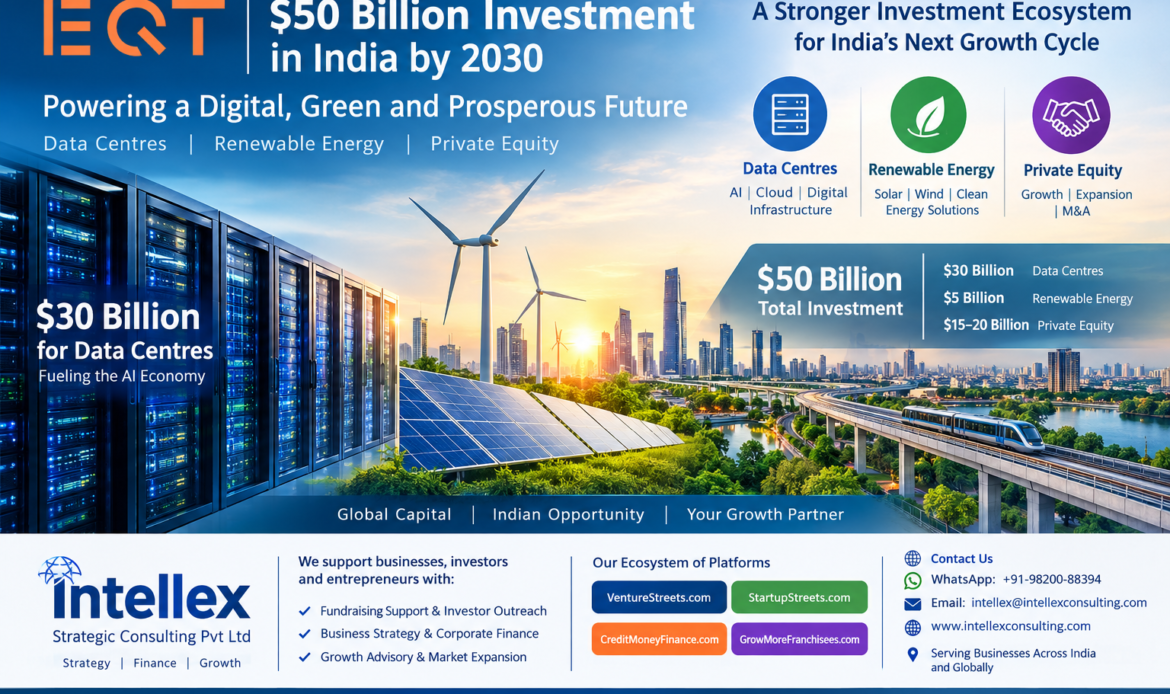
EQT to Invest $50 Billion in India by 2030: $30 Billion Data Centre Push Signals Massive Opportunity in AI, Energy & Infrastructure.
EQT’s $50 Billion India Investment Plan by 2030: Why Data Centres, AI, Renewable Energy and Private Equity Could Transform India’s Next Growth Cycle.
EQT plans to invest around $50 billion in India by 2030, including $30 billion in data centres. Explore the impact on AI infrastructure, renewable energy, private equity and India’s investment ecosystem.
EQT’s $50 Billion India Commitment: A Major Signal for the Next Phase of India’s Growth
India’s position on the global investment map is receiving another significant endorsement, with Swedish private markets investor EQT planning to invest around $50 billion in India by 2030.
According to a September 17, 2026 report by Business Standard, approximately $30 billion of the proposed investment could be directed towards data centres, while the balance is expected to be deployed across renewable energy and private equity opportunities.
The scale of the proposed investment is particularly notable because it brings together several of the themes currently reshaping India’s economy:
- Artificial intelligence
- Data centres
- Digital infrastructure
- Renewable energy
- Private equity
- Technology
- Healthcare
- Infrastructure
- Growth-stage businesses
For Indian businesses, entrepreneurs, investors and project developers, the announcement is more than simply a large investment number. It illustrates how global capital is increasingly looking at India as a long-term market for infrastructure, technology and private-market opportunities.
$30 Billion for Data Centres: AI Is Driving a New Infrastructure Cycle
The largest component of EQT’s proposed India investment is expected to be data centres.
EQT has indicated that it expects to deploy approximately $20 billion more into Indian data centres by 2030, taking its total investment in the segment to around $30 billion. Much of this expansion is expected to be undertaken through EdgeConneX, EQT’s global data-centre platform, and its joint venture AdaniConneX.
The significance goes well beyond the physical construction of data-centre buildings.
The rapid development of generative AI, cloud computing, enterprise software, digital services and high-performance computing is creating enormous demand for:
- Computing capacity
- Data storage
- High-speed connectivity
- Reliable electricity
- Cooling infrastructure
- Fibre networks
- Renewable power
- Energy storage
- Data security
- Digital infrastructure
EQT itself announced an AI Infrastructure strategy in April 2026, focused on the physical infrastructure required to support the AI economy. The strategy is being seeded by EdgeConneX and sits within EQT’s broader digital and energy infrastructure platform.
This makes India’s expanding digital economy an increasingly important investment theme.
Renewable Energy: Data Centres and Power Infrastructure Are Becoming Interlinked
One of the important consequences of the AI and data-centre boom is the growing requirement for reliable electricity.
Data centres operate continuously and require substantial amounts of power. As the computing requirements associated with AI increase, the connection between digital infrastructure and energy infrastructure becomes increasingly important.
EQT expects approximately $5 billion of its proposed India investment to go into solar and renewable energy, according to Business Standard.
This creates opportunities across a much broader ecosystem, including:
- Solar power generation
- Battery storage
- Green power procurement
- Transmission infrastructure
- Energy management
- Renewable-energy platforms
- Power-efficient data centres
- Industrial energy solutions
For entrepreneurs and project developers, this could create opportunities not only in large infrastructure projects but also in specialised technology and service businesses supporting the sector.
$15–20 Billion Expected for Private Equity
EQT’s proposed India allocation is not limited to infrastructure.
The firm expects approximately $15–20 billion to be allocated to private equity investments, according to the Business Standard report.
This is significant for India’s established businesses seeking institutional capital for:
- Expansion
- Acquisitions
- Internationalisation
- Capacity creation
- Professionalisation
- Technology transformation
- New-market entry
- Consolidation
- Pre-IPO growth
- Strategic restructuring
Private equity capital can also play an important role in helping established Indian companies move from entrepreneurial businesses into professionally managed, institutionally backed enterprises.
Why India Is Becoming Increasingly Important to Global Private Capital
EQT’s announcement comes against a broader backdrop of increasing global institutional interest in Asia.
EQT said in September 2026 that it had approximately $50 billion invested across Asia since 1997, while launching EQT Nexus Asia to provide eligible investors access to its Asia-Pacific platform.
EQT’s overall platform has also expanded considerably. Following its combination with Coller Capital, EQT reported total assets under management of approximately €341 billion ($389 billion) as of June 30, 2026.
Against this backdrop, India is being positioned not merely as an emerging-market allocation, but as a major long-term market within global private capital strategies.
What Does This Mean for Indian Businesses?
A large institutional investment programme can have effects far beyond the direct investments made by the investor.
For Indian companies, the potential opportunity can emerge at several levels.
1. Infrastructure Companies
Companies involved in data centres, energy, construction, engineering, cooling, electrical systems, fibre networks and related infrastructure could potentially benefit from expanding capital expenditure.
2. Technology Companies
AI, cloud, cybersecurity, data management, enterprise software and specialised technology businesses could benefit from the growing digital infrastructure ecosystem.
3. Renewable Energy Businesses
The increasing electricity requirements of digital infrastructure may create additional demand for renewable generation and energy-storage solutions.
4. Growth-Stage Companies
Private equity investment can provide growth capital to companies that have moved beyond the earliest startup phase and are looking for institutional funding.
5. M&A Opportunities
Large pools of private capital can also facilitate acquisitions and consolidation within fragmented sectors.
6. Professional Services
Investment of this magnitude generates demand for financial, legal, tax, accounting, due-diligence, valuation, investment banking, corporate restructuring and strategic advisory services.
The Opportunity Is Not Limited to Large Corporates
One important point for India’s entrepreneurial ecosystem is that large institutional investment can create second-order opportunities.
When a large data-centre or renewable-energy project is established, hundreds of suppliers and service providers may participate in the surrounding ecosystem.
These can include:
- Engineering companies
- Equipment manufacturers
- EPC companies
- Facility-management providers
- Technology companies
- Security providers
- Logistics companies
- Energy-management companies
- Construction businesses
- Real-estate developers
- Financial-services providers
Consequently, the investment cycle can potentially create opportunities for companies that may never receive direct investment from the large institutional investor itself.
India’s Startup Ecosystem Could Also Benefit
The development of large-scale infrastructure can create new markets for startups.
For example, entrepreneurs developing solutions around:
AI + Energy + Data + Security + Automation + Infrastructure
could find increasing commercial opportunities as businesses invest in next-generation infrastructure.
This is particularly relevant to startups that have moved from an experimental stage toward demonstrable commercial traction.
Investors generally need more than an attractive idea. They need to understand the business model, market opportunity, scalability, management team, financial performance, capital requirement and potential routes to value creation.
That makes professional preparation and investor targeting increasingly important as India’s funding ecosystem becomes more sophisticated.
What Entrepreneurs Should Take From the EQT Announcement
The most important lesson may be that capital is increasingly being organised around long-term structural themes.
Businesses positioned within areas such as AI infrastructure, renewable energy, digital infrastructure, healthcare, technology and scalable consumer or industrial platforms may increasingly encounter institutional investors looking for sizeable and credible investment opportunities.
However, attracting institutional capital requires preparation.
A company seeking investment should typically be prepared with:
- A clear investment proposition
- A well-developed pitch deck
- Historical financial information
- Forward projections
- A clearly defined funding requirement
- A credible use-of-funds plan
- Market and competitive analysis
- Corporate and legal documentation
- A well-defined investor target list
- A clear growth and exit strategy
The quality of investor targeting can be as important as the quality of the presentation.
India’s Next Investment Opportunity May Be Much Larger Than the Headline
The proposed $50 billion EQT investment programme is significant not simply because of its size, but because of what the allocation represents.
Approximately:
$30 billion → Data centres
$5 billion → Solar and renewable energy
$15–20 billion → Private equity
These figures, reported by Business Standard, illustrate the intersection of three major investment themes: digital infrastructure, energy transition and private capital.
For India, this comes at a time when the country’s technology, infrastructure and entrepreneurial ecosystems are expanding rapidly.
For businesses, the opportunity may therefore extend beyond obtaining capital directly. Companies can also participate as suppliers, technology providers, strategic partners, acquisition targets, project developers and service providers within the wider investment ecosystem.
Intellex Strategic Consulting: Supporting Businesses, Investors and Entrepreneurs
The increasing flow of global capital into India also highlights the importance of professional support for companies seeking investment, strategic growth and capital-market opportunities.
Intellex Strategic Consulting Pvt Ltd works with businesses and entrepreneurs on strategic and financial opportunities, including fundraising support, investor outreach, business strategy, corporate finance and growth-related advisory requirements.
With an India-focused and international outlook, Intellex can assist businesses in preparing their investment proposition, identifying relevant investor segments and developing structured approaches for approaching potential capital providers.
For startups and growth companies exploring international funding opportunities, Intellex’s ecosystem also includes specialised platforms such as:
- VentureStreets.com — Startup funding and investor outreach
- StartupStreets.com — Startup, investor and entrepreneurial ecosystem
- CreditMoneyFinance.com — Credit, finance and financial-services ecosystem
- GrowMoreFranchisees.com — Franchise and business expansion opportunities
Connect with Intellex Strategic Consulting Pvt Ltd
WhatsApp: +91-98200-88394
Email: intellex@intellexconsulting.com
Serving businesses across India and supporting international opportunities globally.
Conclusion
EQT’s proposed $50 billion investment in India by 2030, including an estimated $30 billion for data centres, represents a substantial long-term commitment to India’s digital infrastructure, renewable energy and private-equity landscape.
The announcement also reflects a broader transformation: AI is increasingly becoming an infrastructure story, and infrastructure is increasingly becoming an investment story.
As capital flows into data centres, renewable energy and growth businesses, opportunities can emerge throughout the wider ecosystem—from major infrastructure developers to technology companies, startups, suppliers, professional-service firms and businesses seeking institutional growth capital.
For Indian entrepreneurs and established businesses, the emerging opportunity is therefore not simply to watch the capital arrive—but to understand where they can participate in the value chain and how they can become investment-ready.
More Featured Articles:
Strategic Growth Capital for Manufacturing Businesses in India.