


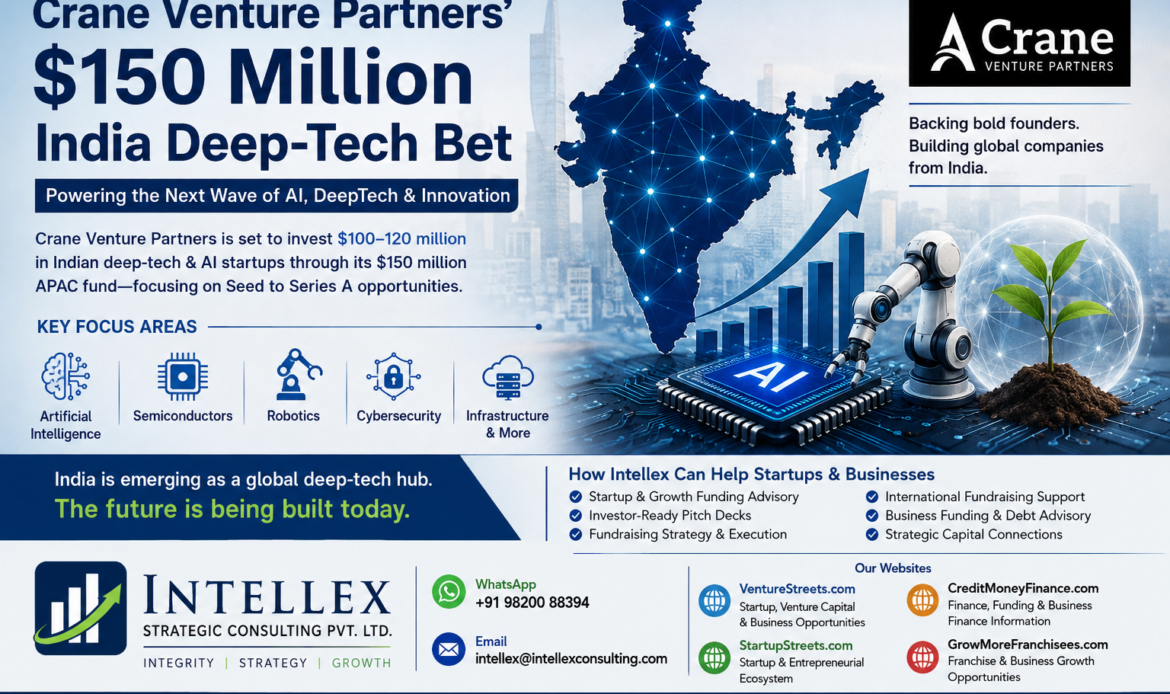
Crane Venture Partners’ $150 Million India Deep-Tech Bet: What It Means for AI, DeepTech & Startup Funding in 2026.
Explore Crane Venture Partners’ $150M APAC fund, its $100–120M India deep-tech focus, AI, robotics and semiconductor opportunities, incubation strategy and Series A funding—and how Intellex can assist startups with fundraising.
India’s deep-tech ecosystem is entering an important new phase. Global venture capital investors are increasingly looking beyond conventional software startups toward artificial intelligence, semiconductors, robotics, advanced manufacturing, cybersecurity, infrastructure technology and other technology-intensive businesses.
A recent development that highlights this shift is Crane Venture Partners’ $150 million Asia-Pacific fund and its growing focus on Indian AI and deep-tech startups. According to recent reports, Crane expects approximately $100–120 million of the fund to be deployed into Indian deep-tech and AI companies, primarily from seed through Series A.
The development is particularly significant because Crane’s strategy goes beyond simply writing investment cheques. The firm is also looking at a “build-and-back” approach, where it may help create or incubate companies alongside founders, while continuing to invest in startups it did not incubate and potentially lead Series A rounds.
For Indian founders, this represents an important evolution in the funding landscape.
Crane Venture Partners’ India Strategy: More Than Just Venture Capital
Crane Venture Partners is a London-based venture capital firm with a history of investing in technology businesses, including AI, cybersecurity, robotics, infrastructure software, developer tools and other deep-tech areas.
The firm’s APAC strategy was launched with a $135 million fund announced in September 2025, focused on early-stage founders across India, Singapore and Australia. More recent reporting indicates that the vehicle ultimately reached approximately $150 million after additional capital was raised.
India has emerged as a major component of this strategy.
Recent reports indicate that Crane expects to deploy roughly 75–80% of the APAC fund in India, translating into an estimated $100–120 million for Indian startups, although the allocation is not necessarily a hard ceiling.
This makes India one of the central markets in Crane’s APAC investment strategy.
What Makes the Strategy Different?
Traditional venture capital generally follows a relatively straightforward model:
Founder → Startup → Product → Fundraising → Investor → Growth
Crane’s approach introduces another pathway:
Technology Opportunity → Founder/Team → Co-Build or Incubate → Product → Investment → Scale
The firm has indicated that companies it helps create or incubate could eventually represent around one-third of its Indian portfolio. At the same time, it intends to invest in independently built companies and participate in Series A rounds.
This is an important distinction.
Deep-tech startups frequently face challenges that conventional SaaS or consumer internet businesses may not face to the same degree.
They may require:
- Significant R&D investment
- Highly specialised technical talent
- Longer product-development cycles
- Access to laboratories and testing infrastructure
- Hardware prototyping
- Regulatory approvals
- Intellectual-property development
- Manufacturing partnerships
- Enterprise pilot projects
- Government and institutional relationships
- Longer periods before commercial revenues scale
Consequently, capital alone may not be sufficient.
Strategic involvement from investors can become extremely valuable.
Why India Is Becoming Attractive for Deep-Tech Investors
India’s startup ecosystem has historically been particularly strong in software, IT services, fintech, SaaS, e-commerce and consumer technology.
However, the next phase of India’s startup story could increasingly involve technology creation rather than simply technology implementation.
Several factors are contributing to this transition.
1. Large technical talent pool
India has a vast engineering and technology talent base.
This creates an important foundation for companies developing:
- Artificial intelligence
- Machine learning
- Semiconductor technologies
- Robotics
- Computer vision
- Cybersecurity
- Aerospace technologies
- Quantum computing
- Industrial automation
- Defence technologies
- Climate technologies
2. Capital efficiency
Indian founders can potentially build sophisticated technology businesses with lower operating costs than comparable companies in some developed markets.
That does not eliminate the need for substantial capital, particularly for hardware and semiconductor businesses, but it can improve the economics of R&D-intensive ventures.
3. Large domestic market
India provides a substantial test market for technology companies.
A startup developing AI for healthcare, financial services, manufacturing, logistics, agriculture or enterprise operations can potentially test and refine its technology within India before expanding internationally.
4. Global opportunity
The most interesting Indian deep-tech startups are not necessarily building only for India.
Increasingly, founders are developing products for global markets from day one.
This is particularly relevant for:
- AI infrastructure
- Cybersecurity
- Enterprise software
- Semiconductor technologies
- Robotics
- Industrial technologies
- Developer infrastructure
Crane’s global network can potentially help portfolio companies connect with international investors, customers and strategic partners as they expand.
Key Investment Areas for Indian Founders
Recent reporting indicates that Crane’s areas of interest include AI, deep-tech, semiconductors, robotics, infrastructure and security, among other technology categories.
For founders, this creates several potential opportunity areas.
Artificial Intelligence
AI remains one of the most important investment themes globally.
However, investors are increasingly looking beyond generic AI applications.
Opportunities may include:
- AI infrastructure
- Vertical AI
- Enterprise AI
- AI agents
- AI-native applications
- AI security
- AI hardware
- Foundation technology
- Industry-specific AI
- AI-enabled healthcare
- AI-enabled manufacturing
The strongest companies are likely to demonstrate more than simply using an existing AI model.
They need to demonstrate defensibility, proprietary technology, distribution, data advantages, domain expertise or another meaningful competitive advantage.
Semiconductors
Semiconductors represent another strategically important opportunity.
India is attempting to build stronger capabilities across the semiconductor value chain, creating opportunities for startups involved in:
- Chip design
- Semiconductor IP
- Embedded systems
- Electronic design automation
- Testing
- Packaging
- Industrial electronics
- AI accelerators
- Edge computing
Deep-tech investors can play an important role because semiconductor businesses often require specialised expertise and patient capital.
Robotics
Robotics is another area where India’s engineering capabilities can potentially translate into globally competitive companies.
Applications include:
- Manufacturing
- Warehousing
- Logistics
- Healthcare
- Agriculture
- Defence
- Infrastructure inspection
- Energy
- Nuclear applications
- Hazardous-environment operations
The reported interest surrounding Bengaluru-based robotics startup Armatrix is one example of the increasing attention being given to Indian deep-tech robotics, although Armatrix itself disputed the reported fundraising discussions.
Seed to Series A: Why This Stage Matters
Crane’s strategy is particularly relevant for startups at the early stages of development.
Recent reporting indicates that the firm typically writes initial cheques in the range of approximately $2–3 million, while its initial investments can range from around $500,000 to $6 million, depending on the stage and opportunity. It can also participate in Series A opportunities.
For a deep-tech founder, this is significant.
A company may have:
- A strong technical founding team
- Proof of concept
- Early prototype
- Intellectual property
- Initial pilots
- Strong technical validation
…but still be several years away from becoming a large commercial enterprise.
The right early-stage investor can therefore provide not just funding but also:
Capital + Strategic Guidance + Networks + Customers + Talent + Follow-on Funding
That combination can materially influence the company’s trajectory.
What Deep-Tech Startups Should Understand About Fundraising
The availability of capital does not mean that every AI or deep-tech startup will automatically qualify for venture funding.
Investors generally want to understand five critical areas.
1. The problem
What important problem is the company solving?
2. The technology
What makes the technology genuinely differentiated?
3. The market
How large can the opportunity become?
4. The team
Does the founding team have the technical and commercial capability to execute?
5. The capital requirement
How much money is required to reach the next meaningful milestone?
A good fundraising proposal should therefore explain what the company will accomplish with the capital, rather than simply stating that it wants to raise money.
How Indian Founders Can Prepare for Global Investors
For founders looking to approach international venture capital investors, preparation becomes extremely important.
A professional investor-ready package should generally include:
Executive Summary
A concise overview of the company, problem, technology, market and funding requirement.
Investor Pitch Deck
A professionally structured presentation covering:
- Problem
- Solution
- Technology
- Product
- Market opportunity
- Business model
- Competition
- Competitive advantage
- Traction
- Customers
- Financial projections
- Funding requirement
- Use of funds
- Founders
- Investment proposition
Financial Model
Investors should be able to understand:
- Revenue assumptions
- Gross margins
- Operating costs
- Cash burn
- Runway
- Customer acquisition
- Capital requirements
- Future funding requirements
Technology Documentation
For deep-tech companies, this can be especially important.
It may include:
- Technical architecture
- IP ownership
- Patents
- Prototype status
- Technology validation
- Testing
- Certifications
- R&D roadmap
Commercial Validation
Where available, founders should document:
- Paying customers
- Purchase orders
- Letters of intent
- Pilot projects
- Enterprise partnerships
- Revenue
- Recurring revenue
- Customer pipeline
Incubation + Investment: A Powerful Combination
The most interesting aspect of Crane’s strategy may be the combination of incubation and venture investment.
An incubator can potentially help a founder move from:
Idea → Technology → Prototype → Product → Market
An investor can then provide capital to move from:
Product → Customers → Revenue → Scale → International Expansion
When these capabilities are combined, the startup can potentially receive support throughout a larger portion of its development journey.
This model is particularly relevant for deep-tech because technology development can be considerably more complicated than building a conventional software product.
What This Means for India’s Startup Ecosystem
Crane’s India strategy is part of a broader trend.
Global investors are increasingly recognising that India can produce companies in sophisticated technology categories rather than only in traditional software and services.
The emerging ecosystem could increasingly produce globally relevant companies in:
AI + Semiconductors + Robotics + Cybersecurity + SpaceTech + DefenceTech + ClimateTech + IndustrialTech + HealthTech + Quantum Computing
This could eventually create a new generation of Indian technology companies with global intellectual property and international revenues.
Opportunities for Founders Beyond the Funding Cheque
A sophisticated founder should not evaluate an investor solely by the amount of capital available.
The more important questions are:
- Can the investor help recruit senior talent?
- Can the investor introduce global customers?
- Can the investor help with international expansion?
- Can the investor support subsequent fundraising?
- Can the investor provide strategic guidance?
- Can the investor introduce other investors?
- Can the investor understand deep technology?
- Can the investor support the company through difficult development periods?
For deep-tech startups, strategic value can sometimes be as important as financial capital.
How Intellex Strategic Consulting Pvt. Ltd. Can Help Startups
For founders looking to raise capital in India or internationally, Intellex Strategic Consulting Pvt. Ltd. provides professional advisory support for businesses and startups seeking funding and strategic capital.
We work with founders and businesses to help them become more investor-ready, identify appropriate funding strategies and present their opportunities professionally to potential investors and funding sources.
Our advisory support can include:
Startup & Growth Funding Advisory
Helping startups and growth companies structure their funding requirements and develop a clear fundraising strategy.
Investor-Ready Pitch Decks
Helping founders present their:
- Business model
- Technology
- Market
- Traction
- Competitive advantage
- Financial opportunity
- Funding requirement
in a professional investor-oriented format.
Fundraising Strategy
Helping businesses evaluate potential sources of capital, including:
- Venture Capital
- Private Equity
- Strategic Investors
- Family Offices
- Institutional Investors
- Corporate Investors
- Growth Capital
International Fundraising
For businesses with global ambitions, we can assist with developing an international fundraising strategy and preparing professional investment documentation suitable for approaching potential investors across markets.
Business Funding & Debt Advisory
In addition to equity fundraising, Intellex also works with businesses seeking appropriate debt and structured funding solutions, depending on eligibility and business requirements.
A New Funding Opportunity for Indian Deep-Tech Founders
The Crane development sends an important message to India’s technology ecosystem:
Global investors are increasingly looking for the next generation of Indian technology companies capable of competing internationally.
For founders building serious businesses in AI, deep-tech, semiconductors, robotics, cybersecurity and advanced technology, the opportunity is significant.
However, capital is increasingly selective.
The startups most likely to attract serious institutional interest will need to demonstrate:
Strong technology + Strong founding team + Large market + Defensible IP + Commercial validation + Capital efficiency + Global ambition
The rise of build-and-back investment strategies may make the ecosystem even more interesting because founders may increasingly have access to investors who can participate not only in financing but also in company creation and development.
Conclusion
Crane Venture Partners’ $150 million APAC strategy, with an expected $100–120 million potentially directed toward Indian AI and deep-tech startups, highlights the growing international confidence in India’s technology ecosystem.
The firm’s willingness to combine incubation, early-stage investment and Series A participation represents an interesting evolution in venture capital and could be particularly relevant for capital-intensive technology companies.
For Indian founders, the message is clear:
The next major wave of Indian entrepreneurship may not simply be about building larger businesses—it may be about building globally significant technology.
Founders who are developing genuinely differentiated technology should therefore begin preparing early for institutional fundraising, rather than waiting until they urgently need capital.
Intellex Strategic Consulting Pvt. Ltd. can assist startups, entrepreneurs and growth companies in India and internationally with funding strategy, investor readiness, fundraising documentation and strategic capital advisory.
About Intellex Strategic Consulting Pvt. Ltd.
Intellex Strategic Consulting Pvt. Ltd. is a professional strategic consulting and financial advisory firm assisting startups, entrepreneurs and businesses with funding, capital raising, financial solutions and strategic growth requirements.
For Funding & Strategic Advisory Enquiries:
📱 WhatsApp: +91 98200 88394
📧 Email: intellex@intellexconsulting.com
Our Websites
🌐 VentureStreets.com – Startup, Venture Capital & Business Opportunities
🌐 StartupStreets.com – Startup & Entrepreneurial Ecosystem
🌐 CreditMoneyFinance.com – Finance, Funding & Business Finance Information
🌐 GrowMoreFranchisees.com – Franchise & Business Growth Opportunities
More Featured Articles:
Top Angel Networks in Australia: The Complete 2026 Guide for Startups Seeking Early-Stage Funding.
Top Angel Networks in India: A Comprehensive Guide for Startups Seeking Early-Stage Funding (2026).
Launch Your Own Skincare, Haircare & Personal Care Brand Through White-Label Manufacturing.
2 replies on “Crane Venture Partners’ $150 Million India Deep-Tech Bet: What It Means for AI, DeepTech & Startup Funding in 2026.”
[…] Crane Venture Partners’ $150 Million India Deep-Tech Bet: What It Means for AI, DeepTech &… […]
[…] Crane Venture Partners’ $150 Million India Deep-Tech Bet: What It Means for AI, DeepTech &… […]