
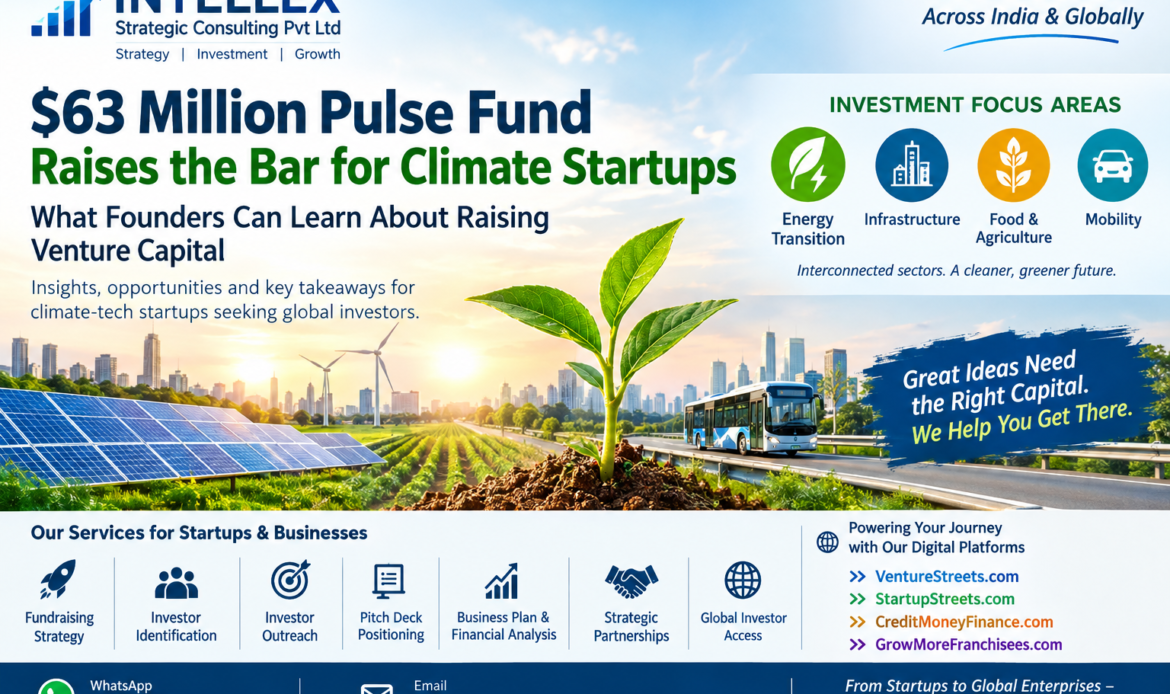
$63 Million Pulse Fund Raises the Bar for Climate Startups: What Founders Can Learn About Raising Venture Capital.
Pulse Fund has raised $63 million for early-stage climate companies across energy, infrastructure, food, agriculture and mobility. Here are key fundraising lessons for startups seeking global investors.
A $63 Million Fund With a Cross-Sector Approach to Climate Investing
The global climate-tech investment landscape has received a significant new signal with Pulse Fund announcing the close of its inaugural $63 million venture capital fund.
Led by Founder and Managing Partner Tenzin Seldon, Pulse Fund says it will invest in early-stage, scalable climate companies operating across four interconnected areas: energy transition, infrastructure, food and agriculture, and mobility.
For startup founders, however, the significance of this development extends beyond the headline figure.
The bigger lesson is about how investors are increasingly looking at businesses that operate at the intersection of multiple industries rather than fitting neatly into one sector.
Pulse Fund describes its philosophy around the idea that the world’s economic and environmental systems are interconnected. Its investment thesis therefore looks for opportunities where innovation in one sector can create value in another.
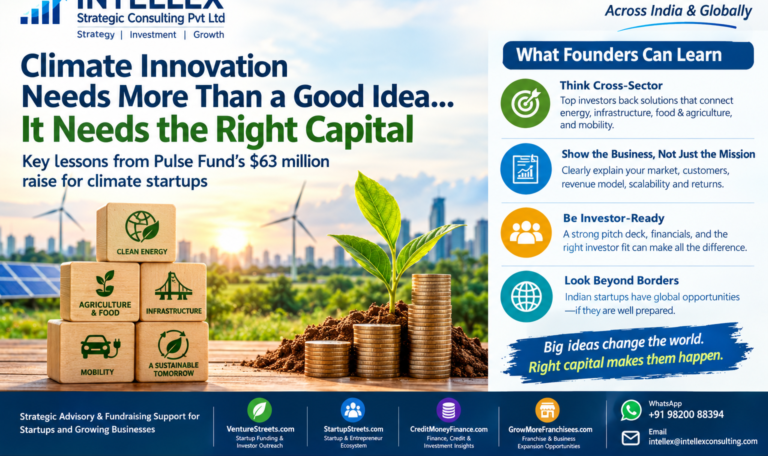
That approach offers several important lessons for founders preparing to raise institutional capital.
Who Is Behind Pulse Fund?
Pulse Fund is led by Tenzin Seldon, Founder and Managing Partner.
According to the firm’s profile, Seldon has more than two decades of experience working with climate technologies and has held leadership, advisory and board roles across climate, technology and nonprofit organisations. Before launching Pulse, she worked with the United Nations Environment Programme in Thailand and later moved into building and scaling climate-related businesses and venture investing.
Pulse’s first fund has attracted institutional investors, corporations, family offices and other strategic investors. The announced backers include Beneficient, C6 Partners, Pivotal Foundation, the Pritzker family, Veronica Chou and others, including an Asian sovereign wealth fund.
The firm has also already invested in companies including Endera, Floodbase, InventWood, it’s electric, Mast Reforestation, Plantible, Twelve and Unravel Carbon.
What Does Pulse Fund Invest In?
The fund’s investment areas are particularly relevant to founders because they illustrate how a modern climate investor can define its opportunity set.
1. Energy Transition
Energy transition remains central to climate investing.
This includes businesses involved in areas such as:
- Renewable energy
- Energy storage
- Grid technologies
- Energy efficiency
- Electrification
- Decarbonisation technologies
- Clean-energy infrastructure
- Technologies supporting industrial transition
For founders, the lesson is that an energy startup should not present only its technology.
The investment case should also explain the size of the market, customer economics, scalability and the role the technology can play in a broader transition.
2. Infrastructure
Climate infrastructure can require substantial capital and traditionally involves long development cycles.
Pulse says it is interested in companies developing capital-efficient and software-enabled approaches to transforming infrastructure systems at scale.
This is an important distinction for startups.
A founder pitching an infrastructure solution should clearly explain:
Problem → Technology → Customer → Deployment Model → Revenue → Capital Requirement → Scalability
Investors need to understand not merely what the technology does, but how it becomes a commercially scalable business.
3. Food & Agriculture
Food and agriculture represent another enormous climate and economic system.
Opportunities can include:
- Agricultural technology
- Alternative proteins
- Regenerative agriculture
- Water efficiency
- Supply-chain optimisation
- Food production technology
- Carbon-efficient farming
- Resource efficiency
Pulse’s thesis specifically considers food systems within the wider climate ecosystem rather than treating agriculture as an isolated vertical.
For startups, this demonstrates why cross-sector positioning can sometimes strengthen an investment proposition.
An agricultural technology company, for example, could potentially demonstrate relevance to food security, water management, energy consumption, supply-chain efficiency and climate resilience.
4. Mobility
Mobility is another major area of climate investment.
The opportunity extends beyond electric vehicles themselves.
It can include:
- Fleet electrification
- Charging infrastructure
- Battery technologies
- Mobility software
- Transportation efficiency
- Sustainable logistics
- Fleet-management technology
- Alternative transportation systems
Pulse’s portfolio includes Endera, an electric commercial vehicle company, illustrating the firm’s interest in businesses connecting mobility with broader infrastructure and energy-transition themes.
The Most Important Lesson for Startup Founders: Investors Buy the Business, Not Just the Idea
One of the biggest mistakes made by early-stage companies is assuming that a powerful mission automatically creates an investment case.
It doesn’t.
A compelling startup fundraising proposition normally needs to answer several questions:
What problem are you solving?
The problem should be measurable and significant.
Who will pay for the solution?
The customer must be clearly identified.
Why will customers pay?
Founders should demonstrate economic value, not simply technological superiority.
Why now?
Investors need to understand why market conditions make the opportunity timely.
What makes the company difficult to replicate?
This could include intellectual property, technology, data, distribution, network effects, manufacturing capabilities, regulatory positioning or other defensibility.
How large can the company become?
Venture capital investors generally need businesses capable of producing substantial growth.
What will the investment accomplish?
The founder should connect the funding requirement with specific milestones.
Climate Startups Should Think Beyond the “Climate” Label
The Pulse Fund example also illustrates a broader fundraising principle.
A startup should not necessarily describe itself only according to its industry label.
Consider a hypothetical battery technology company.
It could be described as:
“A battery technology startup.”
But the investment proposition could potentially be much broader:
“A technology platform enabling lower-cost electrification across transportation, energy storage and distributed infrastructure.”
The second description communicates a larger potential market and demonstrates cross-sector relevance.
Of course, the positioning must be supported by the actual business. Founders should never artificially expand their market simply to impress investors.
The Rise of Cross-Sector Startup Investment
Pulse Fund explicitly describes its investment philosophy around interconnected systems and “cross-sector interdependencies.”
That concept is worth examining carefully.
Many major technology opportunities are no longer confined to a single industry.
For example:
AI + Energy
AI requires computing infrastructure, data centres, electricity and cooling.
Mobility + Energy
Electric mobility requires batteries, charging infrastructure, grid capacity and energy generation.
Agriculture + Water + Climate
Agricultural productivity is closely connected with water availability, resource efficiency and climate resilience.
Infrastructure + Software
Traditional infrastructure can increasingly be combined with software, sensors, data analytics and automation.
For founders, identifying these connections can help build a more comprehensive investment narrative.
What Should Be Inside a Startup Investor Pitch Deck?
A fundraising deck should make it easy for an investor to understand the business quickly.
A practical structure could include:
1. Company Overview
What the company does in one clear sentence.
2. Problem
The problem and its economic significance.
3. Solution
What the startup has built.
4. Product / Technology
How the solution works and what differentiates it.
5. Market Opportunity
TAM, SAM and realistically addressable opportunity.
6. Business Model
How the company generates revenue.
7. Traction
Customers, revenue, growth, contracts, pilots, partnerships or other measurable indicators.
8. Competitive Landscape
Who else operates in the space and why the company is differentiated.
9. Unit Economics
Where relevant, CAC, gross margin, contribution margin, payback period and other important metrics.
10. Growth Strategy
How the company will acquire customers and expand.
11. Management Team
Why this particular team can execute the plan.
12. Fundraising Requirement
Amount being raised, proposed use of funds and milestones expected from the round.
13. Future Capital Requirements
Where appropriate, explain how the current round fits into the longer-term financing strategy.
Revenue and Traction Can Change the Fundraising Conversation
One of the most useful developments for a startup is the transition from an idea-driven fundraising story to an evidence-driven investment story.
A startup with:
- Paying customers
- Recurring revenue
- Strong month-on-month growth
- High retention
- Strategic partnerships
- Demonstrable gross margins
- Repeat orders
- Commercial contracts
can present investors with substantially more information than a concept-stage company.
That doesn’t mean early-stage startups without revenue cannot raise capital.
It means the type of evidence required changes with the maturity of the business.
India’s Climate-Tech Startup Ecosystem Has an International Opportunity
Indian founders are increasingly building businesses relevant to global climate and infrastructure challenges.
Potential areas include:
- Renewable energy
- Battery technology
- Electric mobility
- EV components
- Waste management
- Recycling
- Water technology
- Climate analytics
- Agricultural technology
- Alternative materials
- Green manufacturing
- Carbon management
- Industrial decarbonisation
- Energy efficiency
- Sustainable supply chains
For Indian startups, the global investor universe can therefore extend well beyond traditional domestic venture capital.
However, international fundraising requires careful preparation.
A foreign investor may examine:
- Corporate structure
- Intellectual property ownership
- Cap table
- Financial statements
- Regulatory compliance
- Existing investors
- Customer concentration
- Founder agreements
- Tax structure
- International expansion plans
- Exit potential
- Governance
This makes investor readiness increasingly important.
Don’t Send the Same Pitch Deck to Every Investor
Another important fundraising lesson is that investor targeting matters.
A climate-tech startup should distinguish between:
Climate VC funds
Generalist VC funds
Corporate strategic investors
Family offices
Impact investors
Growth investors
Infrastructure investors
Private equity investors
Government-backed funds
Sector-specific investors
Each category can have different investment mandates, cheque sizes, geographic preferences and risk expectations.
A founder seeking a $1 million seed round should not approach an investor whose normal cheque size is $50 million.
Likewise, a hardware startup with a five-year commercialisation cycle may not fit a fund focused exclusively on software businesses.
Investor-startup fit is therefore one of the most important components of an efficient fundraising process.
How VentureStreets Can Help Startups Approach Global Investors
For startups looking to raise capital, VentureStreets.com focuses on startup funding advisory and investor outreach.
The objective is not simply to produce a long list of investor names.
The more important process is to identify investors whose:
- Sector mandate
- Stage preference
- Geography
- Ticket size
- Investment thesis
- Portfolio interests
- Strategic requirements
align with the startup’s fundraising opportunity.
For Indian startups, this can include exploring investors in India as well as relevant international investors.
For startups outside India, investor targeting can similarly be structured around the company’s stage, sector, geography and existing institutional backing.
Where Intellex Strategic Consulting Comes In
Intellex Strategic Consulting Pvt Ltd works with businesses and startups on strategic, financial and investment-related requirements across India and internationally.
For startups preparing for fundraising, the focus can include:
- Fundraising strategy
- Investor identification
- Investor outreach
- Pitch-deck positioning
- Financial analysis
- Business-plan preparation
- Investor communication
- Strategic partnerships
- Capital-raising support
- Growth strategy
The firm’s startup and investment ecosystem is supported by its digital platforms, including:
VentureStreets.com – Startup funding and investor outreach
StartupStreets.com – Startup, entrepreneurship and investor ecosystem
CreditMoneyFinance.com – Finance, credit and investment information
GrowMoreFranchisees.com – Franchise and business expansion opportunities
A Practical Fundraising Checklist for Founders
Before approaching investors, founders should ideally have the following ready:
☑ Investor-ready pitch deck
☑ Executive summary
☑ Detailed financial projections
☑ Current cap table
☑ Revenue and growth data
☑ Customer / contract information
☑ Market-size analysis
☑ Competitive analysis
☑ Founder and management profiles
☑ Use-of-funds plan
☑ Valuation expectations or fundraising framework
☑ Corporate and legal documentation
☑ Data room
☑ Clearly defined investor profile
Most importantly, founders should be able to explain their company in 30 seconds, three minutes and 30 minutes.
If the story changes dramatically between those three formats, the pitch probably needs further refinement.
The Bigger Message From the $63 Million Pulse Fund
The announcement of Pulse Fund’s $63 million inaugural fund is significant for founders because it demonstrates that specialised capital continues to develop around climate and interconnected technology opportunities.
But the more useful lesson for entrepreneurs is this:
Capital follows clearly articulated opportunities.
Technology alone is not enough.
A startup needs to demonstrate a credible connection between:
Technology → Customer → Revenue → Scale → Capital → Returns
Climate startups have an additional opportunity to demonstrate how their solution intersects with multiple economic systems.
That is precisely where the concept of cross-sector investing becomes relevant.
For founders, the objective should not be to copy Pulse Fund’s pitch or investment thesis. Instead, it is to understand the broader fundraising principle: investors need to see both the problem being solved and the economic engine capable of creating a scalable company.
Looking to Raise Capital? Start With Investor Readiness
If your startup is preparing to raise equity funding in India or internationally, Intellex Strategic Consulting Pvt Ltd can assist with fundraising strategy, investor identification, investor outreach and related strategic requirements.
Contact Intellex Strategic Consulting Pvt Ltd
📱 WhatsApp: +91 98200 88394
📧 Email: intellex@intellexconsulting.com
🌐 VentureStreets.com
🌐 StartupStreets.com
🌐 CreditMoneyFinance.com
🌐 GrowMoreFranchisees.com
For startups, the objective is not simply to find an investor. It is to find the right capital for the right stage, sector, geography and growth strategy.
Source note: Pulse Fund’s $63 million inaugural fund announcement was reported on September 18, 2026. Pulse Fund’s official website confirms its focus on scalable climate companies across energy transition, infrastructure, food and agriculture, and mobility.
More Featured Articles: