
Asiana Fund & JC Capital Launch ₹1,000 Crore Deep-Tech Fund: Funding Opportunity for Indian Startups in Semiconductors, Robotics, Manufacturing & Aerospace.
Asiana Fund and Taiwan’s JC Capital have launched a ₹1,000 crore fund for Indian deep-tech and advanced manufacturing startups. Here is what founders should know about eligibility, sectors, funding stages, commercialisation and investor readiness.
A Major New Funding Opportunity Is Emerging for India’s Deep-Tech Startup Ecosystem
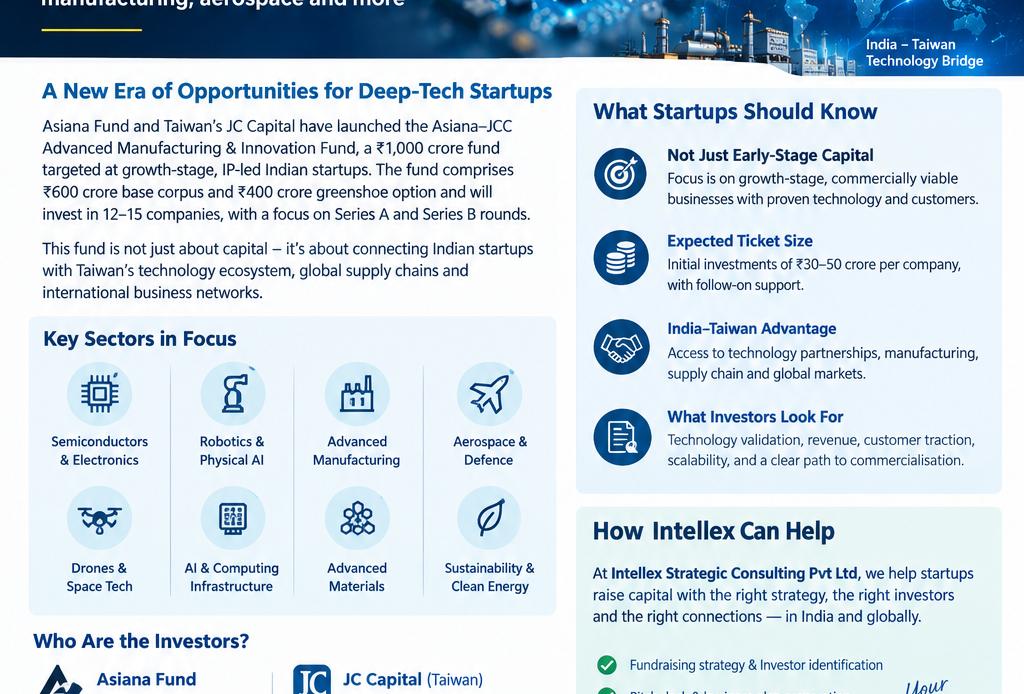
India’s startup funding landscape is seeing an important development with Asiana Fund and Taiwan-based JC Capital launching the Asiana–JCC Advanced Manufacturing & Innovation Fund, a fund with a targeted size of ₹1,000 crore.
The fund consists of a ₹600 crore base corpus and a ₹400 crore greenshoe option and is designed primarily to invest in growth-stage, IP-led businesses operating in areas such as advanced manufacturing, robotics, semiconductors, computing, advanced materials, sustainability, aerospace and defence. The fund intends to build a concentrated portfolio of approximately 12–15 companies, with capital also reserved for follow-on investments.
For founders, however, the significance of the announcement goes beyond the headline ₹1,000 crore figure.
The fund is being positioned as an India–Taiwan technology and industrial ecosystem bridge, potentially giving selected startups access not only to capital but also to technology partnerships, manufacturing capabilities, supply chains and international business relationships.
Official Asiana Fund – Advanced Manufacturing & Innovation Fund
What Is the Asiana–JCC Advanced Manufacturing & Innovation Fund?
The fund is a SEBI-registered Category II AIF, co-sponsored by Asiana Fund and JC Capital of Taiwan.
According to Asiana’s fund information, the vehicle has a stated size of approximately US$105 million, corresponding broadly to the ₹1,000 crore headline size, with sponsor commitments exceeding 20% of the corpus. The stated fund tenure is eight years, with two possible one-year extensions.
The fund’s stated investment areas include:
- Advanced manufacturing
- Robotics and Physical AI
- Semiconductors
- Computing and AI infrastructure
- Advanced packaging and electronics
- Advanced materials
- Sustainability and energy technologies
- Aerospace
- Defence technology
- Drones and space technology
- Med-tech and technology-enabled industrial businesses
- Other IP-led businesses with differentiated technology
The official fund description specifically highlights technologies such as Smart Industrial 4.0 automation, precision components, robotics, next-generation AI chip architectures, HPC, data-centre ecosystems, edge computing, advanced materials, storage technologies, aerospace components, drones and sovereign defence systems.
Who Is Behind the Fund?
Asiana Fund
Asiana Fund is associated with Jalaj Dani, co-promoter of Asian Paints, and has been active in India’s technology and industrial investment ecosystem.
According to Asiana, since 2017 it has deployed more than US$75 million across 11 private-equity investments, building experience across sectors including advanced manufacturing, robotics, drones, medtech and cleantech.
Asiana describes its broader investment philosophy around long-term value creation, active partnering, governance, operational support and helping companies move from startup to maturity.
JC Capital
JC Capital is a Taiwan-based investment firm with exposure to technology sectors including semiconductors, AI/AIoT, clean technology, robotics, automation and computing infrastructure.
Its involvement is particularly significant for startups looking for more than financial capital because the partnership is intended to connect Indian businesses with Taiwan’s technology and electronics ecosystem. JC Capital’s own fund information also highlights semiconductor supply chains, AI and automation, advanced packaging, healthcare, fintech and data-centre infrastructure among its investment themes.
The Most Important Point for Startups: This Is Not Simply an Early-Stage Deep-Tech Fund
This distinction is critical.
A startup developing a technology in a laboratory with no validated product, customers or commercialisation pathway should not automatically assume that this fund is designed for it.
The fund’s stated strategy is focused on growth-stage, IP-led businesses, and reporting around the launch indicates a primary focus on Series A and Series B companies.
ETEntrepreneur reported that the fund is looking for companies where technology has already been proven and there is a credible route toward commercialisation and scale, rather than making very early R&D-stage bets.
In practical terms, founders should be able to demonstrate:
Technology → Product → Customers → Revenue → Scale
rather than merely:
Idea → R&D → Future potential
This distinction could substantially affect how founders prepare their fundraising proposition.
What Types of Startups Could Potentially Fit the Fund’s Thesis?
Based on the publicly stated investment themes, companies operating in the following areas may find the fund’s mandate particularly relevant.
1. Semiconductor Startups
Potentially relevant businesses include:
- Chip design
- Semiconductor IP
- Compound semiconductors
- Power semiconductors
- Advanced semiconductor technologies
- Semiconductor equipment
- Advanced packaging
- Electronics manufacturing technologies
- Secure silicon
- AI chips
- High-performance computing
- Edge computing
The fund’s official materials specifically mention next-generation AI core chip architectures, HPC, semiconductors and computing ecosystems.
2. Robotics & Physical AI
The investment thesis extends beyond conventional software AI.
Potential areas include:
- Industrial robotics
- Autonomous systems
- Robotic vision
- Motion-control systems
- Smart manufacturing
- Factory automation
- Physical AI
- Industrial 4.0
- Autonomous machines
Recent reporting around the fund’s initial pipeline has cited businesses working on robotic vision, motion-control systems and other industrial technologies.
3. Advanced Manufacturing
This could be particularly significant for Indian startups developing technologies that improve:
- Manufacturing productivity
- Precision engineering
- Industrial automation
- Electronics manufacturing
- Components
- Industrial software
- Manufacturing processes
- Supply-chain efficiency
- Smart factories
The fund’s stated objective is closely connected to developing globally competitive technology and manufacturing businesses from India.
4. Aerospace, Defence, Drones & Space Technology
The official fund thesis includes:
- Aerospace components
- Defence systems
- Strategic technologies
- Drones
- Space technology
This is an area where Indian startups have increasingly been developing proprietary hardware and engineering capabilities.
For such businesses, investors may examine not only the technology but also regulatory approvals, defence procurement pathways, manufacturing capability, certifications, customer concentration and the ability to scale production.
The India–Taiwan Connection Could Be as Important as the Capital
This is perhaps the most distinctive feature of the new fund.
The partnership is intended to connect Indian startups with Taiwan’s semiconductor, electronics and manufacturing ecosystem.
The stated objectives include:
Technology transfer
Technology partnerships
Supply-chain integration
Global corporate relationships
Manufacturing scale-up
International expansion
JC Capital has a significant network of corporate investors across markets including the US, Japan, Taiwan and Malaysia, according to reporting around the fund’s launch.
For a startup, therefore, the potential value proposition could extend beyond the investment cheque.
A founder developing a semiconductor component, robotics platform or industrial technology may need:
- Technology partners
- Manufacturing partners
- Component suppliers
- Distribution partners
- Strategic customers
- Overseas investors
- Engineering expertise
- International market access
A strategically aligned investor can potentially help with several of these requirements.
How Much Funding Could a Startup Potentially Seek?
Reports around the fund launch indicate that the fund expects to invest in approximately 12–15 companies, primarily around Series A and Series B.
BusinessLine reported that the fund plans initial investments of approximately ₹30–50 crore per company, while reserving capital for subsequent rounds.
However, founders should not interpret ₹30–50 crore as a guaranteed ticket size or entitlement. Actual investment amounts can depend on company stage, valuation, capital requirements, ownership structure, technology maturity, commercial traction and the fund’s investment process.
The key lesson is that startups should build their fundraising requirement around their business plan and milestones, rather than artificially increasing the amount sought simply because a large fund has been announced.
What Does This Mean for a Startup Seeking Series A or Series B Funding?
For a founder, the announcement provides a useful framework for evaluating fundraising readiness.
A serious Series A/B deep-tech fundraising presentation should ideally answer the following questions.
1. What problem are you solving?
Explain the industrial or customer problem in simple commercial terms.
Avoid making the presentation entirely technology-centric.
2. What is proprietary?
Investors need to understand what prevents competitors from easily replicating the product.
This may include:
- Patents
- Proprietary algorithms
- Semiconductor IP
- Manufacturing know-how
- Proprietary processes
- Data
- Engineering capability
- Customer integration
- Regulatory approvals
- Cost advantages
- Distribution advantages
3. Has the technology actually been validated?
Deep-tech investors will generally need substantially more than a concept.
Founders should document:
- Prototype development
- Testing
- Pilot projects
- Certifications
- Technology readiness
- Customer validation
- Commercial deployments
- Production capability
4. Who is paying?
A strong technology story becomes much more compelling when connected to actual customers and revenue.
Founders should clearly show:
- Number of customers
- Revenue
- Recurring revenue, where applicable
- Average contract value
- Order pipeline
- Repeat customers
- Gross margin
- Customer acquisition
- Revenue growth
Revenue and Commercialisation Could Be Critical
One of the clearest messages emerging from the fund’s stated philosophy is the importance of commercialisation.
ETEntrepreneur reported that the fund intends to evaluate companies based on how soon they can generate revenue and scale, including the possibility of becoming globally competitive rather than focusing purely on R&D-stage technology.
This is an important lesson for deep-tech founders.
A pitch deck should not contain 25 slides explaining the technology and only one slide explaining the business.
Investors need to understand:
How does this technology become a large, profitable and scalable company?
What Should Be in the Pitch Deck?
A startup approaching a fund with this investment thesis should consider preparing a concise but comprehensive deck covering:
Company
- Founders
- Promoters
- Background
- Team expertise
Problem
- Industry problem
- Market inefficiency
- Customer pain point
Technology
- Proprietary technology
- IP
- Technical differentiation
- Technology readiness
Product
- Product architecture
- Demonstration
- Current development status
Market
- TAM
- SAM
- SOM
- Target customers
- Industry growth
Traction
- Revenue
- Customers
- Orders
- Pilots
- Partnerships
- Growth rate
Business Model
- Pricing
- Margins
- Recurring revenue
- Unit economics
Manufacturing
Particularly important for hardware and industrial startups:
- Manufacturing location
- Production capacity
- BOM
- Supplier ecosystem
- Cost structure
- Scalability
Competitive Landscape
- Domestic competitors
- Global competitors
- Technology differentiation
- Cost advantage
- IP advantage
International Opportunity
- Export markets
- Global customers
- International partnerships
- Potential Taiwan/Asia ecosystem connections
Financials
- Historical financial performance
- Projected revenue
- EBITDA
- Cash burn
- Working capital
- Capex
- Break-even
Fundraising
- Amount being raised
- Existing investors
- Previous rounds
- Valuation
- Proposed use of funds
- Expected milestones after the round
What Should the ₹30–50 Crore Be Used For?
If a startup is seeking growth capital of this magnitude, investors will want to understand exactly how the money converts into enterprise value.
A founder could structure the use-of-funds plan around measurable milestones:
| Use of Funds | What Investors May Want to See |
|---|---|
| R&D | Specific product milestones |
| Manufacturing | Production capacity |
| Equipment | Capacity and productivity improvement |
| Hiring | Critical engineering/sales talent |
| Working Capital | Revenue/order-linked requirement |
| International Expansion | Target markets and customers |
| Sales & Marketing | Customer acquisition plan |
| Certifications | Regulatory/commercial milestones |
| Technology/IP | Defensible technology |
| Follow-on Capital | Milestones for next round |
The strongest approach is not simply to say “₹40 crore for expansion.”
Instead:
₹40 crore → X production capacity → Y customers → ₹Z revenue → defined EBITDA/cash-flow milestone
That makes the capital requirement much easier to evaluate.
Why Taiwan Could Matter to Indian Deep-Tech Startups
Taiwan’s importance extends well beyond semiconductor manufacturing.
Its technology ecosystem includes:
- Semiconductor companies
- Electronics manufacturers
- Component suppliers
- Equipment companies
- Contract manufacturers
- Industrial technology companies
- Hardware engineering expertise
- Global technology supply chains
The Asiana–JC Capital partnership is explicitly designed to leverage this ecosystem alongside India’s engineering, operating and manufacturing capabilities.
For an Indian startup, therefore, a potential India–Taiwan connection could become strategically relevant if the business requires:
technology + manufacturing + supply chain + global customers.
Startups Should Also Think Beyond the Fund
The announcement is a useful reminder that fundraising should not be treated as simply finding a large cheque.
Founders should ask:
Does the investor understand my industry?
Can the investor help me recruit?
Can the investor introduce customers?
Can the investor support manufacturing?
Can the investor help with international expansion?
Can the investor participate in future rounds?
Can the investor strengthen the company’s credibility?
Can the investor help build strategic partnerships?
For deep-tech companies, these questions can be particularly important because commercialisation can require significantly more ecosystem support than a conventional software startup.
A Funding Readiness Checklist for Deep-Tech Startups
Before approaching investors, founders should ideally have the following prepared:
☑ Investor-ready pitch deck
☑ One-page investment teaser
☑ Detailed business plan
☑ 3–5 year financial projections
☑ Cap table
☑ Previous funding details
☑ IP documentation
☑ Customer contracts / LOIs where applicable
☑ Revenue and MIS data
☑ Product demonstration
☑ Technology validation
☑ Manufacturing plan
☑ Competitive analysis
☑ Market research
☑ Use-of-funds plan
☑ Promoter profile
☑ Data room
☑ Legal and corporate documents
☑ Clear fundraising narrative
The Bigger Message for Indian Deep-Tech Founders
The emergence of a ₹1,000 crore fund dedicated to advanced manufacturing and deep technology illustrates the growing attention being directed towards businesses that combine technology, engineering, intellectual property and industrial capabilities.
But capital alone does not create a successful deep-tech company.
The fund’s own positioning emphasises commercialisation, operating support, technology partnerships, ecosystem access and long-term value creation.
For founders, the takeaway is therefore broader than:
“A new ₹1,000 crore fund has been launched.”
The more important question is:
“Is my company sufficiently validated, commercially scalable and strategically aligned to attract this category of investor?”
That is the question every founder should answer before entering an institutional fundraising process.
How Intellex Strategic Consulting Can Help Startups With Fundraising
For startups looking to raise capital in India or internationally, Intellex Strategic Consulting Pvt Ltd works with entrepreneurs and businesses on investor outreach, fundraising strategy and capital-raising initiatives.
The objective is to help founders move beyond simply sending a pitch deck to investors and instead develop a structured fundraising process covering:
- Fundraising strategy
- Investor identification
- Investor profiling
- Pitch-deck positioning
- Investment teasers
- Business-plan preparation
- Financial presentation
- Investor outreach
- Strategic investor introductions
- International investor outreach
- Follow-up and investor communication
- Fundraising process management
For deep-tech, technology, manufacturing and growth-stage businesses, the investor proposition needs to be matched carefully with the investor’s sector, stage, geography, cheque size and strategic interests.
Intellex can assist startups in India and across global markets in developing and executing such investor outreach strategies.
Connect with Intellex Strategic Consulting Pvt Ltd
WhatsApp: +91-98200-88394
Email: intellex@intellexconsulting.com
Websites:
Intellex Strategic Consulting
VentureStreets.com – Global Startup Funding Advisory
StartupStreets.com – Startup & Investor Ecosystem
CreditMoneyFinance.com – Finance & Investment Insights
GrowMoreFranchisees.com – Franchise Opportunities
Final Word
The Asiana–JCC Advanced Manufacturing & Innovation Fund represents a significant new pool of institutional capital specifically oriented toward India’s technology and industrial growth story. Its stated focus on Series A/B, IP-led and commercially scalable businesses means that founders should approach such investors with a clear combination of technology credibility, customer validation, financial performance and a credible path to scale.
For founders in semiconductors, robotics, advanced manufacturing, AI infrastructure, aerospace, defence, drones, advanced materials, sustainability and other industrial deep-tech sectors, the development is worth closely monitoring as they plan their next fundraising round.
Intellex Strategic Consulting Pvt Ltd
More Featured Articles: