
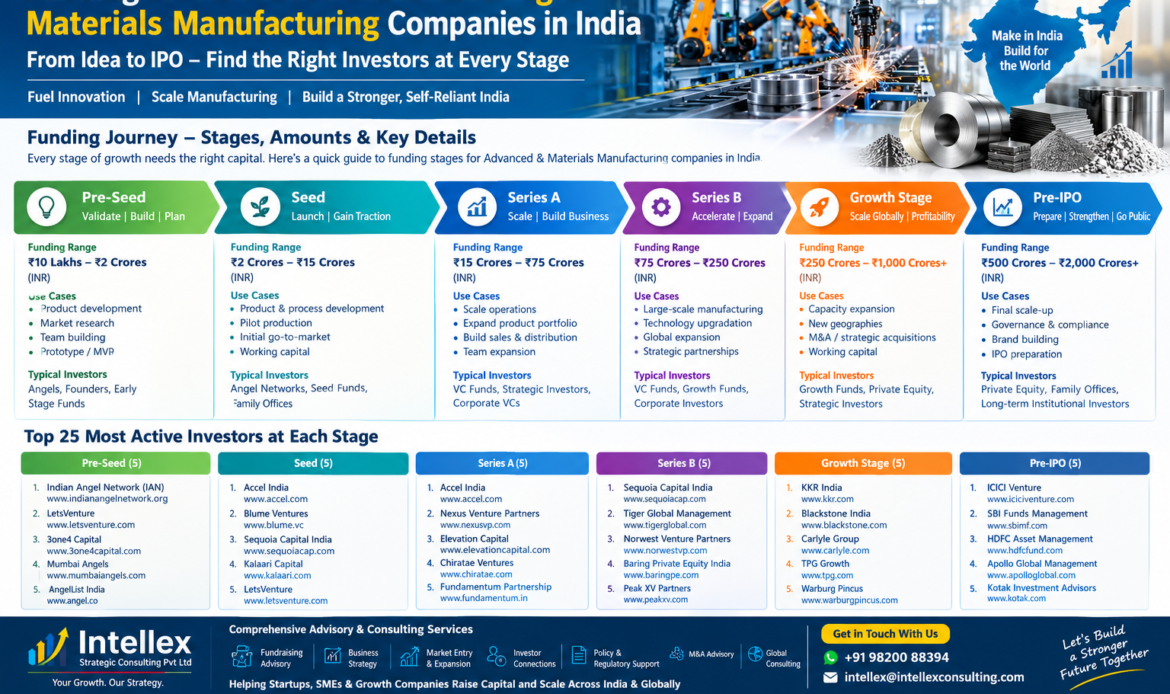
Advanced Manufacturing & Materials Manufacturing Funding in India: A Complete Guide to Pre-Seed, Seed, Series A, Series B, Growth Capital and Pre-IPO Funding.
Complete guide to startup and growth-stage funding for advanced manufacturing and materials companies in India, covering Pre-Seed, Seed, Series A, Series B, Growth, PE, debt, government funding, strategic investors and Pre-IPO capital.
How Indian Advanced Manufacturing, DeepTech and Materials Companies Can Raise Capital — Funding Stages, Investor Types, Deal Structures, Government Support and Investor Directory
India is entering an important phase in the development of advanced manufacturing.
The opportunity extends well beyond conventional factories and traditional industrial businesses. A new generation of Indian companies is working on robotics, industrial automation, precision engineering, additive manufacturing, semiconductor technologies, advanced materials, specialty chemicals, electronic components, battery technologies, energy-storage materials, aerospace and defence manufacturing, industrial AI, sensors, photonics, new materials, medical devices, EV technologies and other engineering-intensive products.
These businesses have one common characteristic:
They generally require more capital, more technical validation and more time to scale than conventional software startups.
A software company may be able to reach a meaningful level of revenue with a relatively small team and limited physical infrastructure. An advanced manufacturing company may need laboratories, equipment, tooling, pilot plants, certifications, testing facilities, intellectual-property development, working capital, inventory and customer qualification before commercial revenues can scale.
Consequently, fundraising for such companies must be planned differently.
This article explains the funding landscape for advanced manufacturing and materials manufacturing companies in India, including:
- Pre-seed funding
- Seed funding
- Pre-Series A
- Series A
- Series B
- Series C and later venture capital
- Growth capital
- Private equity
- Strategic corporate investment
- Venture debt and structured debt
- Project finance
- Pre-IPO capital
- Government-backed technology funding
- R&D and commercialisation support
- Export and working-capital financing
- Investor selection and fundraising strategy
1. What Is Advanced Manufacturing?
Advanced manufacturing broadly refers to manufacturing businesses that use sophisticated technology, engineering, automation, materials science, digital systems or proprietary processes to create higher-value products.
Examples include:
Advanced engineering
- Precision CNC
- Industrial machinery
- Robotics
- Automation equipment
- Industrial sensors
- Machine vision
- Digital manufacturing
- Industrial AI
- Smart factories
- Factory automation
Advanced materials
- Specialty materials
- Nanomaterials
- Functional materials
- Lightweight materials
- High-performance composites
- Advanced ceramics
- Carbon-based materials
- Battery materials
- Semiconductor materials
- Coatings and surface technologies
Electronics and semiconductor ecosystem
- Semiconductor design
- Semiconductor equipment
- Semiconductor packaging
- Electronic components
- Power electronics
- Sensors
- Photonics
- MEMS
- Advanced substrates
Mobility and energy
- Battery technology
- Battery materials
- Energy storage
- EV components
- Fuel cells
- Power electronics
- Charging technology
- Thermal-management technologies
Aerospace and defence
- Aerospace components
- UAV systems
- Propulsion components
- Advanced composites
- Defence electronics
- Precision components
- Space technologies
Additive and next-generation manufacturing
- 3D printing
- Metal additive manufacturing
- Advanced polymers
- Digital manufacturing
- Near-net-shape manufacturing
- Automated production systems
The Indian government’s Advanced Manufacturing Technologies programme has specifically identified areas including nanomaterials and surfaces, robotics and automation, precision manufacturing, advanced forming and near-net-shaped processing.
2. Why Advanced Manufacturing Requires a Different Funding Strategy
The funding journey of an advanced manufacturing company is rarely a simple straight line.
A typical company may move through:
Research → Proof of Concept → Prototype → Pilot → Customer Validation → Certification → First Commercial Order → Production → Capacity Expansion → International Expansion → IPO
Capital requirements increase dramatically as the company progresses.
For example:
| Stage | Typical requirement |
|---|---|
| Research | R&D funding |
| Proof of Concept | Prototype capital |
| Prototype | Seed capital |
| Pilot | Seed / Pre-Series A |
| Commercial validation | Series A |
| Manufacturing scale-up | Series B |
| Capacity expansion | Series C / Growth Capital |
| Multiple factories | PE / Strategic Capital |
| Large-scale expansion | Growth PE / structured capital |
| Pre-IPO | Late-stage PE / Pre-IPO |
| Public markets | IPO |
The important lesson is:
Founders should begin planning the next round before the current round is exhausted.
3. The Funding Stack for an Advanced Manufacturing Company
Unlike many software businesses, an advanced manufacturing company may require several forms of capital simultaneously.
A mature capital structure could include:
Founder Capital + Grants + Angel/VC Equity + Strategic Investment + Venture Debt + Bank Debt + Project Finance + Working Capital + Government Support
This blended approach can reduce excessive equity dilution.
For example, instead of financing an ₹80 crore expansion entirely through equity, a company might potentially structure:
- ₹20 crore promoter contribution
- ₹20 crore equity investment
- ₹15 crore strategic investment
- ₹15 crore term/project finance
- ₹10 crore working-capital facilities
The exact structure will depend on eligibility, creditworthiness, project economics, collateral, investor appetite and lender requirements.
4. Pre-Seed Funding
What is Pre-Seed?
Pre-seed is generally the earliest institutional or organised external funding stage.
The company may still be developing:
- Technology
- Prototype
- Intellectual property
- Product-market fit
- Manufacturing process
- Pilot product
- Initial customer relationships
At this stage, investors are primarily evaluating:
- Founding team
- Technology
- IP
- Market opportunity
- Technical feasibility
- Potential applications
- Competitive advantage
- Scalability
Typical capital requirement
For advanced manufacturing, pre-seed requirements can vary considerably.
A technology startup may require ₹25 lakh–₹2 crore.
A hardware or materials startup may require substantially more because laboratory development, tooling and testing can be expensive.
Common sources
- Founder capital
- Friends and family
- Angel investors
- Incubators
- University-linked programmes
- Government grants
- DeepTech seed funds
- Technology-focused venture funds
- Corporate innovation programmes
Common instruments
- Equity
- Convertible instruments
- SAFE-style instruments where legally and structurally appropriate
- Grants
- Founder loans
- Strategic development agreements
5. Seed Funding
Seed capital is generally used to move from technology development towards commercial validation.
The company should ideally demonstrate at least some of the following:
- Working prototype
- Patent/IP position
- Pilot customer
- Letters of intent
- Purchase orders
- Testing results
- Regulatory pathway
- Manufacturing process
- Unit economics
- Technical validation
Seed capital may finance:
- Product engineering
- Pilot production
- Certification
- Tooling
- Prototype manufacturing
- Hiring engineering teams
- Sales and marketing
- Customer trials
- Working capital
- Initial production infrastructure
For advanced manufacturing companies, a seed investor often needs to understand the difference between technical progress and commercial progress.
A company can have excellent technology but still be uninvestable if it cannot demonstrate a credible route to commercialisation.
6. Pre-Series A
Pre-Series A funding can be particularly important for advanced manufacturing.
The company may have:
- Product-market validation
- First customers
- Repeat orders
- Prototype-to-production capability
- Strong technical differentiation
- Early revenues
The capital may be used to establish the bridge between prototype and scalable commercial manufacturing.
Potential uses include:
- Production tooling
- Manufacturing equipment
- Quality systems
- Inventory
- Customer acquisition
- Certification
- Additional R&D
- Production team
- Supply-chain development
7. Series A Funding
Series A is normally associated with a company that has moved beyond pure technical experimentation and is demonstrating meaningful commercial validation.
Investors will generally examine:
- Revenue
- Gross margins
- Customer concentration
- Repeat orders
- Order pipeline
- Manufacturing yield
- Production capacity
- Customer acquisition
- IP
- Competitive barriers
- Management team
- Capital efficiency
- Future funding requirements
For advanced manufacturing, investors may also examine:
Capacity utilisation + manufacturing yield + contribution margin + working-capital cycle + inventory turns + order visibility.
A manufacturing business with ₹100 crore of orders but poor margins and a very long working-capital cycle can require a completely different funding structure from an asset-light technology company.
8. Series B Funding
Series B typically supports substantial commercial expansion.
Potential uses include:
- New production lines
- New factories
- Geographic expansion
- Export expansion
- Capacity expansion
- New product categories
- R&D centres
- Acquisitions
- Supply-chain integration
- Automation
- Sales infrastructure
At this stage, the company should increasingly be able to demonstrate:
- Predictable revenue
- Strong customer references
- Repeat business
- Improving margins
- Production scalability
- Strong governance
- Financial controls
- Professional management
The investor conversation changes from:
“Can this technology work?”
to:
“How large can this business become, and how efficiently can we scale it?”
9. Series C and Later Venture Capital
Later venture rounds can finance companies with strong growth trajectories.
Typical uses include:
- International expansion
- Large capacity additions
- Acquisitions
- New technology platforms
- Global sales
- Major R&D investments
- Manufacturing clusters
- Strategic supply-chain integration
At this stage, investors may include:
- Large venture funds
- Growth funds
- Sovereign-backed investors
- Corporate strategic investors
- Private equity investors
- Global technology investors
10. Growth Capital
Growth capital becomes increasingly relevant once the company has:
- Established products
- Significant revenues
- Proven customers
- Positive or near-positive EBITDA
- Large order book
- Strong growth prospects
- Professional governance
Growth investors may invest substantially larger amounts than early-stage funds.
The company may use growth capital for:
- Factory expansion
- Acquisitions
- International expansion
- New plants
- Capacity additions
- Working capital
- Technology acquisition
- Management expansion
Growth equity can be particularly useful when promoters want expansion capital without taking on excessive debt.
11. Private Equity
Private equity becomes relevant when the company has moved into a more mature stage.
PE investors typically examine:
- Revenue scale
- EBITDA
- Cash flows
- ROCE
- Working-capital requirements
- Corporate governance
- Promoter succession
- Industry structure
- Market share
- Customer concentration
- Expansion opportunities
- Exit possibilities
A PE investment may involve:
- Minority equity
- Significant minority equity
- Structured equity
- Majority investment
- Buyout
- Growth capital
The investor may also support acquisitions and professionalisation.
12. Strategic Corporate Investors
Advanced manufacturing companies should not limit their fundraising process to financial investors.
Strategic investors can be extremely important.
Potential strategic investors can include:
- Industrial groups
- Automobile companies
- Aerospace companies
- Electronics manufacturers
- Chemical companies
- Energy companies
- Semiconductor companies
- Defence companies
- Global manufacturing groups
A strategic investor may provide:
Capital + Technology + Customers + Distribution + Manufacturing Expertise + Procurement + Global Market Access
This can sometimes be more valuable than capital alone.
However, strategic investments must be structured carefully to avoid excessive exclusivity or restrictions that could limit future commercial opportunities.
13. Government and Technology Funding in India
Government-backed technology financing can be particularly important for capital-intensive DeepTech companies.
Technology Development Board
The Technology Development Board provides financial assistance for development and commercialisation of indigenous technology and adaptation of imported technology.
Its support can take the form of:
- Loans
- Equity
- Grants
The TDB states that its traditional funding can include loans of up to 50% of project cost, equity of up to 25%, and exceptional grant support. Its FAQ also states that DPIIT-registered startups with projects up to ₹5 crore may receive support of up to 70% of project cost under specified conditions. Terms and eligibility should always be checked against the current scheme guidelines.
TDB’s current programme portfolio includes areas such as engineering, defence and civil aviation, chemical, energy, electronics, telecom, space and other technology-intensive sectors.
Research, Development and Innovation Fund
India’s RDI Scheme has a total outlay of ₹1 lakh crore over six years and is designed to increase private-sector participation in R&D and strategic technology development.
TDB and BIRAC have been designated as second-level fund managers under the framework.
This is particularly relevant to companies working in:
- DeepTech
- Robotics
- Energy
- Strategic technologies
- Advanced technology
- Semiconductor-related technologies
- Biotechnology
- Medical devices
- Other R&D-intensive areas
DST Technology Development Programme
DST’s Technology Development Programme supports the development and integration of technologies, including materials, processes and techniques in advanced and emerging areas.
This can be relevant to companies developing technology that must move from laboratory research towards practical industrial application.
14. A Practical Funding Roadmap
A company could structure its capital journey approximately as follows:
| Stage | Primary objective | Potential capital sources |
|---|---|---|
| Idea | Technology development | Founder, grants |
| Pre-Seed | Prototype | Angels, DeepTech funds |
| Seed | Validation | Seed VC, angels, grants |
| Pre-A | Pilot/commercialisation | DeepTech VC |
| Series A | Commercial scale | VC |
| Series B | Manufacturing expansion | VC/Growth |
| Series C+ | Large-scale expansion | Growth VC/PE |
| Growth | Factories/acquisitions | PE/Growth funds |
| Mature | Large expansion | PE/Strategic/Private Credit |
| Pre-IPO | Institutional scale | PE/Pre-IPO funds |
| IPO | Public-market expansion | Public investors |
These are indicative stages rather than rigid definitions.
15. 25 Investors and Investment Platforms to Consider
The following is a non-ranked shortlist of 25 relevant investors/platforms that companies in advanced manufacturing, materials, industrial technology, DeepTech and related sectors may consider.
Investment mandates change frequently. Founders should verify the current mandate, stage, cheque size and sector fit directly with each investor before approaching them.
PRE-SEED / SEED / EARLY DEEPTECH
1. Speciale Invest
Speciale Invest is a specialist Indian DeepTech VC with a stated focus that includes Advanced Manufacturing, deep-tech hardware and frontier technologies.
It invests early, including pre-seed and seed stages, and states that its investment sweet spot is approximately $1 million, with capital reserved for follow-on investments.
Website: specialeinvest.com
Particularly relevant for:
- Advanced manufacturing
- Robotics
- Space
- DeepTech hardware
- New energy
- Frontier technology
2. pi Ventures
pi Ventures is an India-focused DeepTech and AI venture capital firm.
Its portfolio includes companies in areas such as:
- Robotics
- SpaceTech
- Quantum computing
- AI
- Industrial technology
Its website currently indicates cheque sizes of approximately $250,000–$3 million.
Website: piventures.in
3. YourNest Venture Capital
YourNest is one of India’s specialist DeepTech investors.
Its stated areas include:
- AI
- Robotics
- Industry 4.0
- Quantum computing
- SpaceTech
- IoT
- IP-led technology
Its current website states a typical investment range of approximately $500,000–$1.5 million.
Website: yournest.in
YourNest also has a continuation vehicle for mature portfolio companies, demonstrating how specialised DeepTech capital can extend beyond the earliest stages.
4. Blume Ventures
Blume is a multi-stage Indian venture platform with significant DeepTech and B2B manufacturing exposure.
Its portfolio includes companies such as:
- Ethereal Machines
- Ati Motors
- GreyOrange
- Systemantics
- Niqo Robotics
- Volt14
Blume describes itself as a seed/pre-Series A investor and states that its investment interests include DeepTech, CleanTech and manufacturing.
Website: blume.vc
5. Endiya Partners
Endiya is a thematic early-stage investor focused on product companies and technology-led businesses.
Its investment philosophy emphasises technically strong, IP-led product companies.
Website: endiya.com
Potential relevance:
- DeepTech
- Product technology
- Healthcare technology
- Engineering-intensive products
- IP-driven businesses
6. 100X.VC
100X.VC focuses on early-stage Indian founders and uses India SAFE Notes as an early-stage investment instrument.
It can be relevant for companies seeking their first institutional round.
Website: 100x.vc
7. Antler India
Antler operates an early-stage investment platform in India and has been active in sectors including DeepTech, climate technology, mobility and industrial/infrastructure-oriented businesses.
Website: antler.co
8. Indian Angel Network
Indian Angel Network is a broad angel-investor network that can be relevant for early-stage businesses.
For advanced manufacturing, the value may come from matching the company with angels possessing:
- Manufacturing experience
- Engineering backgrounds
- Corporate relationships
- Industrial distribution
- Sector knowledge
Website: indianangelnetwork.com
9. Inflection Point Ventures
Inflection Point Ventures is an angel investment platform with a large network of investors and entrepreneurs.
It can be considered for early-stage fundraising, particularly when founders need both capital and business-network access.
Website: ipventures.in
10. Artha Venture Fund
Artha Venture Fund is an Indian venture capital platform investing in early-stage businesses.
Companies should evaluate its current sector mandate and stage fit before approaching.
Website: arthaventurefund.com
SERIES A / SERIES B / MULTI-STAGE
11. Peak XV Partners
Peak XV is a major India/APAC venture capital platform investing across seed, venture and growth stages.
Its current website describes its strategy as spanning Seed, Venture, Growth and Beyond.
Website: peakxv.com
For advanced manufacturing companies, the strongest fit may arise when a company has moved beyond technical validation and demonstrated significant commercial potential.
12. Accel
Accel is a global venture capital firm with a substantial India investment presence.
It can be relevant for technology-led businesses with strong scalability and large markets.
Website: accel.com
13. 3one4 Capital
3one4 Capital is an Indian venture capital firm with exposure to technology-led businesses.
It has also published research highlighting India’s transformation in production, including semiconductors, EV supply chains, high-value chemicals and precision manufacturing.
Website: 3one4capital.com
14. Lightspeed
Lightspeed has a global investment platform and invests across technology and growth opportunities.
For advanced manufacturing companies, fit is more likely where proprietary technology, large markets and scalable economics are clearly demonstrated.
Website: lsvp.com
15. Norwest
Norwest is particularly relevant for companies that have progressed into substantial early/mid-stage or growth financing.
Its India platform explicitly includes B2B technology, industrials and manufacturing and states that its India strategy includes early/mid-stage venture investments and growth equity.
Its stated India investment ranges include approximately $10–30 million for early/mid-stage venture and $20–100 million for growth equity, subject to transaction specifics.
Website: norwest.com
16. Premji Invest
Premji Invest is a large, long-term investment platform with investments across private and public markets.
Its portfolio includes technology and industrially relevant businesses, and it has demonstrated interest in IP-rich technology businesses.
Website: premjiinvest.com
GROWTH CAPITAL / PRIVATE EQUITY
17. A91 Partners
A91 Partners focuses on Indian businesses and describes itself as a partner to founders building category-leading businesses.
It can become relevant when an advanced manufacturing business has reached meaningful commercial scale and needs growth capital.
Website: a91partners.com
18. ChrysCapital
ChrysCapital is a major Indian private equity platform.
Its current investment-sector information explicitly includes Manufacturing.
This makes it relevant for larger, established manufacturing businesses with significant revenue and expansion potential.
Website: chryscapital.com
19. True North
True North is an established Indian private equity and private credit platform.
It works with entrepreneurs and provides both equity and customised private-credit solutions.
Website: truenorth.co.in
For manufacturing companies, private credit may become relevant where predictable cash flows can support structured financing.
20. Motilal Oswal Private Equity
Motilal Oswal Private Equity is a mid-market alternative investment platform.
Its current business information states that its private-equity platform has backed businesses including niche manufacturing.
Website: motilaloswal.com
21. Advent International
Advent International is a global private equity investor with extensive experience in industrial and manufacturing businesses.
It is generally more relevant to mature companies and larger transactions than to early-stage startups.
Website: adventinternational.com
22. Warburg Pincus
Warburg Pincus is a global private equity investor with a substantial history of investing in India.
It can become relevant for larger companies seeking institutional growth or strategic expansion capital.
Website: warburgpincus.com
LATE-STAGE / PRE-IPO / LARGE GROWTH CAPITAL
23. Avendus Capital / Avendus Future Leaders Fund
Avendus operates across investment banking, alternative investments and private capital.
Its platforms can be relevant to companies approaching substantial institutional scale and eventual public-market transactions.
Website: avendus.com
24. Tata Capital
Tata Capital and its investment platforms can be relevant to established Indian companies requiring growth, structured or private capital.
The broader Tata ecosystem can also provide strategic relevance for industrial and manufacturing businesses, although the appropriate Tata investment vehicle depends on the transaction.
Website: tatacapital.com
25. Motilal Oswal Alternates / Private Credit
For mature manufacturing companies, traditional equity is not always the only answer.
Motilal Oswal’s alternatives platform includes private equity and private credit businesses.
Private credit can be considered for:
- Expansion
- Acquisition financing
- Working capital
- Structured growth
- Promoter financing
- Capital expenditure
Website: motilaloswal.com
16. Investor Selection Should Be Based on Stage — Not Just Brand Name
One of the biggest fundraising mistakes founders make is approaching investors solely because they are well known.
A better approach is to create an investor matrix.
Evaluate:
| Factor | Question |
|---|---|
| Stage | Does the investor invest at our current stage? |
| Cheque | Is our funding requirement within their range? |
| Sector | Do they understand our technology? |
| Geography | Do they invest in India? |
| Manufacturing | Do they understand capex-heavy businesses? |
| Follow-on | Can they participate in future rounds? |
| Strategic value | Can they bring customers or partners? |
| Network | Can they help international expansion? |
| Governance | Can we work together effectively? |
| Exit | Do their fund timelines fit our business? |
17. How Much Should a Company Raise?
The fundraising requirement should not be determined simply by saying:
“We need ₹25 crore.”
Instead, construct a detailed use-of-funds model.
For example:
Technology
₹5 crore
Manufacturing equipment
₹10 crore
Plant and infrastructure
₹8 crore
Working capital
₹5 crore
Sales and marketing
₹3 crore
Team
₹2 crore
Contingency
₹2 crore
Total
₹35 crore
The company should then identify:
How much should be equity?
How much can be debt?
How much can be government-supported?
How much can be strategic capital?
This produces a much stronger financing strategy.
18. The Importance of Milestone-Based Fundraising
Investors prefer capital to be linked to measurable milestones.
For example:
Round 1
₹5 crore
Target:
- Prototype
- Patent filing
- Pilot customer
Round 2
₹15 crore
Target:
- Certification
- Commercial production
- ₹10 crore revenue
Round 3
₹50 crore
Target:
- Factory expansion
- ₹100 crore revenue
- Export market entry
This creates a logical connection between:
Capital → Milestone → Valuation → Next Round
19. Valuation Considerations
Advanced manufacturing valuation can be complicated.
Early-stage companies may be valued primarily on:
- Technology
- IP
- Market size
- Team
- Technology readiness level
- Commercial pipeline
- Strategic relevance
Later-stage companies are increasingly evaluated using:
- Revenue
- EBITDA
- Gross margins
- Growth rate
- Order book
- Cash flow
- ROCE
- Comparable companies
- Transaction multiples
Manufacturing companies should therefore prepare both:
Technology Valuation Logic
and
Financial Valuation Logic.
20. Technology Readiness Level Matters
For DeepTech companies, investors frequently want to know how close the technology is to commercial deployment.
A simplified progression is:
Research → Prototype → Laboratory Validation → Pilot → Field Validation → Commercial Production → Scaled Manufacturing
A company should clearly identify its current stage and provide evidence.
For example:
- Laboratory-tested
- Prototype completed
- 100 hours of testing
- 3 pilot customers
- ₹2 crore purchase orders
- Commercial certification obtained
- Production yield of 92%
Specific evidence is far more persuasive than general statements such as “technology is ready.”
21. What Investors Will Ask
A serious investor is likely to ask:
Technology
- What is proprietary?
- Is there patent protection?
- How difficult is replication?
- What is the technology readiness level?
Market
- What is the addressable market?
- Who are the major competitors?
- Why will customers switch?
Customers
- Who are your customers?
- How many repeat?
- What is the average contract value?
- What is the sales cycle?
Manufacturing
- What is current capacity?
- What is utilisation?
- What is production yield?
- What is the expansion cost?
Economics
- Gross margin?
- EBITDA?
- Contribution margin?
- Working-capital cycle?
Capital
- How much have you raised?
- At what valuation?
- Who are existing investors?
- How much are you raising now?
- What dilution are you offering?
Exit
- Strategic acquisition?
- Secondary sale?
- IPO?
- International listing?
22. Documents Every Company Should Prepare Before Fundraising
A serious fundraising process should have a professional data room.
Corporate documents
- Certificate of incorporation
- MOA/AOA
- Shareholding pattern
- Cap table
- Board resolutions
- Statutory records
Financial documents
- Audited financial statements
- Management accounts
- GST information
- Bank statements
- MIS
- Financial projections
- Working-capital analysis
Technology documents
- Patent details
- Technology reports
- Test reports
- Certification
- R&D documentation
- Technical validation
Commercial documents
- Customer contracts
- Purchase orders
- LOIs
- Pipeline
- Customer concentration
- Distributor agreements
Manufacturing documents
- Plant details
- Machinery list
- Capacity
- Utilisation
- Production costs
- Quality systems
Fundraising documents
- Investor presentation
- Executive summary
- Financial model
- Use of funds
- Valuation rationale
- Existing funding history
- Proposed transaction structure
23. The Investor Pitch Deck
For advanced manufacturing, a conventional 10-slide software-style pitch deck may not be sufficient.
A strong deck should cover:
- Company
- Problem
- Technology
- Product
- IP
- Market
- Applications
- Customer validation
- Manufacturing capability
- Competitive advantage
- Business model
- Revenue
- Gross margin
- Order book
- Capacity
- Expansion plan
- Management
- Financial projections
- Funding requirement
- Use of funds
- Existing investors
- Proposed transaction
- Exit possibilities
24. Debt vs Equity — A Critical Decision
Founders should not automatically raise equity for every requirement.
Equity is generally useful for:
- R&D
- Early-stage losses
- New technology
- Market development
- High-risk expansion
- Acquisition of strategic technology
Debt may be more suitable for:
- Machinery
- Plant expansion
- Inventory
- Receivables
- Equipment
- Established cash-generating operations
Strategic equity may be suitable for:
- Technology partnerships
- Large customers
- Joint ventures
- International expansion
- Supply-chain integration
The ideal structure can therefore be:
Equity for risk + Debt for assets + Strategic capital for acceleration.
25. Venture Debt
Venture debt can become useful after a company has raised institutional equity and demonstrated a credible growth trajectory.
Potential applications include:
- Working capital
- Equipment
- Inventory
- Bridge financing
- Expansion
However, debt creates repayment obligations.
Founders should carefully model:
- Interest
- Principal repayment
- Covenants
- Security
- Warrants
- Cash-flow impact
26. Project Finance
For manufacturing companies, project finance can become a major source of capital.
It may be appropriate for:
- Manufacturing plants
- Production lines
- Large machinery
- Processing facilities
- Industrial infrastructure
The lender will generally focus heavily on:
- Project viability
- Promoter contribution
- Debt service capacity
- Cash flows
- Security
- Project execution
- Customer contracts
This can substantially reduce the amount of equity required for physical expansion.
27. Export Expansion Funding
An advanced manufacturing company with global customers may require a different capital structure.
Potential financing can include:
- Export working capital
- Purchase-order financing
- Receivables financing
- Trade finance
- Letters of credit
- Bank guarantees
- Export credit
- Foreign strategic investment
- Overseas JV capital
The ability to demonstrate export orders can materially strengthen the financing proposition.
28. Semiconductor and Strategic Manufacturing Opportunity
Semiconductors illustrate why patient capital is important in advanced manufacturing.
India’s semiconductor ecosystem is expanding across:
- Design
- Equipment
- Materials
- Packaging
- Testing
- Electronics
- Components
- Supply chain
Recent industry developments show increasing activity around semiconductor manufacturing, materials and equipment, while the government is pursuing expanded support under its semiconductor programmes.
The funding challenge remains significant because companies can require capital across design, tape-out, validation, manufacturing and testing before achieving commercial scale.
This illustrates why advanced manufacturing founders should build a multi-round capital strategy from the beginning.
29. Materials Manufacturing — A Particularly Attractive Financing Category
Materials companies can have significant intellectual-property advantages.
Examples include:
- Battery materials
- Specialty chemicals
- Advanced polymers
- Composite materials
- Coatings
- Ceramics
- Nanomaterials
- Semiconductor materials
- Conductive materials
- Lightweight materials
However, investors will want to understand:
Can laboratory economics become commercial economics?
The critical metrics may include:
- Yield
- Raw-material cost
- Energy consumption
- Production throughput
- Purity
- Scrap
- Scale economics
- Customer qualification
- Certification
- Production reproducibility
30. How Intellex Strategic Consulting Can Help
For advanced manufacturing and materials manufacturing companies, fundraising is not simply about finding an investor.
It involves:
Strategy + Financial Structuring + Investor Identification + Documentation + Positioning + Negotiation + Transaction Management
Intellex Strategic Consulting Pvt. Ltd.
Intellex Strategic Consulting works with businesses seeking capital for growth, expansion, projects, acquisitions and strategic initiatives.
Our services can include:
- Startup fundraising
- Growth-stage fundraising
- Equity investment
- Venture capital introductions
- Private equity opportunities
- Debt funding
- Project finance
- Working-capital finance
- Structured funding
- Strategic investor identification
- Investor outreach
- Pitch-deck preparation
- Financial modelling
- Business-plan preparation
- Fundraising strategy
- M&A advisory
- Acquisition financing
- Pre-IPO advisory
- IPO consulting
We can work with companies across India and international opportunities, subject to transaction suitability, investor mandate, regulatory requirements and due diligence.
31. Intellex Approach to Advanced Manufacturing Fundraising
A typical engagement can be structured around five stages.
Stage 1 — Funding Readiness
Understanding:
- Business
- Technology
- Financial position
- Existing investors
- Funding requirement
- Valuation expectations
- Capital structure
Stage 2 — Funding Strategy
Determine the appropriate combination of:
- Equity
- VC
- PE
- Strategic capital
- Debt
- Project finance
- Government support
Stage 3 — Investor Mapping
Identify investors according to:
- Stage
- Sector
- Ticket size
- Geography
- Technology
- Strategic relevance
Stage 4 — Investor Engagement
Prepare and coordinate:
- Investor presentation
- Financial model
- Executive summary
- Data room
- Investor communication
- Meetings
- Information requests
Stage 5 — Transaction Support
Support can include:
- Commercial discussions
- Term-sheet evaluation
- Financial structuring
- Negotiation support
- Due-diligence coordination
- Transaction process management
32. Fundraising Checklist for Advanced Manufacturing Companies
Before approaching investors, management should be able to answer “yes” to as many of the following as possible:
☐ Clear technology proposition
☐ Defined intellectual property
☐ Prototype or commercial product
☐ Demonstrable customer validation
☐ Documented market opportunity
☐ Clear competitive advantage
☐ Realistic manufacturing economics
☐ Detailed financial model
☐ Clear use of funds
☐ Identified milestones
☐ Professional cap table
☐ Clean corporate documentation
☐ Audited financials where applicable
☐ Customer/order documentation
☐ Detailed expansion plan
☐ Funding requirement clearly quantified
☐ Appropriate equity/debt mix considered
☐ Investor target list prepared
☐ Data room prepared
☐ Management team prepared for investor due diligence
33. The Most Important Principle: Raise Capital Before You Need It
Capital-intensive businesses should avoid waiting until their cash balance becomes critical.
The fundraising cycle can take several months.
A company planning to exhaust its cash in six months should ideally begin fundraising substantially earlier.
For advanced manufacturing businesses, delays can be particularly expensive because:
- Equipment orders take time
- Factories take time
- Certifications take time
- Customer qualification takes time
- Production ramp-up takes time
Therefore:
Fundraising should be treated as a strategic business process, not an emergency financing exercise.
34. Conclusion
India’s advanced manufacturing and materials ecosystem is entering an important period of development.
The opportunity spans:
Advanced Engineering + Robotics + Automation + Materials + Semiconductors + Electronics + Energy + EVs + Aerospace + Defence + Industrial AI + Additive Manufacturing + Precision Manufacturing.
However, technology alone does not create a scalable company.
A successful company needs:
Technology + IP + Customers + Manufacturing + Capital + Management + Distribution + Governance.
The funding strategy should therefore evolve as the company evolves.
Early capital may come from founders, grants, angels and specialist DeepTech investors.
Seed and Series A capital can support product validation and commercialisation.
Series B and later rounds can finance capacity expansion and international growth.
Growth equity and private equity can support larger factories, acquisitions and strategic expansion.
Debt and project finance can finance assets and working capital.
Strategic investors can provide customers, technology, supply-chain access and global relationships.
Pre-IPO investors can provide capital during the transition towards public-market readiness.
For founders, the objective should not simply be to “raise money.”
The objective should be to create the right capital structure for the next phase of the business.
About Intellex Strategic Consulting Pvt. Ltd.
Intellex Strategic Consulting Pvt. Ltd. is a professional services firm assisting businesses with fundraising, debt funding, equity investment, project finance, M&A advisory, startup fundraising, IPO consulting and financial modelling.
We work with businesses seeking to raise capital and scale their operations across India and internationally, subject to investor requirements, transaction suitability and due diligence.
Our Funding & Strategic Services
Startup Fundraising | Venture Capital | Private Equity | Growth Capital | Debt Funding | Project Finance | Working Capital | Strategic Investment | M&A Advisory | Pre-IPO & IPO Consulting | Financial Modelling
Contact Intellex
WhatsApp: 91-98200-04701
Email: intellex@intellexconsulting.com
Our Websites
VentureStreets.com
StartupStreets.com
CreditMoneyFinance.com
GrowMoreFranchisees.com
Intellex Strategic Consulting Pvt. Ltd.
Capital is the Fuel That Drives Business Growth.
More Featured Articles: