

Bessemer Venture Partners’ $5.75 Billion New Funds: Investment Thesis, Startup Funding Criteria, India Strategy, Portfolio & How Founders Can Approach BVP
Bessemer Venture Partners Raises $5.75 Billion: A Detailed Funding Guide for Startups Seeking Seed, Early-Stage and Growth Capital.
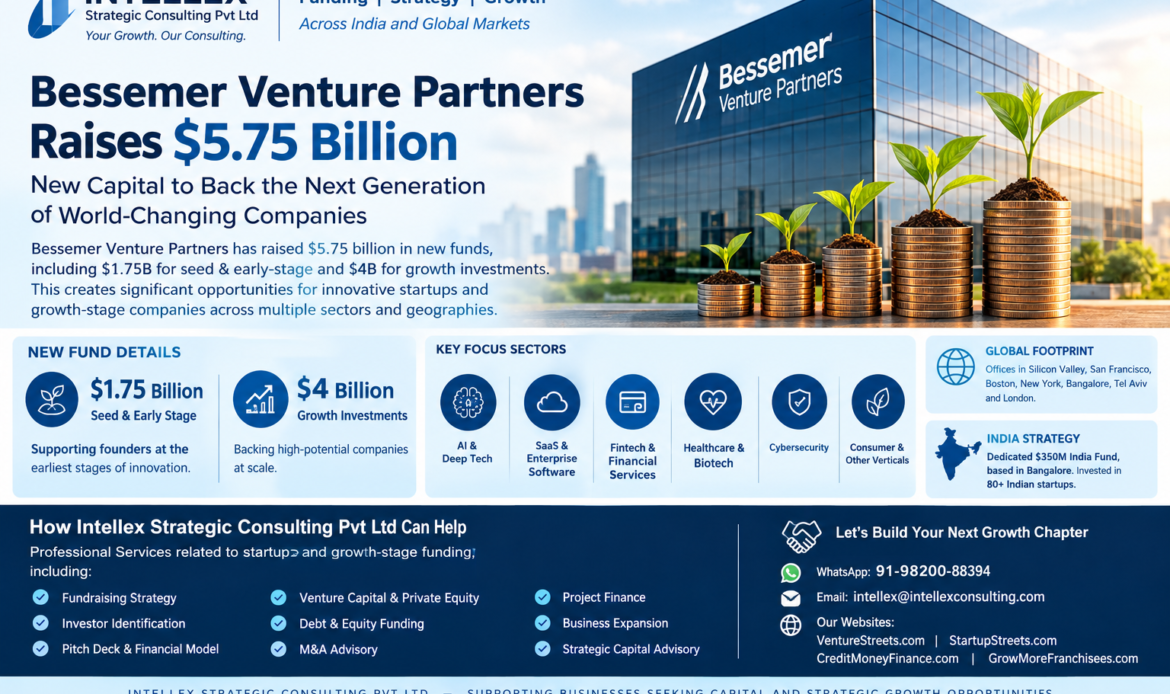
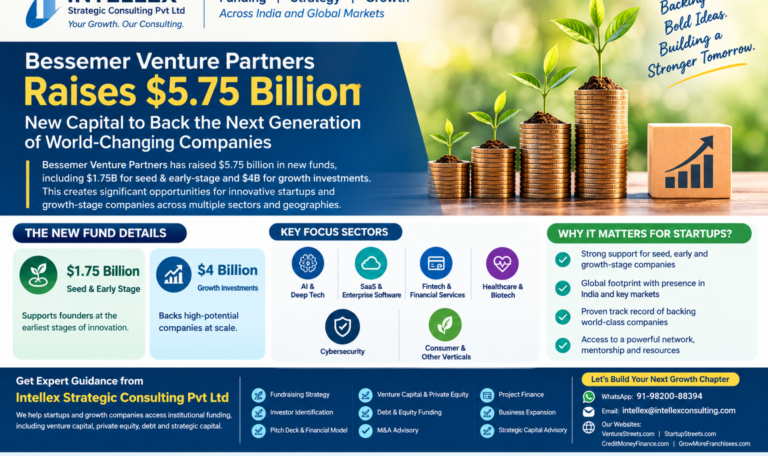
Bessemer Venture Partners has raised $5.75 billion in new capital, including $1.75B for seed and early-stage startups and $4B for growth investments. Explore its investment thesis, sectors, geography, India strategy, track record and what founders should know before approaching Bessemer.
Bessemer Venture Partners’ $5.75 Billion Fund: Why Startups Should Pay Attention
The global venture-capital market has entered an important new phase, particularly as artificial intelligence, enterprise software, fintech, cybersecurity, healthcare technology, infrastructure and deep technology continue to reshape industries.
Against this backdrop, Bessemer Venture Partners (BVP) has announced $5.75 billion of new capital in a single close—comprising $1.75 billion for seed and early-stage investments and $4 billion for growth investments. The announcement was made on September 23, 2026.
For founders, the announcement is significant because it demonstrates that Bessemer is positioning itself to support companies across the funding lifecycle—from very early investments through major growth rounds.
Bessemer says approximately 70% of its investments are made at the early stage, while its dedicated growth strategy is designed to make concentrated investments in companies reaching important scaling milestones.
This creates a potentially relevant funding avenue for startups that are:
- Building technology-led businesses
- Developing AI-native products
- Creating enterprise software
- Building SaaS businesses
- Developing fintech infrastructure
- Working in healthcare technology
- Building cybersecurity solutions
- Developing deep-tech or physical-AI businesses
- Creating consumer technology platforms
- Building globally scalable companies from India or other markets
However, founders should understand that having access to a large fund does not mean every startup is eligible. Bessemer operates through sector and stage-specific investment theses and evaluates individual companies on their market opportunity, product, technology, founders, traction and potential for significant scale.
1. Who Is Bessemer Venture Partners?
Bessemer Venture Partners is one of the world’s longstanding technology investment firms.
Its institutional history goes back much further than the modern venture-capital industry.
Bessemer’s own history records that Henry Phipps and Andrew Carnegie co-founded Carnegie Steel in 1872. In 1911, Phipps established Bessemer Securities, a family office named after the Bessemer process. The investment operation subsequently evolved toward technology investing, opened in Silicon Valley in 1976, and in 1981 the venture-investing group formally spun out as Bessemer Venture Partners.
Therefore, when discussing the “founders” behind Bessemer, it is useful to distinguish between:
Historical roots
- Henry Phipps
- Andrew Carnegie
Modern Bessemer Venture Partners
- The venture investment organization emerged from the Bessemer family-office investment operation and became an independent venture firm in 1981.
This long institutional history is unusual in venture capital and has contributed to Bessemer’s ability to build investment expertise across several technology cycles.
2. Bessemer’s Current Scale
According to Bessemer’s current corporate information, the firm reports approximately:
| Indicator | Current reported figure |
|---|---|
| Assets under management | $20 billion |
| Active portfolio companies | 450+ |
| IPOs / deSPACs | 155+ |
| New capital announced in 2026 | $5.75 billion |
| Seed & early-stage portion of new capital | $1.75 billion |
| Growth portion of new capital | $4 billion |
These figures are reported by Bessemer and can change as new investments, exits and funds are added.
3. The New $5.75 Billion Capital: How Is It Divided?
The new capital has two major components.
$1.75 Billion – Seed and Early Stage
The $1.75 billion allocation is designed to support founders at the earlier stages of company development.
This is particularly relevant to:
- Pre-seed and seed-stage technology companies
- Early Series A companies
- Companies developing new technology categories
- AI-native startups
- SaaS businesses
- Developer platforms
- Fintech infrastructure
- Healthcare technology
- Cybersecurity
- Deep technology
- Other technology businesses with significant long-term market potential
Bessemer states that early-stage investing remains central to its strategy and that approximately 70% of its investments are made at the early stage.
Importantly, Bessemer’s early-stage strategy does not necessarily require substantial existing revenue.
Its early-stage materials state that 62% of Bessemer investments were pre-revenue at the time of initial investment, as of September 30, 2025.
That is an important distinction for founders: the absence of substantial revenue does not automatically eliminate an opportunity, although the company still needs to demonstrate a compelling investment case.
4. $4 Billion Growth Fund: A Major Opportunity for Scaling Companies
The other $4 billion is dedicated to growth investments.
This reflects an important change in the technology funding environment.
Many technology companies are remaining private for longer periods and reaching much larger valuations before IPOs. Bessemer has therefore developed a dedicated growth platform rather than relying only on early-stage investing.
The firm says its growth strategy now operates as a dedicated engine capable of investing in both existing Bessemer portfolio companies and companies that did not originate in the Bessemer portfolio.
For founders, this means the potential Bessemer funding journey is not limited to seed capital.
A company can potentially engage with the firm at:
Seed → Series A → Series B → Later Growth → Pre-IPO / Late Private Stage
The exact stage, valuation and investment structure depend on the company and transaction.
5. Bessemer’s Current Investment Thesis
The firm’s latest announcement places AI at the centre of its current investment thesis.
Bessemer says that since 2022 it has backed 260+ AI-native companies and invested more than $3 billion across the AI stack.
Its AI-related investment activity spans areas including:
- Computing infrastructure
- AI infrastructure
- Foundation models
- Developer platforms
- AI applications
- AI agents
- Data and cloud
- Cybersecurity
- Physical AI
- Robotics
The firm is nevertheless not an AI-only investor.
Its broader investment roadmaps include areas such as:
- Enterprise
- Consumer
- Fintech
- Healthcare / biotech
- Developer technology
- Marketplaces
- Infrastructure
- Deep tech and defense
- Cybersecurity
- Vertical software
Bessemer’s website describes its investment process as roadmap-driven—developing views on where markets are heading and what it will take for companies to win in those markets.
6. What Kind of Startup Could Fit Bessemer’s Investment Approach?
There is no single publicly stated checklist that guarantees investment.
Instead, founders should understand the characteristics visible across Bessemer’s investment activity.
1. Large and expanding market
Bessemer generally seeks companies capable of becoming substantial businesses rather than companies addressing only a narrowly constrained opportunity.
2. Strong technological differentiation
Technology, software, AI, infrastructure, data, proprietary systems or other defensible capabilities can be important depending on the sector.
3. Exceptional founding team
At early stages especially, the founders themselves can be a major component of the investment case.
Bessemer’s early-stage strategy explicitly describes investing in founders before product-market fit and, in some cases, before there is even significant product development.
4. Evidence of market pull
For companies beyond the earliest stage, investors increasingly examine:
- Revenue growth
- Customer acquisition
- Retention
- Gross margins
- Unit economics
- Pipeline
- ARR
- Customer concentration
- Cash burn
- Runway
- Sales efficiency
5. Ability to scale
A company that can grow significantly without costs increasing at the same rate can have a particularly attractive venture profile.
For cloud businesses, Bessemer has historically placed considerable emphasis on ARR growth, growth endurance and the relationship between growth and profitability.
7. Bessemer Growth Investors: What Changes at Later Stages?
For a growth-stage company, the investment conversation becomes considerably more quantitative.
Founders should expect investors to examine:
Revenue
- Current ARR / revenue
- Historical growth
- Forward growth
- Recurring versus non-recurring revenue
Customers
- Number of customers
- Enterprise customers
- Customer concentration
- Net revenue retention
- Churn
Economics
- Gross margin
- CAC
- CAC payback
- Contribution margin
- Burn rate
- Free cash flow
Market
- TAM
- Competitive position
- Market share
- Expansion opportunities
- International opportunity
Management
- Founder capability
- Senior management team
- Hiring plans
- Governance
Bessemer’s growth-stage materials have historically highlighted the importance of ARR growth, growth endurance and efficiency when evaluating cloud companies.
8. Who Is Byron Deeter?
The person featured in the Economic Times report accompanying this article is Byron Deeter, a Bessemer Partner focused on growth.
Byron is particularly associated with:
- AI
- Cloud
- Frontier technology
- Business of sports
- Enterprise technology
Bessemer says 26 of his investments are currently valued above $1 billion each, including 13 IPOs.
His background is particularly interesting for founders because he has experience on both sides of the investment table.
Before becoming a Bessemer investor, Byron founded and served as CEO of Trigo Technologies. He raised a Series A from Bessemer in 2000. The company became an early global SaaS company, reached profitability and was subsequently sold to IBM. He later returned to Bessemer in 2005.
That combination of founder and investor experience is relevant when understanding Bessemer’s founder-oriented approach.
9. India’s Importance to Bessemer
India is particularly relevant to founders considering Bessemer.
Bessemer opened its India office in Bangalore in 2006 and says it has partnered with more than 80 Indian startups across stages and sectors.
In March 2025, Bessemer announced its second dedicated India fund of $350 million, intended to support founders in the region from early stages and beyond.
The India strategy specifically identifies areas including:
- AI-enabled services
- SaaS
- Fintech
- Digital health
- Consumer brands
- Cybersecurity
as areas of continued focus.
This is particularly relevant for Indian founders because it means India is not simply being treated as an overseas sourcing market; Bessemer has established a dedicated local investment platform.
10. Bessemer’s India Investment Team
Some of the prominent Bessemer investment professionals associated with India include:
Vishal Gupta – Partner
Vishal Gupta is based in Bangalore and focuses primarily on:
- Consumer internet
- Fintech
- Healthcare technology
His disclosed investment and board experience includes companies such as bigbasket, Good Glamm Group, Lentra, Livspace, Perfios, Pharmeasy, Swiggy, Urban Company, Innoviti and NephroPlus, among others.
He joined Bessemer in 2006 and has also supported investments associated with companies including Shriram City, Motilal Oswal, Orient Green Power and Shriram EPC.
Anant Vidur Puri – Partner
Anant Vidur Puri focuses on high-potential opportunities in internet marketplaces and India SaaS.
Before Bessemer, he worked at Boston Consulting Group and worked with financial and IT-services clients across India and North America.
He holds an electrical engineering degree from IIT Delhi and an MBA from Harvard Business School.
His portfolio experience includes companies such as Urban Company, Cashify, Zenskar and other Indian consumer and SaaS businesses.
Pankaj Mitra
Bessemer’s current India team also includes Partner Pankaj Mitra, whose portfolio includes Indian technology companies such as Sarvam and other businesses.
11. Bessemer’s India Track Record
Bessemer’s Indian portfolio provides a useful indication of the types of companies it has backed.
Examples include:
- bigbasket
- Swiggy
- Urban Company
- Livspace
- PharmEasy
- Perfios
- Lentra
- Innoviti
- Cashify
- Rupifi
- Zopper
- Vetic
- Sarvam
- Graph
- NephroPlus
- Protectt AI
Bessemer’s own India portfolio pages identify these companies and the relevant investment professionals and sectors.
Several of these businesses have subsequently reached public markets or major corporate milestones. For example, Bessemer records Urban Company and NephroPlus as publicly listed companies on the NSE.
12. Global Track Record
Bessemer’s global portfolio illustrates the breadth of its technology investment strategy.
Its portfolio and historical materials include companies such as:
- Shopify
- Twilio
- Toast
- Auth0
- ServiceTitan
- Perplexity
- Anthropic
- Waymo
- Rocket Lab
- Sila Nanotechnologies
- ClickHouse
- Fireworks
- Legora
- Abridge
The firm’s own history highlights successful investments and exits through IPOs and acquisitions, while its current corporate profile reports 155+ IPOs/deSPACs and 450+ active portfolio companies.
One particularly relevant example is Sila Nanotechnologies, which develops advanced battery materials—showing that Bessemer’s technology investment universe is not restricted to pure software.
13. What Geographies Does Bessemer Cover?
Bessemer describes its approach as global.
Its current office footprint includes:
- Silicon Valley
- San Francisco
- Boston
- New York
- Bangalore
- Tel Aviv
- London
The firm explicitly states that it invests wherever strong companies are being built.
Its global investment history therefore includes companies across:
- United States
- India
- United Kingdom
- Europe
- Israel
- Other international technology markets
For Indian founders, this creates an additional strategic consideration: a company does not necessarily need to remain India-only to be relevant.
An Indian startup developing globally competitive technology, SaaS, AI, fintech infrastructure or deep technology may potentially fit into Bessemer’s broader global investment framework.
14. What Does Bessemer’s New AI Thesis Mean for Indian Startups?
The current fund announcement makes AI particularly important.
For Indian founders, potential areas include:
AI SaaS
Products serving global enterprises from India.
AI-enabled services
Businesses combining software, automation and specialized domain expertise.
AI infrastructure
Data, compute, orchestration, security and developer infrastructure.
Vertical AI
AI solutions specifically designed for:
- Healthcare
- Legal
- Financial services
- Manufacturing
- Logistics
- Insurance
- Enterprise operations
Physical AI and robotics
This could become relevant for Indian startups working in:
- Industrial automation
- Robotics
- Warehousing
- Manufacturing
- Defense technology
- Autonomous systems
AI cybersecurity
Security solutions addressing increasingly automated and AI-driven enterprise environments.
15. What Startups Should Prepare Before Approaching Bessemer
A strong funding opportunity should not be presented simply as:
“We are looking for $10 million.”
Instead, founders should build an investor-ready funding proposition.
A. Executive Summary
Clearly explain:
- What the company does
- Problem being solved
- Target market
- Product
- Business model
- Current revenue
- Growth
- Funding requirement
B. Market Opportunity
Explain:
- TAM
- SAM
- SOM
- Market growth
- Competitive landscape
- Why the market is becoming attractive now
C. Technology
Explain:
- Proprietary technology
- IP
- AI capability
- Data advantage
- Technology moat
- Product differentiation
D. Traction
Where applicable:
- Revenue
- ARR
- Customer count
- Growth rate
- Retention
- Major contracts
- International customers
- Partnerships
E. Financial Model
Investors should be able to understand:
- Historical financials
- Current financial position
- 5-year projections
- Gross margins
- EBITDA
- Cash flow
- Burn
- Funding requirement
- Use of funds
F. Fundraising Strategy
Clearly state:
Amount being raised → valuation expectation → instrument → use of funds → milestones → next round
16. A Founder Should Also Ask: Why Bessemer?
Fundraising is not simply about obtaining capital.
Founders should evaluate the strategic value of an investor.
Bessemer says its platform provides support beyond capital, including:
- Talent advisors
- Network and partnerships
- Operating advisors
- Founder communities
- Events
- Portfolio connections
- Founder resources
The firm reports more than 1,000 introductions annually through its platform and 2,000+ community members.
For a startup entering a major scaling phase, these resources can be relevant alongside the investment itself.
17. Important Point: A Large Fund Does Not Mean Automatic Eligibility
Founders should avoid interpreting the $5.75 billion announcement as a blanket funding programme.
Bessemer is still selecting companies according to its investment theses.
For example:
A startup with no revenue can potentially be investable at an early stage.
But that does not mean every pre-revenue startup qualifies.
Likewise:
A company with $10M+ ARR may potentially fit a growth-investment conversation.
But revenue alone does not establish investment eligibility.
The investment case is likely to depend on the combination of:
Founder + Market + Product + Technology + Traction + Growth + Economics + Competitive Position + Long-Term Opportunity.
18. How Intellex Strategic Consulting Can Help Startups Seeking Institutional Funding
For founders across India and internationally, approaching a major venture-capital investor requires considerably more than sending a generic pitch deck.
Intellex Strategic Consulting Pvt Ltd provides professional services related to startup and growth-stage fundraising, including support around:
- Startup fundraising strategy
- Investor identification
- Venture capital opportunities
- Private equity opportunities
- Early-stage funding
- Growth-stage funding
- Business expansion funding
- Financial modelling
- Investor presentations
- Pitch-deck preparation
- Fundraising documentation
- Strategic investor outreach
- Debt and equity funding
- Project finance
- M&A advisory
- Pre-IPO and IPO-related advisory
Our objective is to help founders understand which investors may be relevant to their business, what information investors are likely to evaluate, and how to present the opportunity in a professionally structured manner.
Investor selection should always be based on the company’s individual requirements, stage, sector, geography and funding objectives.
19. Intellex – Supporting Fundraising Across India and Globally
Intellex Strategic Consulting Pvt Ltd works with businesses seeking capital for:
Startups
- Pre-seed
- Seed
- Series A
- Series B
- Growth capital
Growth Companies
- Business expansion
- Capacity expansion
- New-market entry
- Technology investment
- Acquisitions
Other Capital Requirements
- Venture capital
- Private equity
- Debt funding
- Project finance
- Strategic investment
- M&A
- Pre-IPO funding
For founders considering global investors such as Bessemer, preparation should begin well before the actual investor meeting.
A professionally prepared funding strategy can help identify the appropriate investor universe and align the company’s fundraising proposition with the requirements of potential capital providers.
20. Final Takeaway for Startup Founders
Bessemer Venture Partners’ $5.75 billion new capital announcement is an important development for technology companies seeking institutional capital.
The structure is particularly notable because it combines:
$1.75 billion for seed and early-stage investing
with
$4 billion for growth investing.
For Indian founders, the firm’s $350 million dedicated India fund, Bangalore presence and history of backing more than 80 Indian startups add another important dimension.
The key lesson for founders is not simply to ask, “Does Bessemer have money available?”
The more useful questions are:
- Does the company fit Bessemer’s current investment thesis?
- Is the company operating in a market Bessemer is actively researching?
- Is the opportunity large enough?
- Is there meaningful technological differentiation?
- Is the founding team capable of executing the plan?
- What evidence exists of product-market fit?
- What are the company’s growth metrics?
- What is the international opportunity?
- What milestones will the new capital achieve?
- Why is Bessemer the appropriate investor for the company’s next stage?
A well-structured answer to these questions can materially improve the quality of a fundraising process.
About Intellex Strategic Consulting Pvt Ltd
Intellex Strategic Consulting Pvt Ltd is a professional services firm providing services related to startup and growth-stage funding, venture capital, private equity, debt funding, project finance, M&A advisory, financial modelling and strategic capital raising.
For Funding & Strategic Capital Advisory:
WhatsApp: 91-98200-88394
Email: intellex@intellexconsulting.com
Our Websites:
VentureStreets.com
StartupStreets.com
CreditMoneyFinance.com
GrowMoreFranchisees.com
Intellex Strategic Consulting Pvt Ltd — supporting businesses seeking capital and strategic growth opportunities across India and global markets.
Note: Investment fund sizes, portfolio statistics, team responsibilities and investment priorities can change. The figures and strategy discussed above reflect publicly available information checked in September 2026 and should not be interpreted as a guarantee that Bessemer or any other investor will invest in a particular company.
More Featured Posts: