

Activate’s $105 Million AI Fund Signals New Opportunities for Startups Seeking Venture Capital in India.
Activate has closed a $105 million AI-focused fund to back early-stage and growth startups. Learn what this means for AI founders and how startups can prepare for institutional fundraising.
The Indian startup funding ecosystem continues to evolve, with specialised venture capital funds increasingly focusing on sectors where technology, innovation and global scalability intersect.
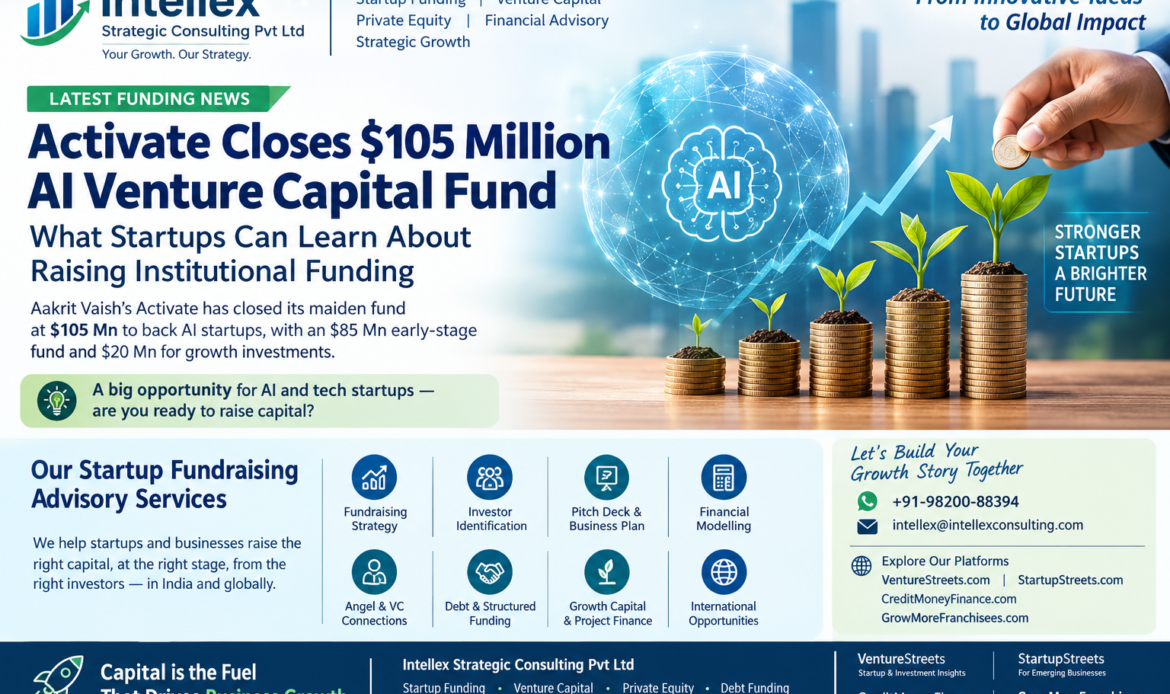
A recent development that deserves the attention of founders is the closing of Activate’s maiden fund at $105 million, led by Aakrit Vaish and Pratyush Choudhury. The fund is focused on artificial-intelligence startups and is designed to invest across early-stage and growth opportunities.
According to reports published in September 2026, Activate’s investment platform comprises an $85 million early-stage fund and $20 million deployed through growth investment vehicles. The firm has already made 10 investments, including seven early-stage investments and growth investments in companies such as Sarvam AI, ElevenLabs and Wispr Flow.
For startup founders, however, the bigger lesson goes beyond the size of one particular fund.
It demonstrates why understanding investor mandates, preparing for institutional capital and approaching the right investors at the right stage have become increasingly important.
What Is Activate’s $105 Million Fund?
Activate is an AI-focused venture capital firm founded by Aakrit Vaish and Pratyush Choudhury.
The firm was launched in December 2025 and initially targeted a $75 million fund. According to reporting by Moneycontrol, the fund was subsequently oversubscribed, with the target increasing to $105 million.
The final fund structure reported in September 2026 includes:
- $85 million early-stage fund
- $20 million deployed through growth investment vehicles
- 10 investments made since the first close
- Seven early-stage investments
- Growth investments including Sarvam AI, ElevenLabs and Wispr Flow
- Plans reported for approximately 25–30 startups
- Initial investment sizes reported at approximately $500,000 to $3 million for the early-stage strategy.
The firm has positioned itself around AI-native businesses and has indicated an interest in supporting founders from very early stages, including the ideation or pre-incorporation stage.
That is particularly relevant for entrepreneurs developing new AI products, infrastructure, services and applications.
What Types of Startups Could Benefit From This Emerging Funding Environment?
The Activate example highlights several categories attracting investor attention.
1. AI Infrastructure
This includes businesses developing infrastructure required to build and operate AI systems.
Examples can include:
- AI computing infrastructure
- Developer tools
- Data infrastructure
- Model infrastructure
- AI deployment platforms
- AI security
- Enterprise AI infrastructure
Infrastructure companies can potentially address very large markets, but they often require substantial technical expertise and capital.
2. Foundation Models and Deep-Tech AI
Another important segment is the development of foundational AI technologies.
These businesses may require:
- Advanced technical teams
- Significant computing resources
- Proprietary datasets
- Research capabilities
- Strong intellectual property
- Access to specialised talent
For founders operating in this category, conventional startup fundraising approaches may not be sufficient. The investor universe needs to include funds that understand the technical and capital requirements of deep-tech businesses.
3. AI-Powered Services
AI is also changing traditional services businesses.
This includes opportunities where AI is used to fundamentally redesign:
- IT services
- Business-process outsourcing
- Professional services
- Customer support
- Software development
- Enterprise operations
- Knowledge work
This is an important area because founders do not necessarily need to build a foundation model themselves to create a scalable AI business.
4. Consumer AI Applications
AI is also creating new opportunities in consumer-facing products.
Potential categories include:
- Education
- Financial services
- Healthcare applications
- Commerce
- Content
- Gaming
- Productivity
- Personalisation
The key consideration for investors is often not simply whether a company uses AI, but whether AI creates a meaningful competitive advantage and supports a scalable business model.
What Does This Mean for Indian Startup Founders?
The emergence of specialised AI funds provides an important lesson for founders:
Fundraising is not simply about finding an investor with money. It is about finding an investor whose mandate matches the business.
A startup developing AI infrastructure may need a very different investor from a consumer brand, fintech company, manufacturing startup or healthcare business.
Similarly, a pre-seed startup may need an investor comfortable with very early uncertainty, whereas a company generating substantial revenue may be looking for a growth investor.
Therefore, founders should begin fundraising by answering several fundamental questions.
1. What Stage Is Your Startup At?
Investors generally differentiate between various stages of development.
Idea / Pre-Seed
At this stage, investors may focus heavily on:
- Founder capability
- Technology
- Market opportunity
- Problem being solved
- Initial validation
- Product vision
Seed Stage
The emphasis may increasingly move towards:
- MVP
- Customer validation
- Early revenues
- User growth
- Product-market fit indicators
- Business model
Series A and Beyond
Investors typically require substantially more evidence around:
- Revenue
- Growth rate
- Customer acquisition
- Retention
- Unit economics
- Market size
- Competitive positioning
- Management team
A startup should therefore identify investors whose investment stage corresponds to its current requirements.
2. How Much Capital Should You Raise?
One of the common mistakes founders make is deciding the fundraising amount without preparing a detailed capital requirement.
Instead, founders should build a funding plan around measurable milestones.
For example:
Capital requirement → 18–24 month runway → business milestones → next funding round
A founder should be able to explain:
“We are raising ₹X crore to achieve Y milestones over the next Z months.”
Those milestones could include:
- Product development
- Hiring
- Technology infrastructure
- Customer acquisition
- Geographic expansion
- Regulatory approvals
- Manufacturing capacity
- Working capital
- Revenue targets
The funding requirement should therefore be connected to a business plan rather than simply being an arbitrary number.
3. Your Pitch Deck Is More Than a Presentation
A professional investor pitch deck should communicate the investment opportunity quickly and logically.
A strong deck normally addresses:
Company Overview
What does the company do?
Problem
What significant problem exists?
Solution
How does the company solve it?
Market Opportunity
How large is the addressable market?
Product / Technology
What has been developed?
Business Model
How does the company make money?
Traction
What evidence exists that customers want the product?
Competitive Landscape
Who else operates in the market?
Competitive Advantage
Why can this company establish a defensible position?
Financial Performance
Revenue, margins, burn and other relevant metrics.
Financial Projections
Future revenue and expenditure assumptions.
Fund Requirement
How much capital is being raised?
Use of Funds
Where will the capital be deployed?
Founding Team
Why is this team capable of executing the plan?
Investment Opportunity
What structure or investment instrument is being proposed?
4. Investors Look Beyond the Idea
An attractive idea alone generally does not make a complete investment case.
Founders should be prepared to demonstrate evidence around:
Market + Product + Team + Traction + Economics + Scalability
For an AI startup, additional questions can arise around:
- Proprietary technology
- Data advantage
- Computing requirements
- Model dependency
- Gross margins
- AI inference costs
- Intellectual property
- Security
- Regulatory considerations
- Ability to differentiate from rapidly evolving competitors
This is particularly important because AI is developing rapidly and investors may want to understand whether a startup has a sustainable advantage rather than simply incorporating publicly available AI tools into an existing business model.
5. Investor Selection Should Be Strategic
A startup should ideally prepare an investor universe rather than approaching investors randomly.
An investor mapping exercise can classify potential investors according to:
| Investor Parameter | Questions to Consider |
|---|---|
| Stage | Pre-seed, Seed, Series A, Growth? |
| Sector | AI, SaaS, Fintech, Deep Tech, Consumer, Healthcare etc.? |
| Geography | India, US, Europe, Middle East, Asia? |
| Ticket Size | What is the typical initial cheque? |
| Business Model | B2B, B2C, SaaS, Marketplace, Manufacturing? |
| Founder Profile | Does the investor back first-time founders? |
| Follow-on | Can the investor support future rounds? |
| Strategic Value | Can the investor provide customers, networks or expertise? |
The objective is to build a targeted investor pipeline.
Why AI Startups Need a Different Fundraising Strategy
AI startups can have significantly different capital requirements from conventional software startups.
For example, an AI company may need to invest in:
- Computing
- GPUs
- Data acquisition
- Research and development
- Technical talent
- Model training
- Cloud infrastructure
- Product engineering
At the same time, AI can potentially allow startups to build products faster than previous technology cycles.
This creates both an opportunity and a challenge.
Founders need to demonstrate not only what their technology does, but also why their technology can become a commercially scalable business.
The Importance of Investor-Ready Financial Models
A professional financial model is an essential component of institutional fundraising.
It should ideally cover:
Revenue Assumptions
- Customer acquisition
- Pricing
- Sales volumes
- Recurring revenue
- Geographic expansion
Cost Structure
- Employee costs
- Technology
- Marketing
- Infrastructure
- Administration
- Manufacturing, where applicable
Cash Flow
- Monthly cash requirements
- Burn rate
- Runway
- Working capital
Funding Requirement
- Amount required
- Timing
- Proposed deployment
Scenario Analysis
- Base case
- Growth case
- Conservative case
Investors will naturally test the assumptions behind the projections, so founders should be able to explain the reasoning behind every major number.
Fundraising Is a Process, Not a Single Meeting
Many founders make the mistake of treating fundraising as:
Pitch Deck → Investor Meeting → Funding
In practice, the process can involve multiple stages:
Preparation → Investor Mapping → Outreach → Initial Meeting → Information Sharing → Due Diligence → Commercial Discussions → Term Sheet → Documentation → Closing
The process can take considerable time.
Therefore, founders should ideally begin preparing well before the point at which cash becomes critical.
What Startups Should Do Before Approaching Investors
A useful pre-fundraising checklist includes:
Corporate Documentation
- Incorporation documents
- Shareholding structure
- Cap table
- Founder agreements
- Intellectual-property documentation
Financial Information
- Historical financial statements
- Bank statements
- GST/tax information where relevant
- Management accounts
- Financial projections
Business Information
- Pitch deck
- Business plan
- Product information
- Customer data
- Revenue information
- Market research
Legal & Compliance
- Material contracts
- Employment agreements
- IP ownership
- Regulatory compliance
- Existing investor documentation
Fundraising Material
- Funding requirement
- Valuation expectations
- Proposed structure
- Use of funds
- Investor target list
Being prepared can significantly improve the quality and efficiency of investor discussions.
The Bigger Message From the $105 Million Activate Fund
The significance of Activate’s fund extends beyond AI.
It illustrates an important trend in the venture capital ecosystem: specialised capital is becoming increasingly important.
Investors are developing deeper expertise around areas such as:
- Artificial intelligence
- Deep technology
- Climate technology
- Fintech
- Healthcare
- Enterprise software
- Consumer technology
- Defence technology
For founders, this means that identifying the right capital partner can be as important as identifying the amount of capital required.
The reported Activate strategy is particularly focused on AI-native startups and therefore should not be interpreted as a general indication that every startup can access this fund. Its mandate is specific, and founders should assess their own sector, stage, traction and investor fit before approaching any fund.
Intellex Strategic Consulting – Startup Fundraising Advisory
For startups seeking to raise capital, Intellex Strategic Consulting Pvt Ltd provides fundraising and financial advisory support across India and internationally.
Our role is to help founders approach fundraising in a structured and professional manner.
Our Startup Fundraising Support Can Include:
- Startup fundraising strategy
- Investor identification
- Investor mapping
- Pitch deck development and refinement
- Financial modelling
- Business plan preparation
- Fundraising documentation
- Equity fundraising
- Venture capital opportunities
- Angel investor outreach
- Family office opportunities
- Strategic investor identification
- Debt and structured funding options
- Growth capital
- Project finance
- Investor communication
- Fundraising process management
For startups with strong business models, market potential and appropriate traction, the objective is to develop a fundraising strategy aligned with the company’s business plan and capital requirements.
Capital is the Fuel That Drives Business Growth.
Why Professional Fundraising Preparation Matters
A founder may have an excellent business but still struggle to raise capital if the investment opportunity is not presented clearly.
Professional preparation can help answer the questions investors are likely to ask:
Why this company?
Why this market?
Why now?
Why this team?
Why this valuation?
Why will customers buy?
How will the company scale?
What will the new capital accomplish?
What is the potential pathway for investors?
These questions should be addressed before entering serious fundraising discussions.
A Message for Startup Founders
The latest AI-focused fund announcements demonstrate that substantial pools of institutional capital continue to be created around specific technology themes.
But fundraising success is not simply about the availability of capital.
It depends on the combination of:
Right Business + Right Stage + Right Investor + Right Story + Right Financials + Right Fundraising Strategy
Founders should therefore avoid sending the same pitch to hundreds of investors without understanding their investment mandates.
A targeted and well-prepared fundraising campaign can create a much more structured approach to the capital-raising process.
About Intellex Strategic Consulting Pvt Ltd
Intellex Strategic Consulting Pvt Ltd is a professional services firm supporting businesses and startups with fundraising, financial advisory, investment opportunities and strategic growth requirements across India and globally.
For startup funding and investor-related opportunities, connect with us:
WhatsApp: 91-98200-88394
Email: intellex@intellexconsulting.com
Explore Our Platforms
VentureStreets.com
StartupStreets.com
CreditMoneyFinance.com
GrowMoreFranchisees.com
Intellex Strategic Consulting Pvt Ltd
Startup Funding • Venture Capital • Private Equity • Debt Funding • Financial Advisory • Strategic Growth
More Featured Articles:
Top Angel Networks in Singapore: The Ultimate Guide for Startups Seeking Angel Investment in 2026.