
Seligman Ventures Doubles Deployable Capital to $1 Billion: A Detailed Funding Guide for AI, Semiconductor, Cloud Infrastructure, Data Center and Cybersecurity Startups
Seligman Ventures Raises Deployable Capital to $1 Billion: Investment Thesis, Founders, Portfolio, Funding Criteria and What Startups Need to Know
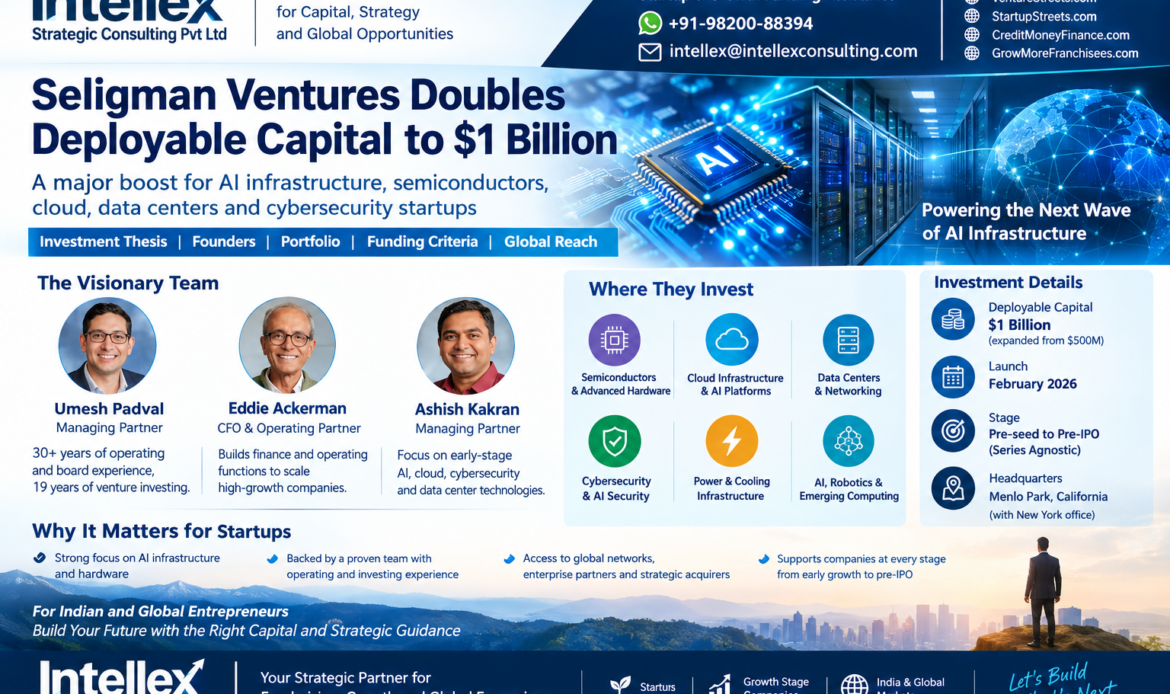
Seligman Ventures has increased deployable capital to $1 billion to invest from pre-seed to pre-IPO in AI infrastructure, semiconductors, cloud, data centers and cybersecurity. Explore its team, investment thesis, portfolio and funding approach.
Seligman Ventures’ $1 Billion Capital Expansion Signals Growing Investor Interest in AI Infrastructure and Hardware
The artificial intelligence investment cycle is increasingly moving beyond foundation models and software applications toward the physical infrastructure required to make AI work at scale.
Semiconductors, high-performance computing, networking, optical connectivity, power management, cooling, cybersecurity and data-center infrastructure are becoming critical investment areas.
Against this backdrop, Seligman Ventures has announced a significant expansion of its deployable capital to $1 billion, less than a year after launching its venture platform with $500 million.
According to Reuters, Seligman Ventures launched in February 2026 with $500 million and had invested more than $300 million across 14 investments by September 2026. The firm is targeting what its executives describe as the physical bottlenecks created by the rapid expansion of artificial intelligence.
For technology entrepreneurs, this development is important because it highlights an investment thesis that goes well beyond conventional SaaS or consumer applications.
Seligman Ventures is looking at the infrastructure underneath the AI economy.
1. What Is Seligman Ventures?
Seligman Ventures is the venture capital arm of Seligman Investments, a Silicon Valley-based technology investment platform associated with Columbia Management Investment Advisers and Columbia Threadneedle Investments.
The venture platform was officially launched in February 2026 with an initial $500 million capital commitment, designed to invest in technology companies from early stage through pre-IPO.
The investment platform focuses particularly on:
- Artificial intelligence infrastructure
- Cloud infrastructure
- AI and machine learning
- Semiconductors
- Data-center hardware
- Networking and interconnects
- Power and cooling infrastructure
- Cybersecurity
- AI-enabled security
- Physical AI and emerging computing architectures
Seligman Ventures’ current public investment philosophy describes the firm as series agnostic, with investments ranging from pre-seed through pre-IPO.
That makes the firm potentially relevant not only to early-stage founders but also to companies that have already achieved substantial commercial traction and are approaching major growth rounds or the public markets.
2. Why Has the Capital Been Increased to $1 Billion?
The expansion reflects the rapid increase in demand for AI infrastructure.
Reuters reported on September 28, 2026 that Seligman Ventures had more than doubled its deployable capital from the original $500 million to $1 billion after investing more than $300 million across 14 companies.
Managing Partner Umesh Padval told Reuters that deal flow had been significantly higher than initially expected.
The firm’s thesis is that AI growth creates bottlenecks throughout the technology stack.
For example, AI requires:
More compute → more semiconductors → more networking → more optical connectivity → more electricity → more cooling → more data centers → more cybersecurity.
Consequently, opportunities can emerge at virtually every infrastructure layer.
3. Who Leads Seligman Ventures?
Seligman Ventures is led by three principal venture professionals:
Umesh Padval — Managing Partner
Umesh Padval is the senior figure associated with the venture platform and brings more than 35 years of operating and board experience, including 19 years of venture investing according to Seligman’s current profile.
His background is particularly relevant to semiconductor and infrastructure founders.
Before his investment career, Padval served as President and CEO of C-Cube Microsystems, which he helped scale before its acquisition by LSI Logic in 2001.
His previous board and investment experience includes companies such as:
- Mellanox — acquired by NVIDIA
- IDT — acquired by Renesas
- Elantec — acquired by Intersil
- P.A. Semi — acquired by Apple
- Isovalent — acquired by Cisco
- Lastline — acquired by VMware
- Skyhigh Networks — acquired by McAfee
- ThousandEyes — acquired by Cisco
- Berkeley Design Automation — acquired by Mentor Graphics
Seligman’s own announcement also lists prior investments including Cohere, Clari, Exaforce, Harness, Relyance AI, StackGen and others.
Padval has also served on numerous public and private company boards. Thomvest’s biography notes more than 40 public and private board roles over his career.
For founders, this background is significant because it means the investment team has experience not only evaluating technology companies but also dealing with:
- Product-market fit
- Enterprise sales
- Strategic partnerships
- Board governance
- M&A
- Public markets
- Scaling technology organizations
- Follow-on fundraising
Ashish Kakran — Managing Partner
Ashish Kakran is the other Managing Partner at Seligman Ventures.
Seligman describes his focus as early-stage investments in cloud infrastructure, AI/ML, cybersecurity and modern data-center technologies.
His investment focus is particularly relevant for startups building technology at the intersection of AI and infrastructure.
The team has also been researching Physical AI, including robotics, world models, deployment systems and infrastructure. Seligman’s research has mapped hundreds of companies across the emerging Physical AI ecosystem.
Eddie Ackerman — CFO & Operating Partner
Eddie Ackerman serves as CFO and Operating Partner.
His role extends beyond fund-level financial management. Seligman says Ackerman works closely with founders to build finance and operating functions capable of scaling with the company.
For startups entering rapid growth, this can be particularly relevant because institutional investors increasingly evaluate:
- Financial controls
- Cash-flow management
- Forecasting
- Unit economics
- Hiring plans
- Corporate governance
- Reporting systems
- Capital allocation
4. Seligman Ventures’ Current Capital Position
The evolution of the venture platform is noteworthy.
| Particular | Current information |
|---|---|
| Initial venture capital | $500 million |
| Launch | February 2026 |
| Current deployable capital | $1 billion |
| Investments reported by Reuters | 14 |
| Capital invested by September 2026 | More than $300 million |
| Investment range | Pre-seed to pre-IPO |
| Approach | Series agnostic |
| Primary sectors | AI/cloud infrastructure, data-center hardware, cybersecurity |
| Main operating base | Silicon Valley |
| Additional office | New York |
The $1 billion figure should be understood as deployable capital for the venture platform, rather than assuming that the entire amount has already been invested.
Reuters reported that the firm expected to make approximately five to ten new investments over the following 12 months.
5. What Does Seligman Ventures Invest In?
Seligman divides its investment opportunity into three major areas.
A. AI + Cloud Infrastructure
This includes technologies supporting the transition from conventional cloud computing toward AI-oriented computing architectures.
Areas identified by Seligman include:
- Agentic infrastructure
- Vertical AI agents
- Agent networking
- Context systems
- Data pipelines
- AI at the edge
- Training infrastructure
- Fine-tuning infrastructure
- Cloud infrastructure
- AI compute
6. Data Centers and Advanced Hardware
This is arguably one of the most distinctive parts of the Seligman Ventures thesis.
The firm is interested in the physical infrastructure needed to operate increasingly demanding AI workloads.
Its publicly stated areas include:
- High-performance AI platforms
- Power-efficient computing
- High-speed networking
- Scale-up and scale-out networks
- High-speed interconnects
- Power-efficient semiconductors
- Next-generation power systems
- Cooling technologies
- Data-center infrastructure
This creates potential relevance for semiconductor startups, chip-design companies, networking companies, optical technology businesses and advanced hardware startups.
7. Cybersecurity
AI is also changing cybersecurity.
Seligman Ventures identifies opportunities including:
- AI-powered security platforms
- Security for AI deployments
- Enterprise cybersecurity
- Automated security operations
- Tools capable of operating at enterprise scale
The firm’s historical investment experience also includes cybersecurity companies such as Skyhigh Networks, Exaforce and other security-focused businesses.
8. Seligman Ventures’ Investment Thesis
For entrepreneurs, understanding the thesis is more important than simply knowing that a venture firm has capital.
Seligman identifies several principles.
Thesis-driven investing
The firm says each investment is based on a clearly articulated view about where technology leadership is emerging.
This means founders should be able to explain:
Why now?
Why this technology?
Why this market?
Why will the company become strategically important?
Technical advantage
Seligman says it focuses on areas where technical advantages can compound.
For a startup, this could mean:
- Proprietary semiconductor architecture
- Superior performance
- Lower energy consumption
- Better networking
- Unique cybersecurity technology
- Proprietary AI infrastructure
- Difficult-to-replicate IP
- Deep technical expertise
Comfort with difficult engineering
The firm’s published investment approach specifically highlights companies solving complex engineering problems.
This is important for founders working in:
- Semiconductors
- Robotics
- AI hardware
- Networking
- Data centers
- Power electronics
- Optical communications
- Cybersecurity infrastructure
Operator-oriented partnership
Seligman describes its approach as “operators first.”
The team’s background includes entrepreneurship, executive leadership, boards, venture investing and public-market technology research.
For founders, this potentially means the investor can become involved in matters such as:
- Strategic planning
- Board governance
- Hiring
- Enterprise introductions
- Fundraising
- Business development
- M&A discussions
- Follow-on financing
9. Seligman Ventures’ Portfolio
The firm’s publicly listed portfolio currently includes companies operating across AI, cybersecurity, cloud infrastructure, networking, semiconductors and data-center technologies.
Examples include:
SambaNova
AI computing infrastructure company focused on enterprise AI systems.
Eliyan
Develops technology designed to address connectivity and data-transfer bottlenecks between AI chips.
In July 2026, Eliyan announced a $145 million Series C at a reported $1 billion valuation, with Seligman Ventures leading the financing. Umesh Padval joined Eliyan’s board.
Velaura AI
Semiconductor/AI compute infrastructure company focused on reducing power consumption and operating costs for AI data centers.
Velaura AI announced a $110 million Series A in August 2026 at a valuation above $1 billion, with Seligman Ventures as the primary lead.
Lumilens
An optical networking company addressing connectivity requirements for AI data centers.
Seligman reports that Lumilens emerged from stealth with more than $900 million in total funding, including a financing of more than $700 million co-led by Seligman Ventures.
Smallest AI
AI voice technology company. Seligman identifies its Series A as being led by Seligman Ventures.
Cognichip
A company working on semiconductor design automation.
Exaforce
Cybersecurity company focused on AI-native security operations.
StackGen
Cloud infrastructure automation company.
Upscale
AI networking and silicon-level networking infrastructure.
Clockwork
Technology designed to improve GPU utilization and resilience of AI workloads.
Epic Microsystems
Power infrastructure technology for AI data centers.
Modiqo
Infrastructure supporting AI-agent systems.
Core Automation
AI research focused on automating complex knowledge work and scientific discovery.
CMAtrics
Part of Seligman Ventures’ current portfolio.
The firm’s public portfolio page provides the current list and descriptions of these companies.
10. What Stage of Startup Does Seligman Ventures Fund?
One of the important features for founders is the firm’s broad stage mandate.
Seligman Ventures states that it invests from:
Pre-Seed
For companies at the earliest stages with compelling technology and a credible founding team.
Seed
For startups developing products, validating technology and establishing initial market traction.
Series A / Early Growth
For companies beginning commercial scale and demonstrating evidence of product-market fit.
Later Growth
For businesses with established products, customers and significant growth opportunities.
Pre-IPO
The firm can also participate in later-stage private companies approaching the public markets.
Seligman describes this as a pre-seed-to-pre-IPO, series-agnostic approach.
11. What Does Seligman Ventures Look For in a Startup?
Although the firm does not publicly publish a rigid checklist or universal minimum revenue requirement, its published thesis gives founders a fairly clear indication of the characteristics it is interested in.
Founding team
A strong technical and commercial leadership team is critical.
Large and expanding market
The technology should address a market capable of supporting a major company.
Deep technology
Seligman’s focus makes technically defensible businesses particularly relevant.
Strategic importance
The technology should ideally become an important part of an emerging technology stack.
Differentiation
Founders should be able to demonstrate why competitors cannot easily reproduce the technology.
Enterprise potential
For infrastructure businesses, enterprise adoption and strategic relationships can be particularly important.
Scalability
Investors will want to understand how the business can scale without proportionally increasing costs.
Capital efficiency
Especially for hardware and semiconductor companies, a detailed explanation of how capital will be converted into technological and commercial milestones is essential.
12. Does Seligman Ventures Have a Geographic Investment Restriction?
Seligman Ventures is headquartered in Menlo Park, California, at the heart of Silicon Valley, and also has a New York office.
The firm’s public materials emphasize Silicon Valley relationships, technology networks and U.S. technology ecosystems.
However, Seligman Ventures’ publicly available materials do not state a simple formal geographic exclusion such as “U.S. only.” Therefore, founders outside the United States should not assume either eligibility or ineligibility purely based on geography.
For an international startup—including a company from India—the practical questions would be:
- Where is the company incorporated?
- Where is the IP held?
- Where are the customers?
- What is the addressable global market?
- Where is the technology developed?
- Where is the core management team located?
- What is the planned international expansion?
- Does the company have a structure suitable for international institutional investment?
These issues should be clarified with the investor during the fundraising process.
13. Why Seligman’s Public-Market Background Matters
Seligman Investments has a much longer history than Seligman Ventures.
The Seligman investment heritage dates back to 1864, while its technology investment platform has been led by Paul Wick since 1990.
The venture strategy therefore combines:
Private-company venture investing + public-market technology research.
Reuters reported that the venture team works alongside Seligman’s public-market analysts and uses information from both private and public companies to evaluate competitive dynamics.
For startups, this can matter because a company may eventually need to compete against established public technology companies.
Understanding:
- NVIDIA
- AMD
- Broadcom
- Marvell
- Cisco
- hyperscalers
- cybersecurity vendors
- semiconductor companies
and other incumbents can be essential to assessing a startup’s long-term competitive position.
14. What Startups Should Prepare Before Approaching Seligman Ventures
A startup interested in Seligman Ventures should ideally have a highly focused investment package.
1. Executive Summary
One or two pages covering:
- Company
- Founders
- Problem
- Solution
- Technology
- Market
- Traction
- Revenue
- Funding sought
- Existing investors
- Valuation
- Use of funds
2. Investor Pitch Deck
A professional 15–25 slide presentation covering:
- Vision
- Problem
- Solution
- Product
- Technology
- Competitive advantage
- Market opportunity
- Business model
- Traction
- Customers
- Revenue
- Unit economics
- Competition
- IP
- Go-to-market
- Management team
- Financial projections
- Funding requirement
- Use of funds
- Existing investors
- Exit possibilities
15. Additional Information Needed by AI Hardware and Semiconductor Startups
For hardware companies, a normal SaaS pitch deck may not be sufficient.
Founders should consider providing:
- Semiconductor architecture
- Chip roadmap
- Tape-out history
- Fabrication partner
- Manufacturing strategy
- Yield assumptions
- BOM economics
- Performance benchmarks
- Power consumption
- Cost per unit
- Customer qualification status
- Design wins
- IP portfolio
- Patent position
- Licensing model
- Production timeline
- Capital requirements
- Working-capital requirements
The more capital-intensive the business, the more important it becomes to show how funding translates into measurable technical and commercial milestones.
16. How Indian Startups Can Position Themselves
Indian companies developing AI infrastructure, semiconductor technologies, advanced electronics, cybersecurity, cloud infrastructure and enterprise AI may increasingly encounter global investors looking for exposure to technology infrastructure.
For an Indian startup, the international fundraising proposition can include:
India engineering advantage + global market + proprietary technology + scalable economics.
A company should clearly articulate whether it intends to:
- Sell primarily in India
- Sell globally from India
- Establish a U.S. subsidiary
- Establish overseas IP ownership
- Build manufacturing partnerships
- Target global enterprise customers
- Raise capital internationally
The corporate structure and intellectual-property ownership should be reviewed carefully before approaching international institutional investors.
17. What Makes the Seligman Model Different?
The most notable feature is the attempt to connect several parts of the technology investment lifecycle.
Seligman describes an integrated platform extending from private investments to public markets.
For a founder, that can potentially mean access to:
Seed → Growth → Late Stage → Pre-IPO → Public Markets
rather than treating each financing stage as completely disconnected.
Its network strategy also emphasizes enterprise buyers, corporate development executives and strategic acquirers.
That can be valuable for infrastructure companies whose ultimate outcomes may involve strategic acquisitions as well as IPOs.
18. Seligman Ventures and the New AI Infrastructure Investment Cycle
The expansion to $1 billion comes at a time when AI investment is increasingly moving toward physical infrastructure.
The AI ecosystem requires enormous investment in:
Compute
↓
Semiconductors
↓
Networking
↓
Optical interconnect
↓
Data centers
↓
Power
↓
Cooling
↓
Cybersecurity
This creates opportunities for startups at multiple layers of the technology stack.
Seligman Ventures’ investment portfolio illustrates this approach, ranging from AI systems and cybersecurity to networking, optical technologies, semiconductor infrastructure and data-center hardware.
19. What Entrepreneurs Can Learn From Seligman’s Investment Strategy
The Seligman model offers several practical lessons for founders.
Build for a structural technology shift
Rather than creating a product around a temporary trend, founders should understand the deeper infrastructure transformation taking place.
Technical differentiation matters
For infrastructure startups, simply using AI is unlikely to be sufficient. The company should explain its proprietary technology and defensibility.
Infrastructure markets can produce large companies
The current investment cycle demonstrates that investors are looking beyond consumer-facing AI applications toward the infrastructure that powers them.
Capital requirements must be realistic
Hardware and semiconductor businesses can require substantial capital. A credible financing roadmap is therefore essential.
Strategic relationships matter
Large enterprise customers, hyperscalers, semiconductor companies and strategic acquirers can be important components of the growth strategy.
20. Intellex Strategic Consulting Pvt Ltd – Supporting Startups Seeking Global Capital
For startups in India and internationally, raising institutional capital requires much more than preparing a pitch deck.
Intellex Strategic Consulting Private Limited provides professional services related to startup fundraising and growth-stage funding, supporting companies in areas including:
- Startup fundraising
- Early-stage capital
- Venture capital fundraising
- Private equity opportunities
- Growth capital
- Debt funding
- Equity investment
- Project finance
- Financial modelling
- Investor identification
- Pitch-deck preparation and refinement
- Fundraising strategy
- Investor outreach
- Capital-raising process management
- M&A advisory
- Pre-IPO and IPO consulting
Intellex can assist entrepreneurs in developing an investment proposition suitable for discussions with domestic and international investors, while helping founders organize their business, financial and fundraising information for investor review.
The firm’s focus includes helping well-managed startups and growth-stage companies with strong business models and market potential identify appropriate capital-raising opportunities.
For companies operating in AI, advanced manufacturing, semiconductors, SaaS, cybersecurity, fintech, healthcare technology, infrastructure, consumer technology and other growth sectors, a structured fundraising strategy can help founders approach the market more efficiently.
21. Preparing an Investor-Ready Fundraising Strategy
Before contacting a venture capital investor such as Seligman Ventures, founders should ideally establish:
Investment requirement
How much capital is actually required?
Funding stage
Pre-seed, seed, Series A, Series B, growth or pre-IPO?
Valuation
What valuation is being proposed and why?
Dilution
How much equity is the company willing to offer?
Use of funds
Exactly how will the money be deployed?
Milestones
What will the company achieve with the new capital?
Investor fit
Why is this particular investor strategically relevant?
Exit pathway
What could the long-term liquidity opportunities be?
A professional fundraising strategy should connect all these elements.
22. Conclusion
Seligman Ventures’ move from an initial $500 million venture platform to $1 billion of deployable capital represents an important development in the current AI infrastructure investment landscape. Reuters reports that the firm had already invested more than $300 million across 14 investments by September 2026.
Its investment strategy is particularly focused on the infrastructure required for the next generation of computing: AI and cloud infrastructure, advanced data centers, semiconductors, networking, power, cooling and cybersecurity.
The combination of Umesh Padval’s long technology operating and venture-investing background, Ashish Kakran’s focus on early-stage AI/cloud/cybersecurity infrastructure and Eddie Ackerman’s finance and operating expertise gives the platform a broad operating and investment perspective.
For founders, the key takeaway is not simply that another $1 billion has entered venture capital. It is that AI infrastructure is becoming an investment category in its own right, creating opportunities for companies solving difficult problems underneath the visible AI application layer.
For Indian and international entrepreneurs building globally scalable technology businesses, understanding the investment thesis of specialist funds such as Seligman Ventures can be an important part of developing a targeted fundraising strategy.
About Intellex Strategic Consulting Pvt Ltd
Intellex Strategic Consulting Pvt Ltd is a professional services firm supporting businesses and entrepreneurs with fundraising, debt funding, equity investment, project finance, M&A advisory, startup fundraising, financial modelling and related strategic financial services across India and international markets.
For Startup & Growth Funding Assistance:
WhatsApp: 91-98200-88394
Email: intellex@intellexconsulting.com
Our Websites:
VentureStreets.com
StartupStreets.com
CreditMoneyFinance.com
GrowMoreFranchisees.com
Intellex Strategic Consulting Pvt Ltd – Professional Services for Businesses Seeking Capital, Growth and Strategic Opportunities Across India and Globally.
Information in this article is based on publicly available information as of September 28, 2026. Investment mandates, capital availability, portfolio positions and investor criteria can change. Startups should independently verify current eligibility and investment terms with Seligman Ventures before making an approach. This article is informational and does not constitute an offer or guarantee of funding.
More Featured Articles:
1 reply on “Seligman Ventures Doubles Deployable Capital to $1 Billion: A Detailed Funding Guide for AI, Semiconductor, Cloud Infrastructure, Data Center and Cybersecurity Startups.”
[…] Seligman Ventures Doubles Deployable Capital to $1 Billion: A Detailed Funding Guide for AI, Semicon… […]